

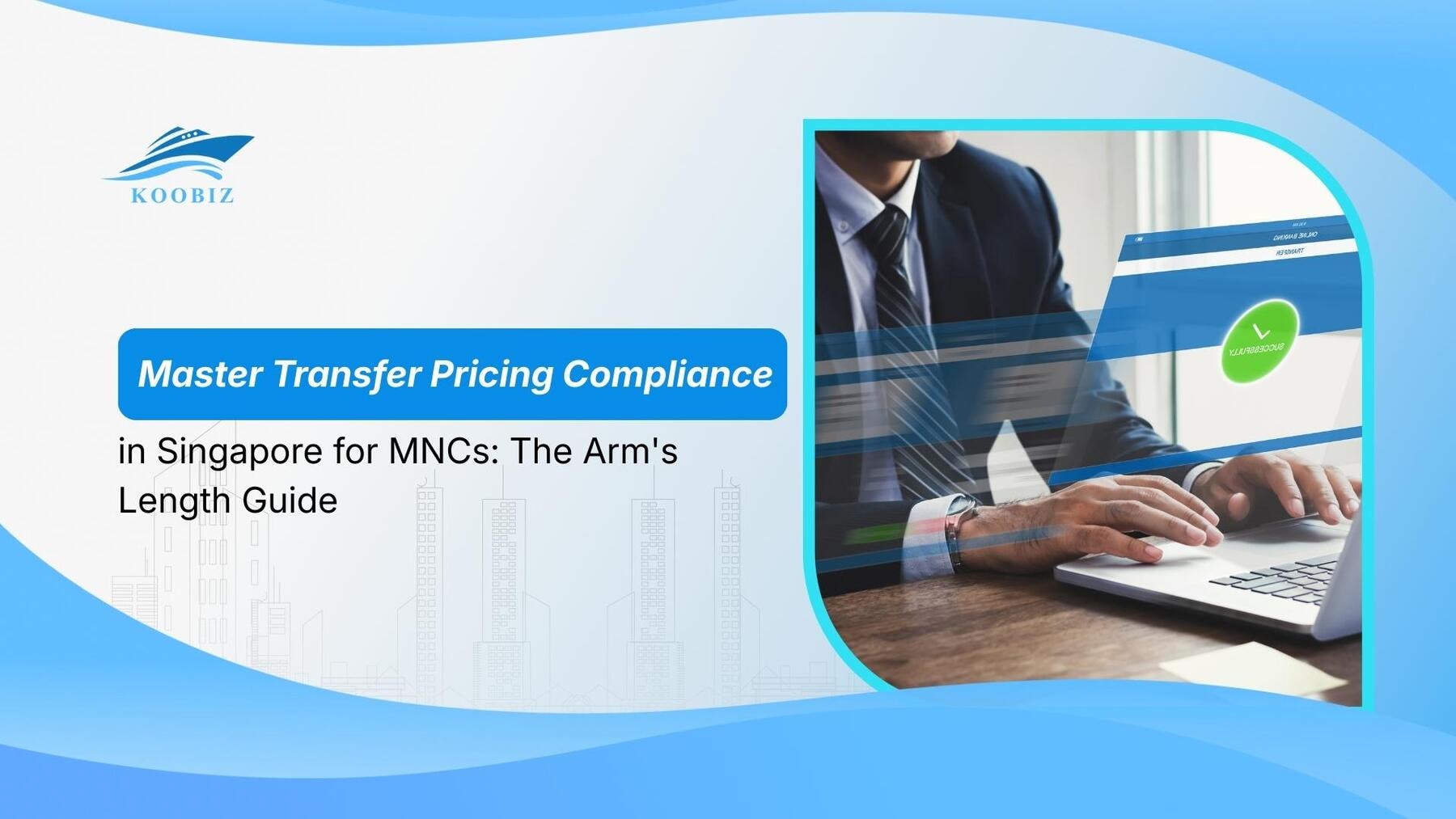
For Multinational Corporations (MNCs) expanding into Asia, Singapore offers an attractive tax regime, yet it demands rigorous adherence to regulatory standards, particularly regarding cross-border transactions. Transfer Pricing Compliance in Singapore has moved from being a supplementary reporting requirement to a central focus of the Inland Revenue Authority of Singapore (IRAS), especially with the enforcement of the 8th Edition Guidelines.
At Koobiz, we recognize that the technical requirements under Section 34D of the Income Tax Act can be challenging for both foreign investors and established MNCs. This guide is designed to help you clearly understand and apply the Arm’s Length Principle, assess when transfer pricing documentation becomes mandatory, and navigate the IRAS-mandated three-step approach. Whether you are reviewing intercompany financing arrangements or preparing for a potential tax audit, a solid grasp of these rules is essential to mitigate surcharge risks and protect your company’s standing in Singapore.
What constitutes Transfer Pricing under Singapore Tax Law?
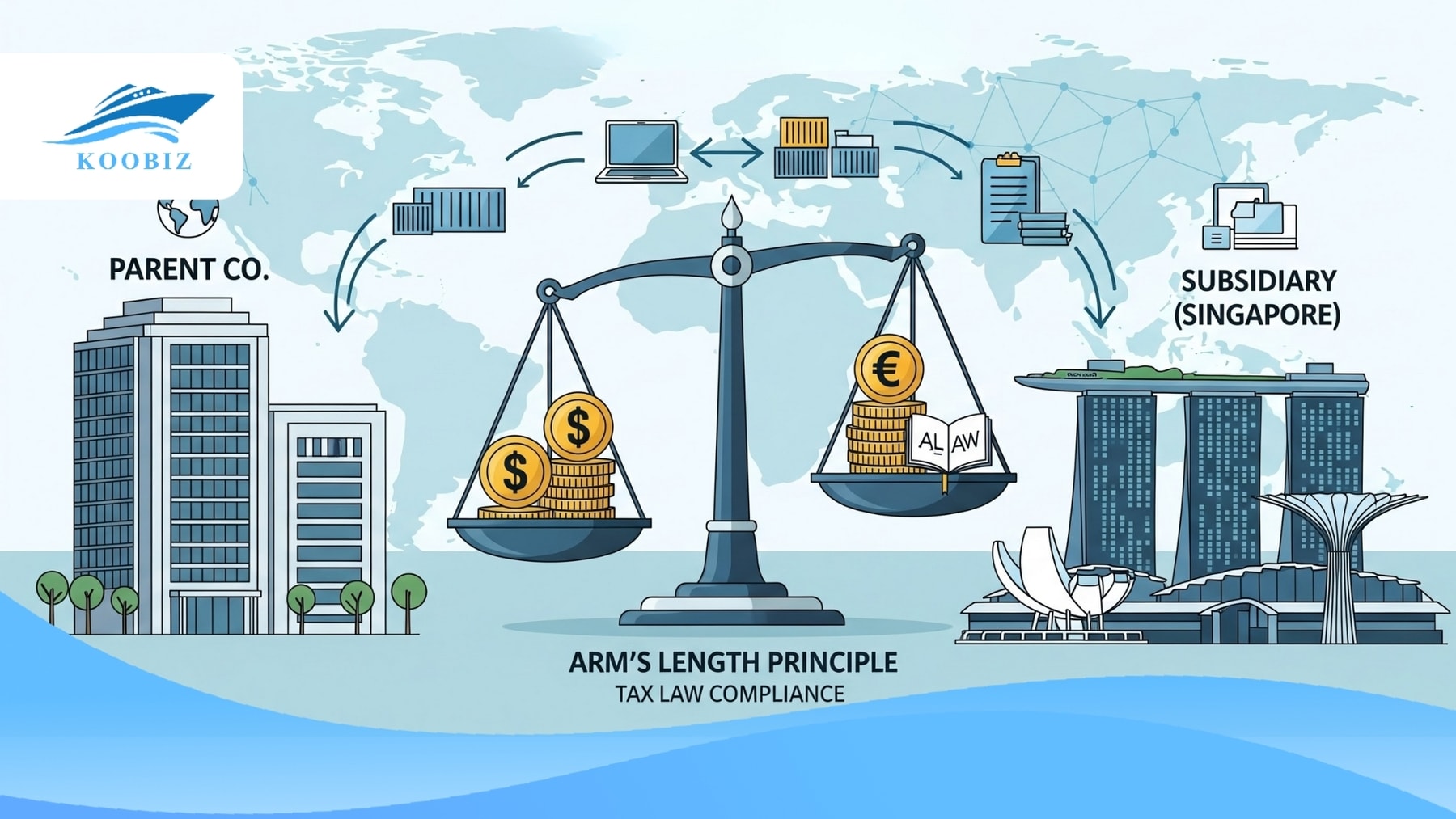
Transfer Pricing is the pricing mechanism used for transactions between related parties, such as the sale of goods, provision of services, or transfer of intangible assets, which must strictly reflect market conditions.
To delve deeper, transfer pricing is a neutral accounting term, not an illegal practice. However, under Section 34D of the Income Tax Act, IRAS scrutinizes these prices to prevent profit shifting and ensure profits reflect true economic value in Singapore.
Defining “Related Party” & Scope
IRAS defines related parties broadly, generally where there is control, significant influence, or a shared holding company. As a result, the scope of transfer pricing is wide and includes:
- Operational Activities: Management fees, royalties, and intercompany loans.
- Audit Scope: Every internal invoice is a potential subject of scrutiny.
Koobiz Advice: Transparency and consistency in these definitions are your first line of defense against tax adjustments.
According to IRAS e-Tax Guide (Eighth Edition), the authority explicitly states that taxpayers are expected to apply the arm’s length principle to ensure that their pricing with related parties reflects independent pricing behavior.
How is Compliance with the Arm’s Length Principle Determined?
Compliance is achieved when related party pricing matches what independent parties would agree to under similar circumstances. This must be backed by robust documentation and comparable market data.
To determine compliance, IRAS applies the Arm’s Length Principle (the international standard). If your internal pricing deviates significantly from market rates—either artificially inflating costs or suppressing revenue—IRAS will deem it non-compliant.
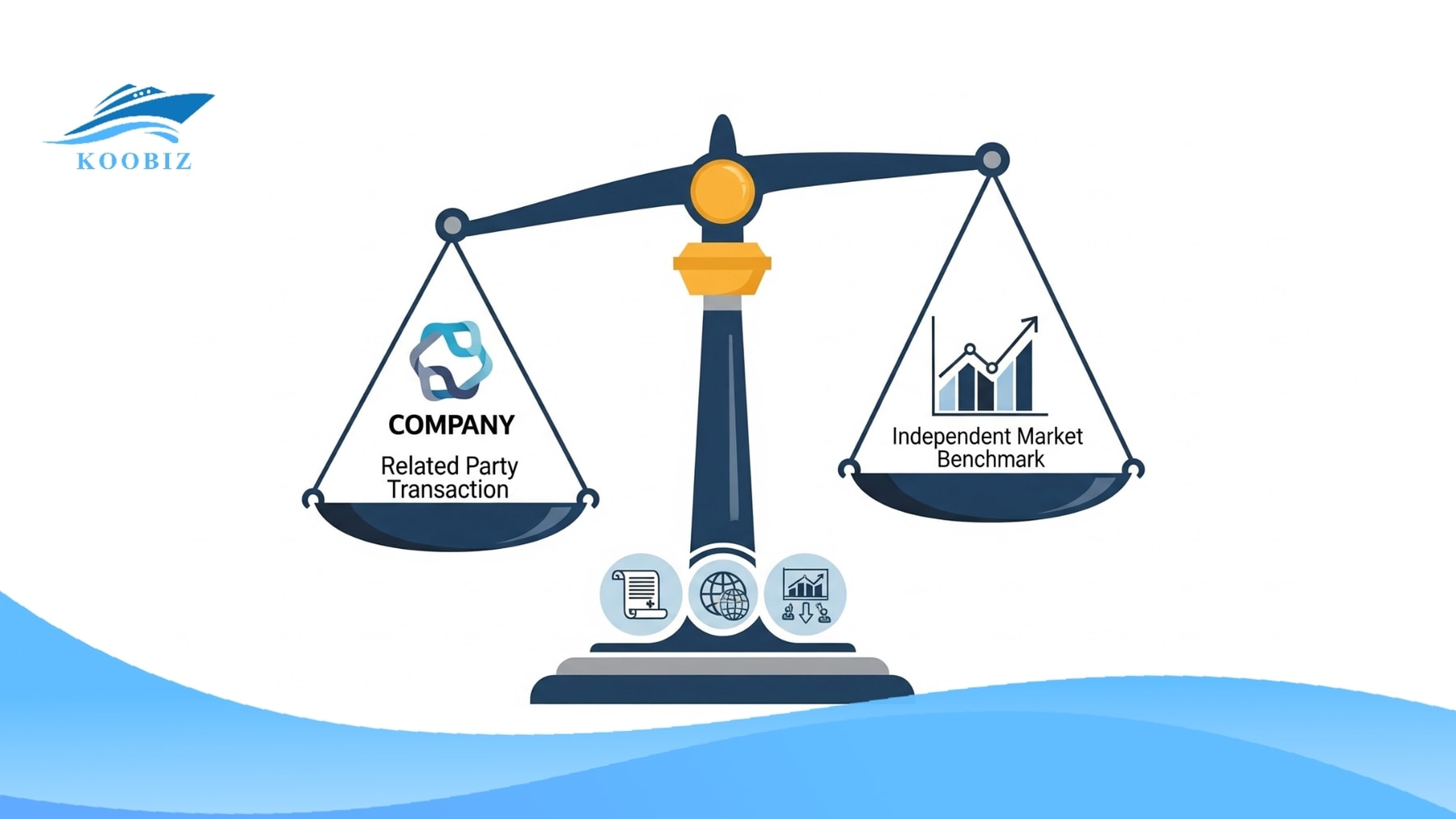
The Core Test: “Would independent parties agree?”
To pass this test, businesses must analyze three key factors:
- Contractual Terms: Are the terms standard for the industry?
- Economic Circumstances: Do the prices reflect current market realities?
- Business Strategies: Is the pricing commercially rational?
At Koobiz,we assist companies in stress-testing their intercompany pricing against this “independent party” benchmark, identifying exposure early and rectifying gaps before an audit arises.
Research by the OECD confirms that the Arm’s Length Principle remains the global standard for ensuring fair tax bases across jurisdictions.
What are the Mandatory Requirements for Transfer Pricing Documentation (TPD)?
There are two specific mandatory conditions that trigger the requirement for TPD: having gross revenue exceeding S$10 million for the basis period, or being explicitly required by IRAS to prepare such documentation.
Beyond applying the arm’s length principle in theory, Singapore law imposes strict documentation standards to ensure pricing can be properly substantiated. It is important to distinguish routine bookkeeping from Qualifying Transfer Pricing Documentation, which must meet specific regulatory criteria.
- Gross Revenue Threshold: If your company’s gross revenue (not just profit) exceeds S$10 million in the basis period concerned, you are legally required to prepare contemporaneous TPD.
- Specific Requirement: Regardless of revenue, if IRAS issues a specific direction to your company to prepare TPD for a previous basis period, you must comply.
Exemptions from TPD
Even where the S$10 million revenue threshold is met, IRAS grants transaction-level exemptions to ease the compliance burden for lower-value dealings between related parties.
- Purchase/Sale of Goods: Exemption applies if the total value is below S$15 million.
- Loans: Exemption applies if the loan value is below S$15 million (applicable where the IRAS Indicative Margin is applied).
- Services, Royalties, and Others:
- For YA 2025 and prior: Exemption applies if the total value is below S$1 million.
- For YA 2026 onwards: The threshold increases to S$2 million, providing greater relief for businesses.
TPD must be prepared on a contemporaneous basis, meaning it should be completed before the due date of filing the corporate income tax return. The documentation must cover, among others, the group structure, business activities, intercompany transactions, and a defensible pricing analysis. Failure to produce adequate TPD upon IRAS’ request exposes the company to immediate penalties and potential tax adjustments.
At Koobiz, we support clients in preparing robust, compliant TPD that aligns with the detailed content requirements set out in the Second Schedule of the Income Tax (Transfer Pricing Documentation) Rules 2018, helping businesses mitigate risk and withstand IRAS scrutiny.
The IRAS 3-Step Approach to Applying the Arm’s Length Principle
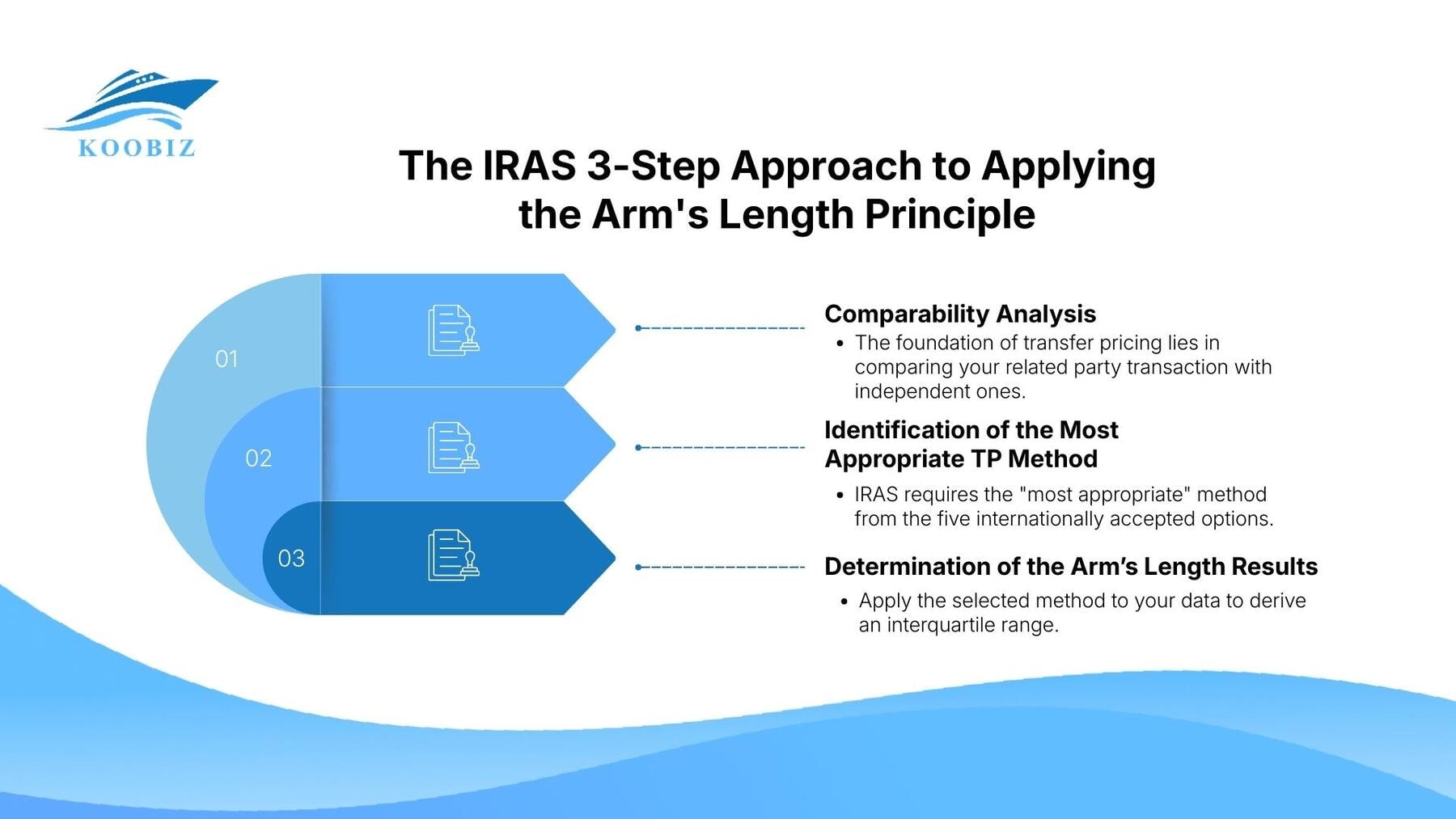
To justify pricing to tax authorities, MNCs are expected to apply a structured three-step methodology prescribed by IRAS. Transfer pricing is not a matter of estimation or intuition; it must be supported by a disciplined and evidence-based approach.
Step 1: Comparability Analysis
The foundation of transfer pricing lies in comparing your related party transaction with independent ones. This analysis must examine:
- Characteristics: What goods or services are being traded?
- Functional Analysis (FAR): Who performs the Functions, owns the Assets, and assumes the Risks?
- Economic Circumstances: What are the market conditions?
Step 2: Identification of the Most Appropriate TP Method
IRAS requires the “most appropriate” method from the five internationally accepted options:
- CUP Method: Compares specific prices (ideal for commodities).
- Resale Price Method: Focuses on gross margins (for distributors).
- Cost Plus Method: Focuses on mark-ups (for manufacturers/service providers).
- TNMM: Compares net profit margins (most common for complex operations).
- Profit Split: Splits profits based on contribution (for highly integrated value chains).
Step 3: Determination of the Arm’s Length Results
Apply the selected method to your data to derive an interquartile range.
- Within Range: Compliant.
- Outside Range: Adjustment required to the median.
Real-world Impact: A Koobiz client in logistics used the TNMM to successfully justify their operating margin against competitors, eliminating subjectivity in their IRAS filings.
Case Studies: Transfer Pricing in Action
Real-world examples demonstrate the practical application of the Arm’s Length Principle and the potential pitfalls of incorrect pricing.
To clarify how these rules affect daily operations, consider these two common scenarios that often trigger IRAS scrutiny.
Scenario A: The Limited Risk Distributor (Tangible Goods)
- Context: TechGlobal SG is a Singapore subsidiary acting as a distributor for its US parent. It purchases electronic components from the parent at S$80 per unit and resells them to local customers at S$100.
- The Issue: After deducting local operating expenses (marketing, staff, rent), TechGlobal SG reports a Net Operating Margin of 1%.
- IRAS Analysis: Using the TNMM (Transactional Net Margin Method),IRAS benchmarks TechGlobal SG against comparable independent distributors operating in Singapore. The benchmarking analysis shows that similar distributors typically earn an arm’s length operating margin of 3% to 5%.
- Outcome: The adjustment leads to additional taxable income in Singapore, along with a 5% surcharge imposed on the transfer pricing adjustment, highlighting how even routine distribution models can result in costly exposure if pricing is not properly supported.
Scenario B: Intercompany Management Fees (Services)
- Context: SingHQ Pte Ltd acts as a regional hub, providing HR and IT support services to its subsidiaries in Vietnam and Thailand. Each subsidiary is charged a flat management fee of S$1 million per year, without detailed invoices or service breakdowns.
- The Issue: The subsidiaries cannot verify the specific services received or the basis of the cost.
- IRAS Analysis: IRAS applies the “Benefit Test”. Did the subsidiaries actually need and receive these services? Is the fee based on Cost + Mark-up (e.g., Cost + 5%)?
IRAS will expect formal intercompany agreements and contemporaneous evidence, such as timesheets, service reports, email correspondence, or cost allocation schedules, to substantiate the charges.
- Outcome: The deduction may be denied at the subsidiary level, or the income reclassified at SingHQ, potentially triggering double taxation disputes and additional tax exposure across multiple jurisdictions.
What are the Penalties for Non-Compliance with Transfer Pricing Rules?
Non-compliance with Transfer Pricing rules triggers severe financial consequences, including a fine of up to S$10,000, a 5% surcharge on adjustments, and potential interest on underpaid taxes.
The consequences of ignoring these rules are not just administrative but financially punitive. IRAS has taken a stricter stance on enforcement to deter profit shifting.
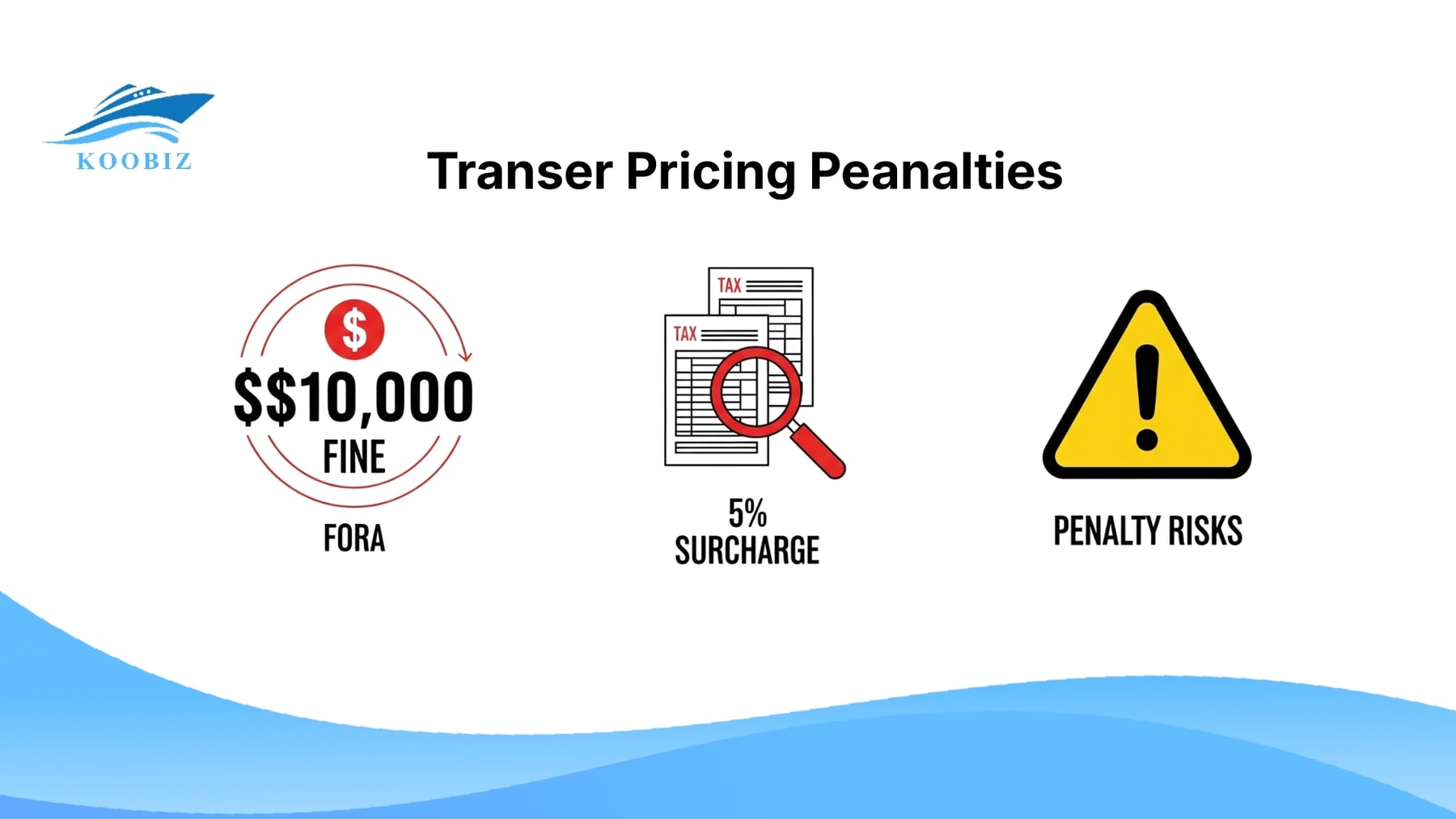
- Fine for Non-Documentation: Failure to prepare or submit TPD upon request can result in a fine not exceeding S$10,000. This applies even if the pricing itself was correct but the documentation was missing.
- 5% Surcharge on Adjustments: If IRAS reviews your accounts and decides to adjust your transfer price (increasing your taxable income), a 5% surcharge is imposed on the amount of the adjustment, regardless of whether there is additional tax payable. This surcharge is not tax-deductible.
- No Safe Harbour from Penalties: Unlike some jurisdictions where having documentation provides penalty protection, in Singapore, the 5% surcharge is strictly applied on adjustments.
Note on Remission: While strict, IRAS may consider remitting part or all of the surcharge in cases where taxpayers are cooperative or voluntarily initiate a retrospective adjustment within two years (provided no audit has commenced). Proactive correction is key.
Beyond immediate penalties, repeated non-compliance can trigger wider tax audits, including reviews of GST and withholding tax positions, and may result in reputational harm with regulators and counterparties. In practice, investing in robust transfer pricing compliance upfront is significantly more cost-effective than dealing with escalating penalties and enforcement actions later.
Contextual Border:
Having covered the “What” (definitions), the “Why” (compliance rationale), and the “Consequences” (penalties), we now turn to the “How.” The next section examines complex, real-world applications, such as intercompany financing arrangements and dispute resolution mechanisms, that sophisticated MNCs commonly encounter as their operations scale.
Handling Specific Related Party Transactions and Dispute Resolutions
MNCs face specific compliance requirements for intercompany loans and services, alongside mechanisms for resolving cross-border disputes.
How are Intercompany Loans Treated under the 8th Edition Guidelines?
Rule: Loans must be priced using a Base Reference Rate + Arm’s Length Spread or the IRAS Indicative Margin.
- 8th Edition Update: Benchmarking must strictly match the loan tenure.
- Domestic Loans (New Jan 2025 Rule): For domestic loans entered into from 1 Jan 2025, if neither party is in the business of lending, taxpayers can choose to apply the IRAS Indicative Margin.
- Key Benefit: Doing so exempts the transaction from TPD and, crucially, IRAS will not make Section 34D adjustments on these specific loans.
- Interest-Free Loans: From 2025 onwards, interest-free domestic intercompany loans are generally not acceptable unless supported by strong commercial justification. For cross-border loans, IRAS typically does not adjust interest-free arrangements where the Singapore entity is the lender, largely due to Singapore’s remittance-based taxation system. However, documentation and rationale remain important to mitigate audit risk.
In practice, intercompany financing has become a high-focus area under the 8th Edition, and structuring loans correctly from inception is critical to avoid unnecessary adjustments and penalties.
What is the Safe Harbour Rule for Routine Support Services?
Rule: Taxpayers can apply a fixed 5% cost mark-up on routine support services (e.g., HR, IT listed in Annex C).
- Benefit: No detailed benchmarking study is required.
- Condition: Costs must be strictly pooled and correctly allocated.
What is the Difference Between Advance Pricing Arrangements (APA) and Mutual Agreement Procedures (MAP)?
APA is proactive; MAP is reactive. Use APAs for certainty and MAPs to resolve double taxation.
| Feature | Advance Pricing Arrangement (APA) | Mutual Agreement Procedure (MAP) |
|---|---|---|
| Nature | Prospective (Forward-looking / Prevention) | Reactive (Backward-looking / Cure) |
| Primary Purpose | Determine pricing for future years (3-5 years). | Resolve double taxation after adjustments. |
| Benefit | Audit immunity on covered transactions. | Eliminates double taxation via authority agreement. |
When should MNCs consider a Transfer Pricing Health Check?
Conduct a health check immediately if you meet any of the following criteria:
- [ ] Revenue: Gross revenue > S$10 million.
- [ ] Thresholds: Services/Royalties > S$1 million (S$2 million from YA 2026).
- [ ] Outdated Data: Benchmarking study > 3 years old.
- [ ] Losses: Singapore entity is consistently loss-making.
- [ ] Risks: Interest-free loans exist between related parties.
Koobiz offers a “traffic light” risk assessment to identify and remediate these exposures.
About Koobiz
Managing transfer pricing in Singapore goes beyond technical compliance, it requires commercial insight, regulatory awareness, and hands-on local experience. Koobiz is a trusted corporate services firm supporting businesses at every stage of their Singapore journey.
We specialize in:
- Singapore Company Incorporation: Setting up your optimal business structure.
- Bank Account Opening: Facilitating seamless financial integration in Singapore.
- Tax & Accounting Services: From Corporate Income Tax filing to Transfer Pricing Documentation preparation.
- Audit & Assurance: Ensuring full regulatory compliance.
Transfer pricing risks should never slow down your expansion. With Koobiz, your related party transactions are structured to be compliant, commercially sound, and well-prepared for IRAS scrutiny, so you can focus on growing your business with confidence.
Disclaimer: This guide is for informational purposes only and does not constitute legal or tax advice. Transfer pricing rules are subject to change. Please consult with a professional advisor or IRAS guidelines for specific business circumstances.