

Successfully registering for Goods and Services Tax (GST) is a key step for growing businesses in Singapore. The process can seem complex due to strict rules and compliance needs. At Koobiz, we understand that whether you are scaling up to meet the mandatory S$1 million turnover requirement or strategically opting for voluntary registration to optimize your tax position, getting the registration right is paramount.
To help you manage this transition smoothly, this guide provides a comprehensive walkthrough on how to register for GST in Singapore, covering the latest 2026 updates including the InvoiceNow mandate and annual assessment rules.
IMPORTANT UPDATES FOR 2026
Before proceeding, be aware of two critical changes to the GST regime:
InvoiceNow Mandate for Voluntary Registration:
- From 1 November 2025: New companies (applying within 6 months of setup) that register voluntarily must use InvoiceNow-ready software to send invoice data to IRAS.
- From 1 April 2026: All new voluntary registrants must use InvoiceNow solutions. Applications may be rejected without this.
Grace Period for Prospective Registration: For registration liabilities arising on or after 1 July 2025, IRAS offers a 2-month grace period for the registration effective date, giving you more time to prepare.
Do You Need to Register for GST?
Yes, you must register for GST if your business’s taxable turnover exceeds S$1 million under either the retrospective or prospective view.
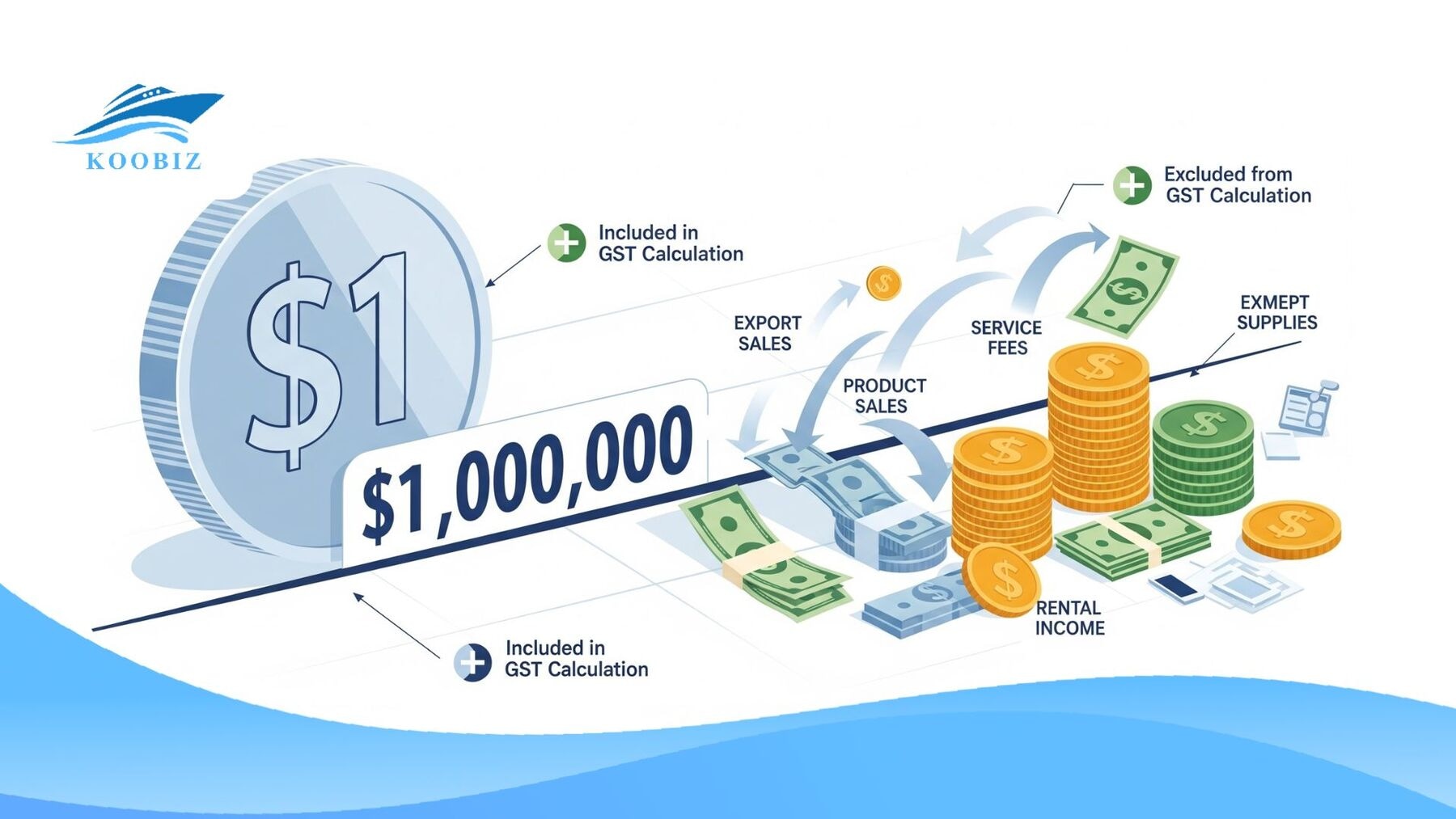
Accurate liability assessment requires calculating your “Taxable Turnover,” not merely reviewing total bank deposits. This figure is defined by the specific inclusion of certain revenue streams and the exclusion of others.
What Counts Towards Taxable Turnover?
IRAS requires you to sum up the following income sources to see if you hit the S$1 million threshold:
- Standard-Rated Supplies (9%): Most local sales of goods and services in Singapore (for example, retail purchases and consultancy fees).
- Zero-Rated Supplies (0%): Goods exported overseas and international services provided to foreign clients.
What is EXCLUDED from Taxable Turnover?
Do not include these when calculating your S$1 million turnover:
- Exempt Supplies: Financial services (such as interest income or share issues) and the sale or lease of residential properties.
- Out-of-Scope Supplies: Sales where goods are delivered from outside Singapore to another place outside Singapore (third-country sales).
- Sale of Capital Assets: Proceeds from selling major business assets like machinery or furniture.
To determine whether you’ve crossed the S$1 million mark, you need precise calculations of these revenue streams. At Koobiz, we frequently help clients audit their revenue sources to avoid accidentally triggering a GST registration requirement.
Why that registration matters: Failing to register when required is a serious offense in Singapore (penalty up to S$10,000 and 10% additional penalty). If you’re liable but don’t apply, IRAS may backdate your registration, forcing you to pay GST on past sales out of your own pocket.
Compulsory vs. Voluntary Registration
Compulsory registration is mandated by law based on revenue milestones, whereas voluntary registration is a strategic choice for businesses earning under the threshold.
To help you decide or determine your obligation, here is a direct comparison of the two paths:
| Feature | Compulsory Registration | Voluntary Registration |
|---|---|---|
| Who is it for? | Businesses with taxable turnover > S$1 million. | Businesses with taxable turnover < S$1 million. |
| Trigger | Mandated by law under the Retrospective (Annual) or Prospective view. | Strategic choice by the business owner. |
| Key Benefit | Compliance with the law (avoids penalties). | Ability to claim input tax (refunds) on business expenses. |
| Key Obligation | Must register within 30 days of liability notification date. | Must commit to remaining registered for at least 2 years. |
| New Requirement | Must be ready to charge GST. | Must use InvoiceNow solutions (phased implementation). |
| Risk | Late registration attracts backdated taxes and fines. | Administrative costs and GIRO requirement. |
Retrospective View vs. Prospective View (Compulsory)
If you’re under the compulsory regime, you use one of these tests to determine when to register:
- Retrospective View (Annual Assessment): You must register if your taxable turnover for the calendar year (1 Jan to 31 Dec) exceeds S$1 million.
- Deadline: You have until 30 January of the following year to apply.
- Effective Date: You will be registered for GST on 1 March of that year.
- Prospective View: You must register if you reasonably expect your taxable turnover to exceed S$1 million in the next 12 months. This typically applies if you have signed a large sales contract.
- Deadline: You must apply within 30 days of the date of your forecast/signed contract.
Businesses can now monitor compliance more easily by reviewing the past calendar year (retrospective). For future-looking assessments (prospective), IRAS requires formal documentation like purchase orders or signed contracts to support your forecasted figures.
Voluntary Registration Considerations
If you’re not required to register, the decision often comes down to cost versus benefit. Voluntary registration is especially advantageous for exporters (who sell zero-rated goods but incur GST on local costs) or start-ups with significant upfront capex.
However, voluntary registration comes with conditions: you must stay GST-registered for at least two years, comply with all filing requirements, and set up GIRO payments for taxes and refunds. Also, with the InvoiceNow mandate starting November 2025 for new companies, you’ll need a compatible accounting system to transmit invoice data to IRAS as part of your application.
Practical Case Studies: Determining Your Liability
Applying the abstract rules of registration to concrete business scenarios helps clarify exactly when you need to act.
To help you visualize whether your business falls under the mandatory or voluntary brackets, let’s examine three updated scenarios based on 2026 rules.
Scenario 1: The Retrospective Trigger (Mandatory)
Situation: TechFlow Solutions, a software consultancy, had steady revenue. By 31 December 2025, their accumulated revenue for the calendar year reached S$1.2 million.
Verdict: They have triggered the Retrospective View.
Action: TechFlow must apply for GST registration by 30 January 2026. Their GST registration will be effective from 1 March 2026.
Note: They do not need to check their turnover at the end of every quarter, only at the end of the calendar year.
Scenario 2: The Prospective Trigger (Mandatory)
Situation: BuildStrong Construction is a new company. On 15 July 2025, they secure a confirmed contract worth S$1.5 million.
Verdict: They have triggered the Prospective View.
Action: They must apply within 30 days. Under the new rules for liabilities arising after 1 July 2025, IRAS allows a grace period. While they apply in August, their effective date might be set to 1 October 2025 (approx. 2 months later), giving them time to set up their invoicing systems.
Scenario 3: The Strategic Choice (Voluntary)
Situation: PureExport Trading (incorporated in Jan 2026) buys goods locally and exports them to Europe. Their annual turnover is only S$800,000.
Verdict: They are not required to register.
Action: However, they choose Voluntary Registration in April 2026 to claim input tax refunds. Because they are applying after 1 April 2026, they must adopt an InvoiceNow-ready solution to transmit invoice data to IRAS as part of their application approval conditions.
Prerequisites for GST Registration
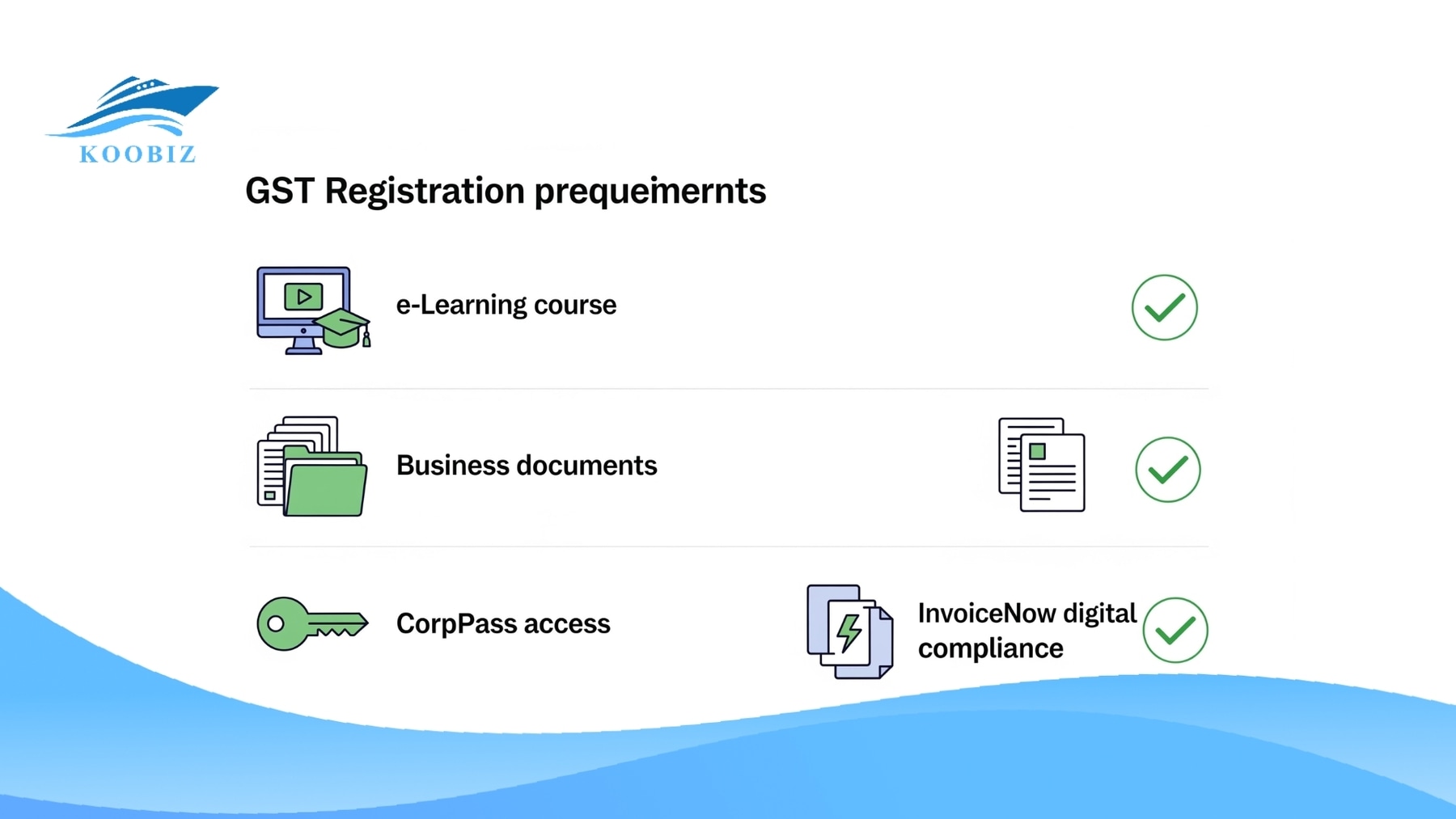
There are three main categories of prerequisites: administrative access, business documentation, and educational requirements.
Before logging into the portal, ensuring you have these elements ready will streamline the application process and prevent session timeouts.
The e-Learning Course Requirement
The most overlooked prerequisite is the “Overview of GST” e-Learning course. Business owners (sole proprietors, partners, or directors) applying under the Voluntary Registration scheme are generally required to complete this course.
Exemptions apply if:
- Your director/partner has already managed other GST-registered businesses, or
- You engage a professional tax agent (like Koobiz) to handle your GST matters. Our affiliation can reassure IRAS of your compliance.
Additional Voluntary Requirements (2026)
- GIRO Account: You must have a GIRO application form processed or pending.
- InvoiceNow: You must be prepared to declare your InvoiceNow-ready software details.
By preparing your CorpPass (with “IRAS Digital Services” authorized), your ACRA Business Profile, and your bank account details for GIRO setup beforehand, you ensure a frictionless application experience.
How to Submit Your Application via myTax Portal
The standard method involves a digital submission via the myTax Portal, which typically takes about 15 to 20 minutes to complete if all documents are prepared.
To guide you through the technical interface, here is the exact workflow you will encounter.
Step 1: Logging in with CorpPass
To begin, visit the IRAS myTax Portal (mytax.iras.gov.sg) and select “Business Tax.” You must log in using your CorpPass credentials.
Specifically, ensure that the person logging in has been assigned the “Approver” or “Preparer” role for GST (Filing and Applications) within the CorpPass system. Without this authorization, the relevant menus will not appear. Once logged in, navigate to the menu bar, select “GST”, and then click on “Apply for GST Registration”.
Step 2: Completing Form GST F1
Once inside the module, you will likely be filling out Form GST F1 (Application for GST Registration). The form acts as a dynamic interview, asking for details regarding your financial year-end, turnover figures, and business activities.
Detailed inputs required include:
- Turnover Details: You must declare your taxable turnover.
- Financial Year End (FYE): This determines your filing cycle (usually quarterly).
- Industry Code (SSIC): Ensure this matches your ACRA profile.
If you are a professional service provider or a consultant, be precise about your business description. For Koobiz clients, we handle this data entry meticulously to prevent discrepancies that could trigger an IRAS audit query.
Step 3: Processing Time and Notification
After submission, the standard processing time is approximately 10 working days.
During this period, IRAS may contact you for additional information or clarification regarding your business model. Upon approval, you will receive a notification via the portal and a physical letter containing your GST Registration Number and the effective date. It is crucial to monitor your email and portal inbox during this window so you do not miss the approval notice.
What is the Effective Date of Registration?
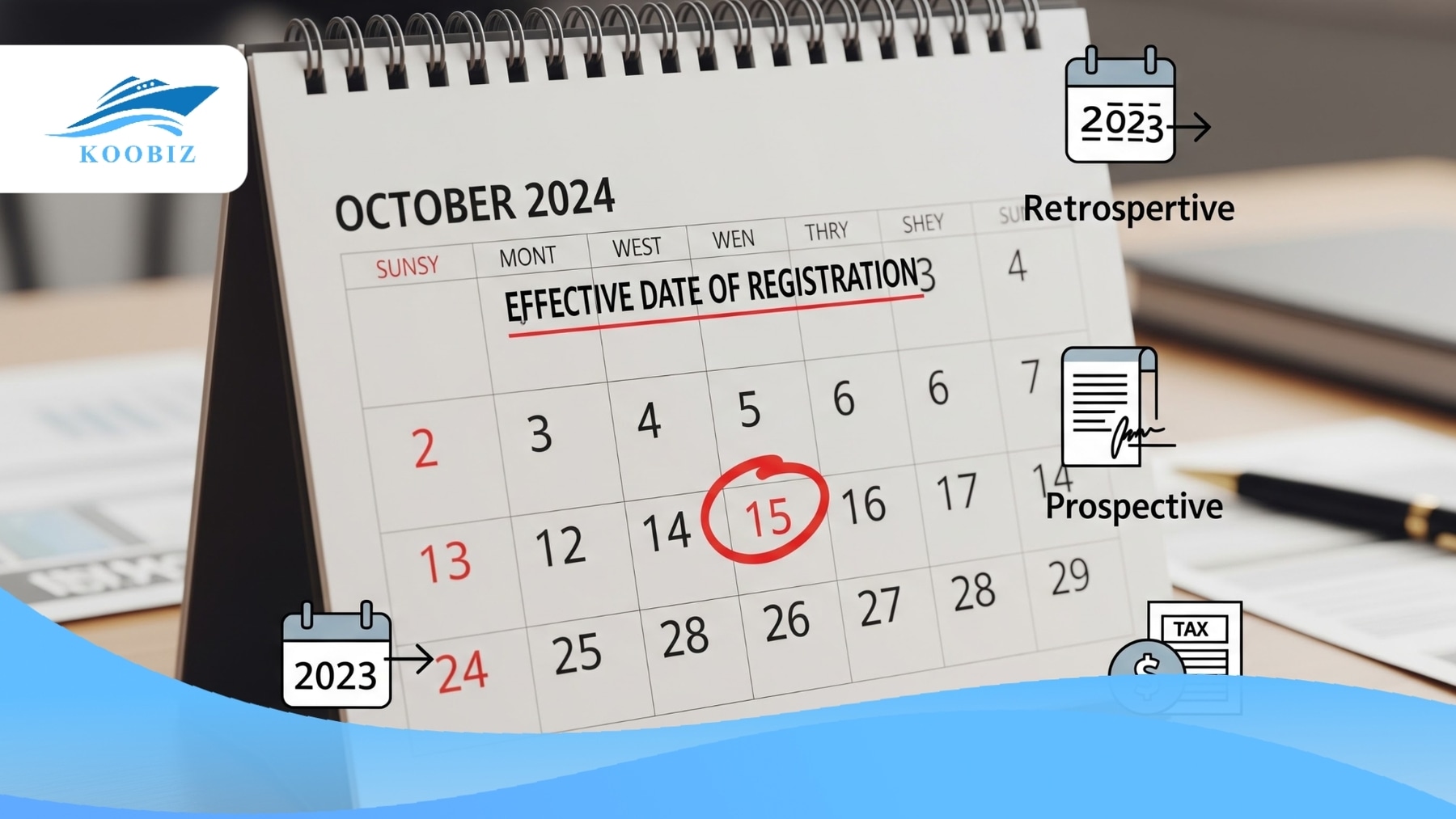
The Effective Date of Registration is the specific date from which you become a taxable person and must strictly start charging GST.
This date is legally binding and marks the boundary between your non-GST and GST eras.
- Retrospective: Usually 1 March following the end of the calendar year.
- Prospective: Typically the date requested, or approximately 2 months after the liability trigger date (post-July 2025 rules).
- Voluntary: Typically the date requested or a date assigned by IRAS upon approval.
From this exact date onwards, you must charge GST (currently 9%) on your standard-rated supplies. If you issue an invoice on the effective date without GST, you will have to absorb that tax amount yourself and pay it to IRAS.
Claiming Pre-registration Input Tax
GST-registered businesses can claim input tax on qualifying expenses incurred before their effective registration date.
IRAS allows claims on:
- Goods: Held on hand at the effective date (e.g., inventory).
- Services: Purchased within 6 months prior to the effective date (e.g., consultancy, renovation).
Strict documentation is required, including original tax invoices. Koobiz assists clients with these retrospective audits to maximize refunds, provided the goods haven’t been sold or consumed prior to registration.
Special Registration Cases
Specialized schemes exist for specific business models to simplify compliance.
Exemption from Registration
If your turnover exceeds S$1 million but supplies are wholly (or substantially) zero-rated (exports), you may apply for exemption. This saves administrative effort but disqualifies you from claiming input tax refunds.
Overseas Vendor Registration (OVR)
Overseas suppliers with global turnover >S$1 million selling >S$100,000 of digital services to Singapore consumers must register under this simplified pay-only regime.
GST Group Registration
Related companies can register as a single taxable group. This eliminates the need to account for GST on intra-group transactions, significantly reducing paperwork and cash flow constraints.
Responsibilities After Registration
Compliance involves immediate operational adjustments regarding pricing and payments.
GST-Inclusive Pricing
All public price displays (tags, menus, websites) must be GST-inclusive (e.g., S$109, not S$100++). Showing the breakdown is optional, but the final payable price must be clear.
GIRO Payment Setup
IRAS mandates GIRO for GST payments and refunds for all voluntary registrants, and strongly recommends it for compulsory registrants. Failure to set up GIRO when required can lead to penalties or cancellation of voluntary registration. Koobiz handles this setup immediately upon registration.
Conclusion
Registering for GST in Singapore is more than ticking a box. It’s a transition to a stricter regulatory environment that requires precise bookkeeping and timely compliance. Whether you’re compelled to register due to growing revenue or choosing voluntary registration to optimize your tax position, accuracy is essential.
At Koobiz, we specialize in simplifying Singapore’s corporate landscape for entrepreneurs. From determining your exact liability to handling the Form GST F1 submission and managing ongoing quarterly filings, our team ensures your business remains compliant while you focus on growth.
Ready to streamline your GST application? Visit Koobiz.com today to consult with our tax specialists about your Singapore incorporation and GST registration needs.
Disclaimer: This guide is based on IRAS regulations as of January 2026. Tax laws are subject to change. Readers are advised to consult with professional tax advisors or refer to the latest IRAS publications before taking action.