

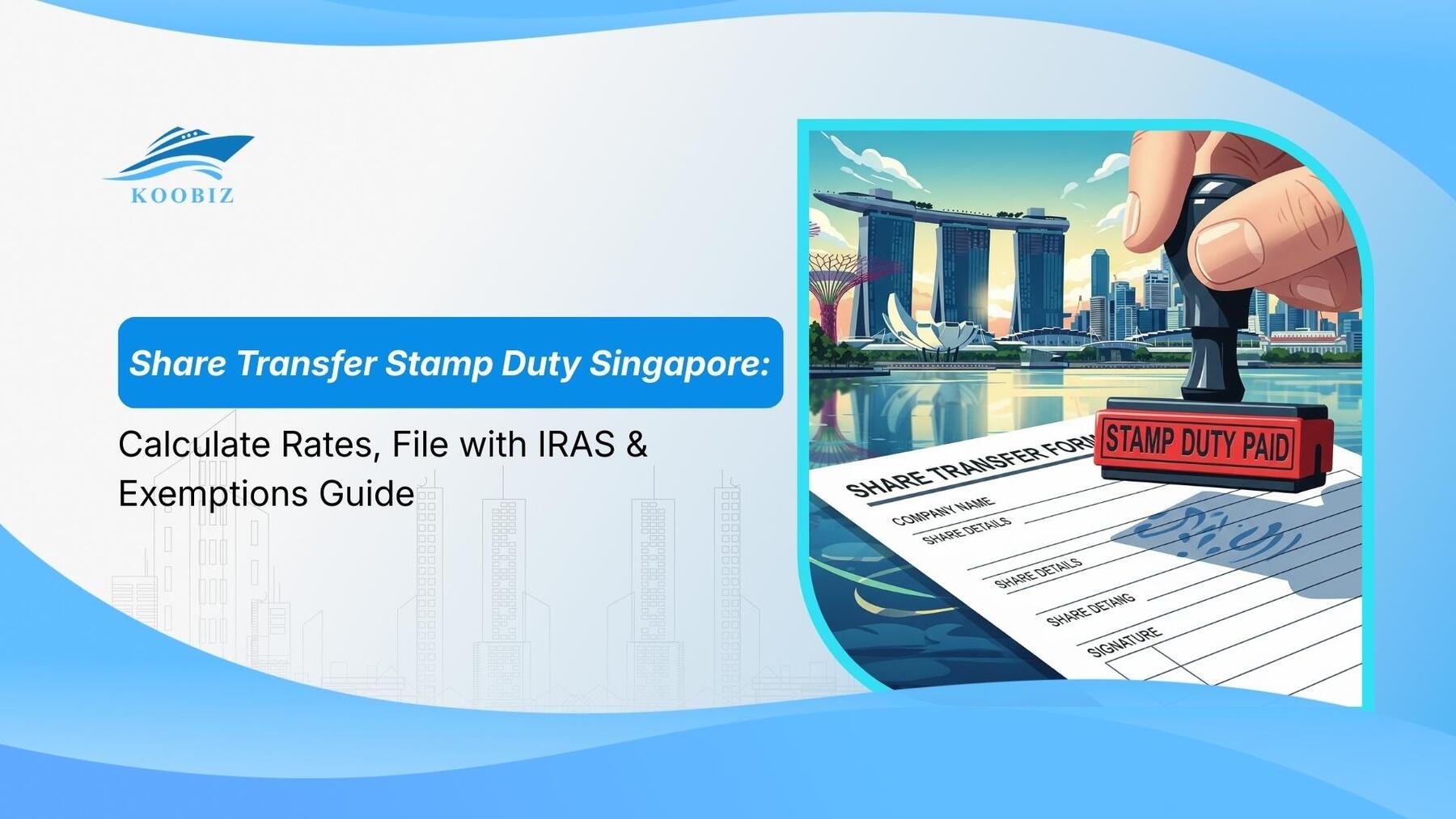
Transferring ownership of a Singapore Private Limited company is not merely a commercial transaction, it is a regulated act that triggers stamp duty obligations. Whether you’re an owner selling equity, an investor buying a stake, or a company secretary overseeing compliance, a clear grasp of Share Transfer Stamp Duty is essential to ensure the transfer is legally effective. Getting the stamping wrong can render the documents unenforceable and expose you to substantial penalties. At Koobiz we guide Singapore businesses through these regulatory steps from incorporation to complex compliance and in this guide we explain how to calculate the 0.2% duty, how to file with IRAS, and which exemptions may reduce your liability.
Is Stamp Duty Payable on Share Transfers in Singapore?
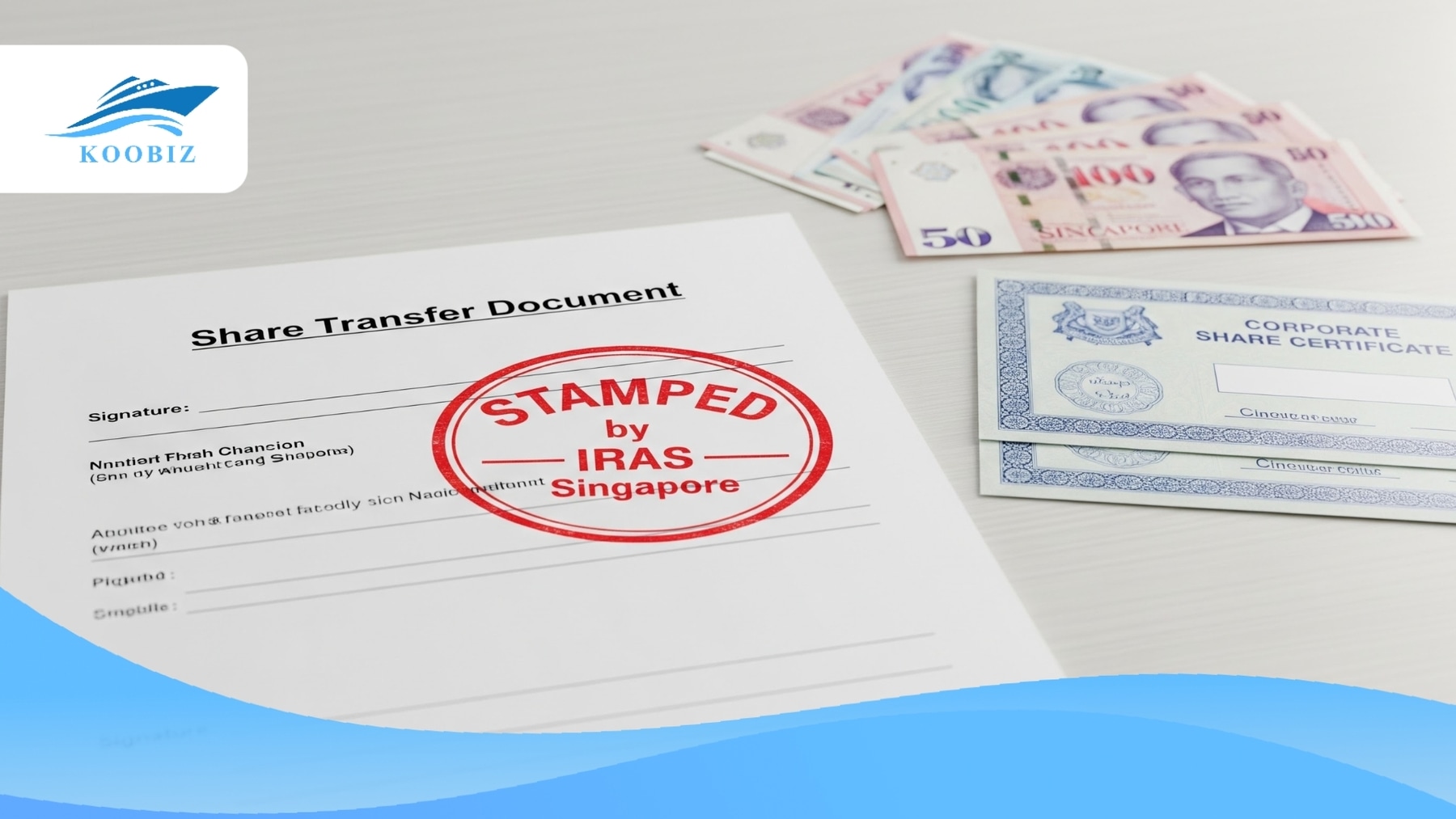
Yes. Stamp Duty applies to share transfers in Singapore because it is imposed on the Share Transfer Document (formerly known as the Instrument of Transfer) under the Stamp Duties Act. The document must be stamped and validated by IRAS for the transfer to be legally effective.
This obligation arises from the legal framework governing corporate documentation in Singapore. For private companies, a share transfer has no legal effect until the relevant document, whether executed physically or electronically is duly stamped. This differs from listed shares traded on the SGX, which are typically scriptless and settled electronically, and therefore do not follow the same stamping mechanics.
Importantly, stamp duty is triggered at the point of execution. The liability arises the moment the share transfer document is signed. Whether the shares are sold for consideration or transferred as a gift (where the consideration is nominal or nil), IRAS treats the transaction as a dutiable event based on the value of the shares being transferred.
How to calculate Share Transfer Stamp Duty Rates
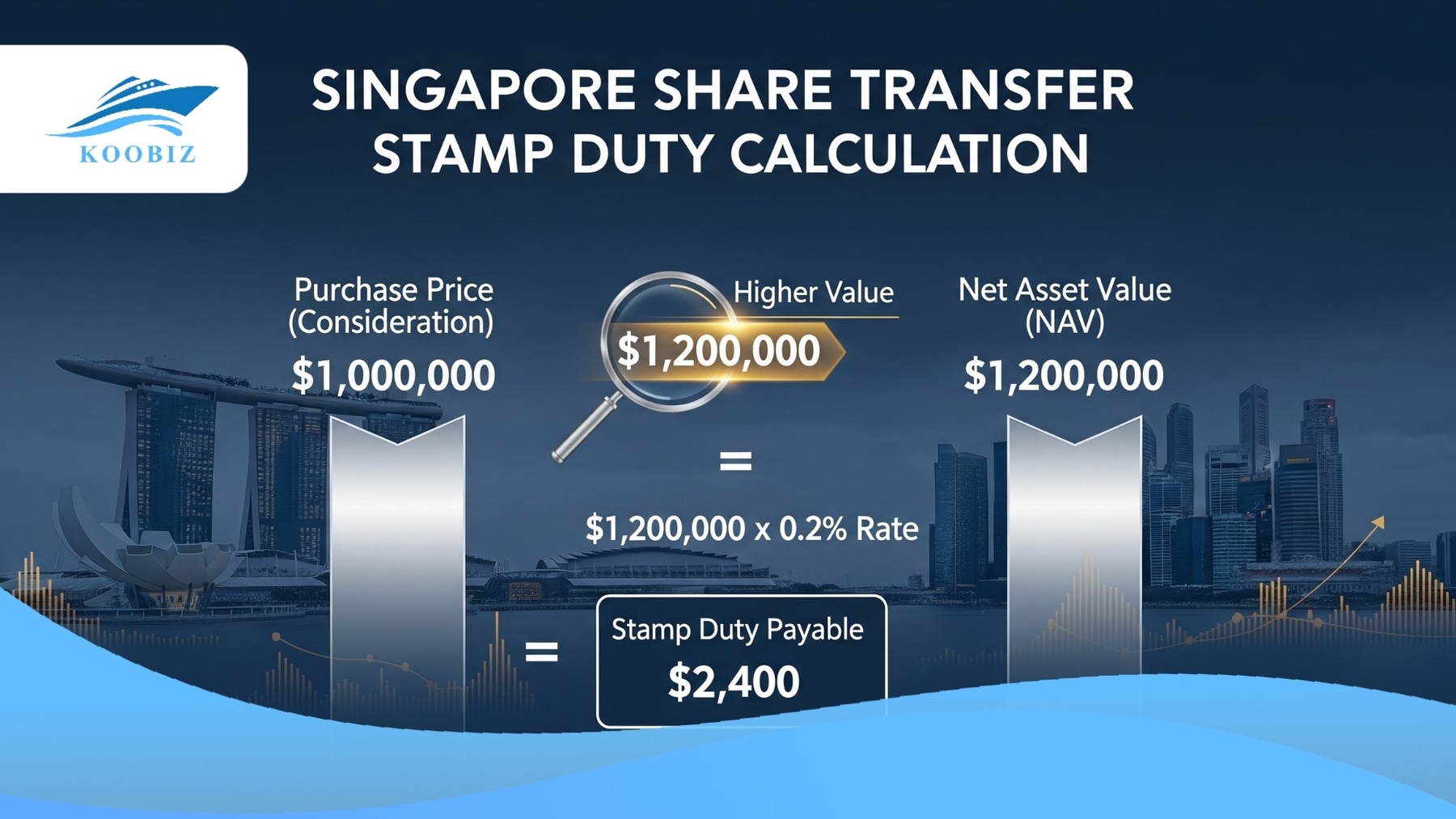
Stamp duty on a share transfer is calculated using one of two valuation bases: the Purchase Price (consideration) or the Market Value of the shares. The applicable duty is charged at a flat rate of 0.2% on whichever value is higher.
While IRAS formally uses the term “Market Value,” in practice, for most private companies that do not hold significant property assets, Net Asset Value (NAV) is commonly accepted as the market value proxy.
To avoid underpayment and potential penalties, it is essential to compare both figures and apply the 0.2% rate to the higher amount. Although full financial statements are not always required at the point of e-Stamping, IRAS expects taxpayers to retain a working copy of the valuation to substantiate the calculation if queried during a review or audit.
The 0.2% Rate Formula Explained
The calculation formula for Share Transfer Stamp Duty is simple: identify the higher of the consideration or the market value, apply the 0.2% rate, and round the resulting amount down to the nearest dollar.
Minimum Duty: Regardless of how small the computed amount may be, the minimum stamp duty payable is SGD 1.
For instance, where shares are transferred at a value of SGD 100,000, the duty is calculated as follows: 100,000 × 0.2% = SGD 200
That said, the key technical point lies in the rounding treatment. While the final duty payable is rounded down to the nearest dollar, the underlying share valuation must remain accurate and defensible. If the computed duty amounts to SGD 150.80, IRAS will typically assess the payable duty as SGD 150. Although the rate is relatively low, it can still translate into a meaningful tax cost for large-value share transfers running into the millions.
Net Asset Value (NAV) vs. Consideration Price
When assessing stamp duty, the starting point is to compare the Consideration Price (the amount paid by the buyer) with the Market Value of the shares, commonly reflected by the company’s Net Asset Value (NAV) – calculated as total assets less liabilities.
In practice, Koobiz advises clients that using NAV serves as a protective benchmark for IRAS, helping to prevent share transfers from being structured at artificially low values. As shown in the table below, the stamp duty is always computed based on the higher of these two figures, in line with IRAS requirements.
| Comparison Factor | Scenario A (Standard Sale) | Scenario B (Nominal/Gift) |
|---|---|---|
| Consideration Price | $50,000 | $1 |
| Net Asset Value (NAV) | $20,000 | $1,000,000 |
| Duty Base Used | $50,000 (Price is higher) | $1,000,000 (NAV is higher) |
| Duty Payable (0.2%) | $100 | $2,000 |
To calculate NAV, you typically use the company’s latest management accounts or audited financial statements. If the company owns property, the NAV generally must be adjusted to reflect the open market value of that property, rather than just its book value, to satisfy IRAS requirements.
Real-World Case Studies: Calculation Examples
To make these rules easier to digest, let’s look at three practical scenarios that Singapore business owners commonly face.
Case Study 1: The High-Valuation Startup (Price > NAV)
Scenario: “TechGenius Pte Ltd” is a startup with few physical assets (low NAV) but high future potential. An investor buys 10% of the shares for SGD 500,000. The proportionate NAV of those shares is only SGD 50,000.
- Analysis: The Purchase Price ($500k) is significantly higher than the NAV ($50k).
- Calculation: $500,000 × 0.2% = SGD 1,000.
- Outcome: Stamp duty is payable on the full purchase price.
Case Study 2: The “Nominal” Family Transfer (NAV > Price)
Scenario: Mr. Tan wants to transfer his business to his son. To keep it simple, he sells the shares for a nominal sum of SGD 1. However, the company is profitable and has a Net Asset Value of SGD 1,000,000.
- Analysis: Even though the “price” is $1, IRAS looks at the market value.
- Calculation: $1,000,000 × 0.2% = SGD 2,000.
- Outcome: Mr. Tan must pay $2,000 in stamp duty, not $0. This is a common pitfall for family transfers.
Case Study 3: The Property Holding Entity (The “ACD” Trap)
Scenario: An investor buys 100% of “LandHoldings Pte Ltd” for SGD 2,000,000. The company’s primary asset is a residential bungalow in Sentosa.
- Analysis: Because the company is “property-rich” (assets are >50% residential property), it is classified as a Property Holding Entity (PHE).
- Outcome: The investor does not just pay the standard 0.2% ($4,000). They are likely liable for Additional Conveyance Duties (ACD).
- 2025 Context: With recent property cooling measures, ACD rates mirror the Additional Buyer’s Stamp Duty (ABSD). For entities or foreign buyers, this can now exceed 60% of the property value, treating the share transfer essentially as a direct property purchase.
Koobiz Tip: Always check if the target company holds residential property before signing.
Step-by-Step Guide to Filing Stamp Duty with IRAS
The stamping process is carried out fully online via the government portal, having replaced the former practice of using physical adhesive stamps. The following workflow should be followed to ensure the document is properly stamped and legally validated:
- Login to the Portal: Access the IRAS e-Stamping Portal (mytax.iras.gov.sg) using your CorpPass (for corporate representatives) or SingPass (for individuals/Business Users).
- Select Document Type: Navigate to the main dashboard and select “Share Transfer” from the list of stampable documents.
- Enter Transaction Details: Input the required information into the digital form, including:
- Transferor (Seller) & Transferee (Buyer) details.
- Number of Shares being transferred.
- Consideration Price and the calculated Net Asset Value (NAV).
- Declare Property Status: You must declare if the company is a Property Holding Entity (PHE). This step is crucial for determining if ACD applies.
- Make Payment: Complete the stamp duty payment via GIRO, PayNow, or AXS.
- Download Certificate: Once payment is successful, a Stamp Certificate is generated immediately. Download this and attach it to your Share Transfer Document. Without this certificate, the Company Secretary cannot update the Electronic Register of Members (EROM) with ACRA via BizFile+.
Time Limits and Deadlines for Stamping
Strict statutory timelines apply. A share transfer document must be stamped within 14 days if it is executed in Singapore, or within 30 days if it is signed overseas.
This distinction is particularly important for cross-border transactions. For example, where a transfer form is sent to a director in London for execution, the 30-day period runs from the date the document is signed abroad, not from the date it is returned to Singapore. Conversely, where the document is signed digitally or physically in Singapore, the 14-day deadline applies. Failure to meet these timelines results in automatic late-stamping penalties, which are addressed in the supplementary section.
Common Stamp Duty Exemptions and Reliefs

Certain stamp duty reliefs are available, mainly for transactions where beneficial ownership remains unchanged or where the transfer occurs as part of a corporate group restructuring.
Although stamp duty applies as a default rule, careful structuring can take advantage of these statutory reliefs to reduce or eliminate the tax exposure, particularly in the context of internal group reorganisations.
Relief for Associated Permitted Entities & Section 15
Corporate groups can often waive stamp duty during internal restructuring to streamline operations. The two most common reliefs are:
- Associated Permitted Entities Relief: Requires the companies to be associated by at least 75% in voting capital and power.
- Section 15 (Reconstruction & Amalgamation): A stricter relief typically requiring 90% ownership and often stipulates that the consideration be paid primarily in shares of the transferee company.
Important Conditions:
- Retention Period: The companies must typically remain associated for at least two years post-transfer.
- Intent: The transfer must be for genuine restructuring/rationalization, not for tax avoidance.
- Adjudication: These reliefs are not automatic. You must apply to IRAS for adjudication before the duty payment deadline to claim the waiver.
Transfer of Shares as a Gift
Transferring shares as a Gift (Voluntary Conveyance inter vivos) does not exempt you from stamp duty; instead, the duty is calculated strictly on the Market Value (NAV) since there is no purchase price.
Many business owners mistakenly believe that “giving” shares to a family member or partner for $0 implies $0 tax. This is incorrect. In a gift scenario, IRAS treats the market value as the dutiable amount.
- Comparison:
- Sale: Duty on Higher of Price vs. NAV.
- Gift: Duty on NAV (since Price is $0).
Therefore, gifting shares of a highly valuable company will still result in a significant stamp duty bill.
Handling Penalties, Refunds, and Special Share Scenarios
Managing share transfers goes beyond routine e-Stamping. It also involves addressing late-stamping penalties, navigating Additional Conveyance Duties (ACD) for property-holding entities, and handling transactions that are subsequently aborted.
In practice, business owners must be ready for atypical scenarios that can complicate stamp duty assessments. At Koobiz, we regularly support clients who have missed statutory deadlines or need assistance rectifying prior filings.
Late Payment Penalties and Appeals
IRAS imposes a tiered penalty structure for late stamping, which can be up to 4 times the original duty amount depending on the duration of the delay.
- Delay ≤ 3 Months: $10 penalty or an amount equal to the duty payable (whichever is greater).
- Delay > 3 Months: $25 penalty or 4 times the duty payable (whichever is greater).
For example, if the unpaid duty was $1,000 and you are 4 months late, you could owe $1,000 (Duty) + $4,000 (Penalty) = $5,000 total. You can submit an appeal via the IRAS portal if there was a genuine oversight, but waivers are not guaranteed.
Additional Conveyance Duties (ACD) for Property Holding Entities
Where the target company qualifies as a Property Holding Entity (PHE), the share transfer may expose the buyer to Additional Conveyance Duties (ACD), which can far exceed the standard 0.2% stamp duty.
- A company is generally regarded as a PHE if 50% or more of its total tangible assets comprise prescribed immovable properties, namely residential real estate situated in Singapore.
- 2025 update: ACD was introduced to close a tax arbitrage gap. With ABSD rates for entities and foreign buyers rising sharply in recent years in some cases reaching 60–65% ACD rates have been aligned accordingly. As a result, acquiring shares in a property-holding company can now attract a tax burden broadly comparable to purchasing the underlying residential property outright.
Stamp Duty on Shares in Foreign Currency
When shares are denominated in a foreign currency (e.g., USD), the value must be converted to Singapore Dollars (SGD) using the exchange rates published by MAS or IRAS on the date of the document execution.
You cannot simply use the USD value to calculate the duty. The sequence is:
- Determine Value in Foreign Currency.
- Convert to SGD using the spot rate on the date of signing.
- Apply 0.2% rate to the SGD figure.
Applying for a Refund for Aborted Transfers
Where a share transfer is subsequently rescinded or set aside after stamp duty has already been paid, an application for a refund may be made to IRAS within six months from the date of the instrument or its execution.
To support a successful refund claim, it must be clearly demonstrated that the transaction was effectively aborted and that legal ownership of the shares did not pass to the buyer. This typically requires documentary evidence such as a Rescission Agreement and confirmation that the company’s register of members was never updated.
Conclusion
Navigating Share Transfer Stamp Duty in Singapore requires attention to detail from calculating the market value correctly to ensuring the e-Stamping is completed within the 14-day window. While the 0.2% rate seems low, mistakes in valuation or identifying Property Holding Entities can lead to costly penalties or Additional Conveyance Duties.
At Koobiz, we simplify corporate compliance for entrepreneurs and businesses. Whether you need assistance with company incorporation, Company Secretary services to draft your Share Transfer Document, or guidance on opening a corporate bank account in Singapore, our team is ready to support your growth.
Ready to streamline your share transfer process?
Visit Koobiz.com to consult with our experts today.

![How to Issue Compliant Share Certificates in Singapore [ACRA Guide]](/_next/image?url=https%3A%2F%2Fcms.koobiz.com%2Fwp-content%2Fuploads%2F2026%2F01%2Fhow-to-issue-compliant-share-certificates-in-singapore-acra-guide.jpg&w=3840&q=100)