

Navigating Singapore’s philanthropic sector requires distinguishing between three key concepts: the Non-Profit Organisation (NPO), the Registered Charity, and the Institution of a Public Character (IPC). At Koobiz, we guide social entrepreneurs and corporations through these complexities to ensure a solid foundation. This article outlines the essential legal structures, tax benefits, and governance requirements needed to establish a successful non-profit in Singapore.
What is a Non-Profit Organisation in Singapore?

Definition: Think of a Non-Profit Organisation (NPO) in Singapore as any group set up to serve a public cause—like helping the community, supporting the arts, or protecting the environment. The key rule is that any extra money it makes must be put back into its mission. It cannot be paid out to the people who run it or its members as profit.
Imagine a regular business (like a cafe) exists to make money for its owners. An NPO (like a community shelter or an arts group) exists to serve its cause. Its “profit” is measured in social impact, not cash payouts.
Think of “NPO” as a purpose, not a specific legal label. It’s the why behind your group. To legally operate, you must choose a formal structure (like a company or society) that matches this purpose. The key difference from a regular business is the “non-distribution constraint”: profits serve the cause, not people.
What are the 3 Key Legal Structures for NPOs?
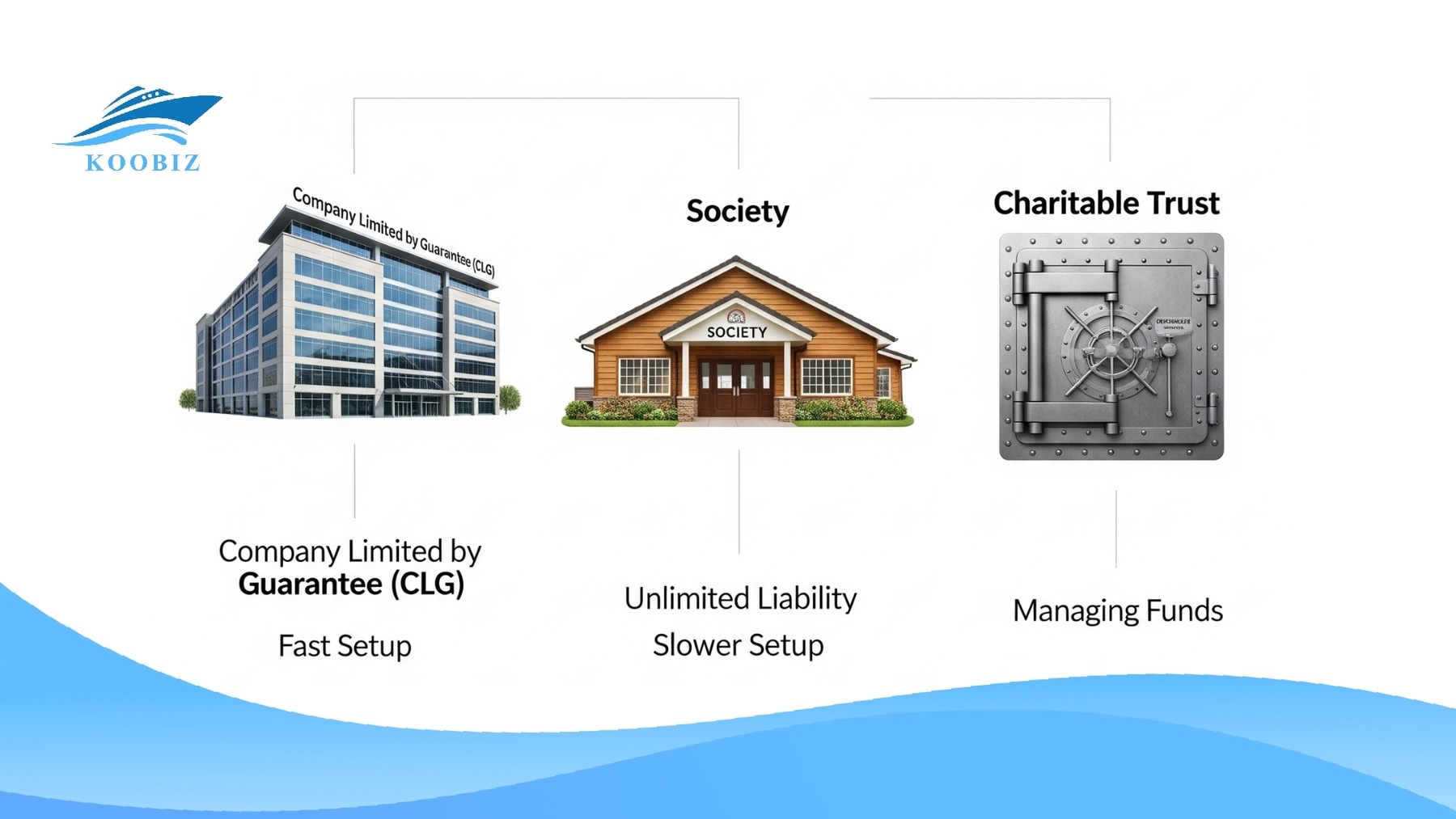
This is your first big decision. It’s like choosing the right type of vehicle for a journey. Here’s a simple comparison:
| Feature | Public Company Limited by Guarantee (CLG) | Society | Charitable Trust |
|---|---|---|---|
| Legal Status | Separate Legal Entity | No Separate Legal Entity | No Separate Legal Entity |
| Regulator | ACRA | Registry of Societies (ROS) | Ministry of Law / Courts |
| Liability | Limited (Members liable usually up to $1) | Unlimited (Office bearers personally liable) | Unlimited (Trustees personally liable) |
| Setup Speed | Fast (1-2 days) | Slow (2-4 months) | Moderate |
| Best For | National charities, large scale operations | Small clubs, volunteer groups, hobbyists | Grant-making foundations, scholarship funds |
Choosing the right structure is the first critical decision you will make. This choice affects your liability, statutory obligations, and ability to scale. Below, we provide a deeper look into the nature of each structure.
Public Company Limited by Guarantee (CLG)
A Public Company Limited by Guarantee (CLG) is the most common structure for non-profit organizations that intend to operate on a larger scale, such as national charities or foundations.
Unlike a private limited company that issues shares, a CLG has members who guarantee to contribute a nominal amount (usually SGD 1.00) if the company is wound up. Because it is regulated by ACRA under the Companies Act, it possesses a separate legal identity. This allows the organization to sue, be sued, hire staff, and hold property in its own name, distinct from its members. At Koobiz, we generally recommend this structure for professional NPOs seeking registered charity status due to its robust governance framework and limited liability protection.
Societies
A Society is a membership-based group, suitable for smaller organizations, clubs, or volunteer groups that operate primarily for the benefit of their members or a specific community.
Regulated by the Registry of Societies (ROS), a society is defined as a club, company, partnership, or association of 10 or more persons. It is simpler and less costly to set up than a CLG but comes with higher personal risk. Since a Society does not have a separate legal personality, office bearers can be held personally liable for the society’s debts and legal obligations. This makes it best suited for grassroots community groups or hobby clubs where the operational risk and financial overhead are low.
Charitable Trusts
A Charitable Trust is a legal arrangement typically used to manage funds or property set aside for specific charitable purposes, rather than for conducting active operations.
In this structure, trustees hold the assets for the benefit of the charitable purpose under a Trust Deed. Trustees have a fiduciary duty and can be personally liable if they breach the trust. Consequently, this structure is rarely used for active service delivery organizations and is more appropriate for scholarship funds, grant-making foundations, or managing a specific bequest.
According to data from the Commissioner of Charities, the CLG structure has seen the highest growth rate among new registered charities in the last decade due to its professional perception and limited liability protection.
Which one should you pick?
Choose a CLG if: You have big ambitions, plan to fundraise from the public, want to hire employees, and need to protect your board members from personal risk. It’s the standard for professional, scalable charities.
Choose a Society if: You’re starting a small community club, a sports group, or a volunteer network with friends. It’s simpler and cheaper but riskier for the leaders.
Choose a Trust if: Your main goal is to manage and give out money (like a scholarship fund or a family foundation) rather than run active programs.
What is the Difference Between NPO, Charity, and IPC?
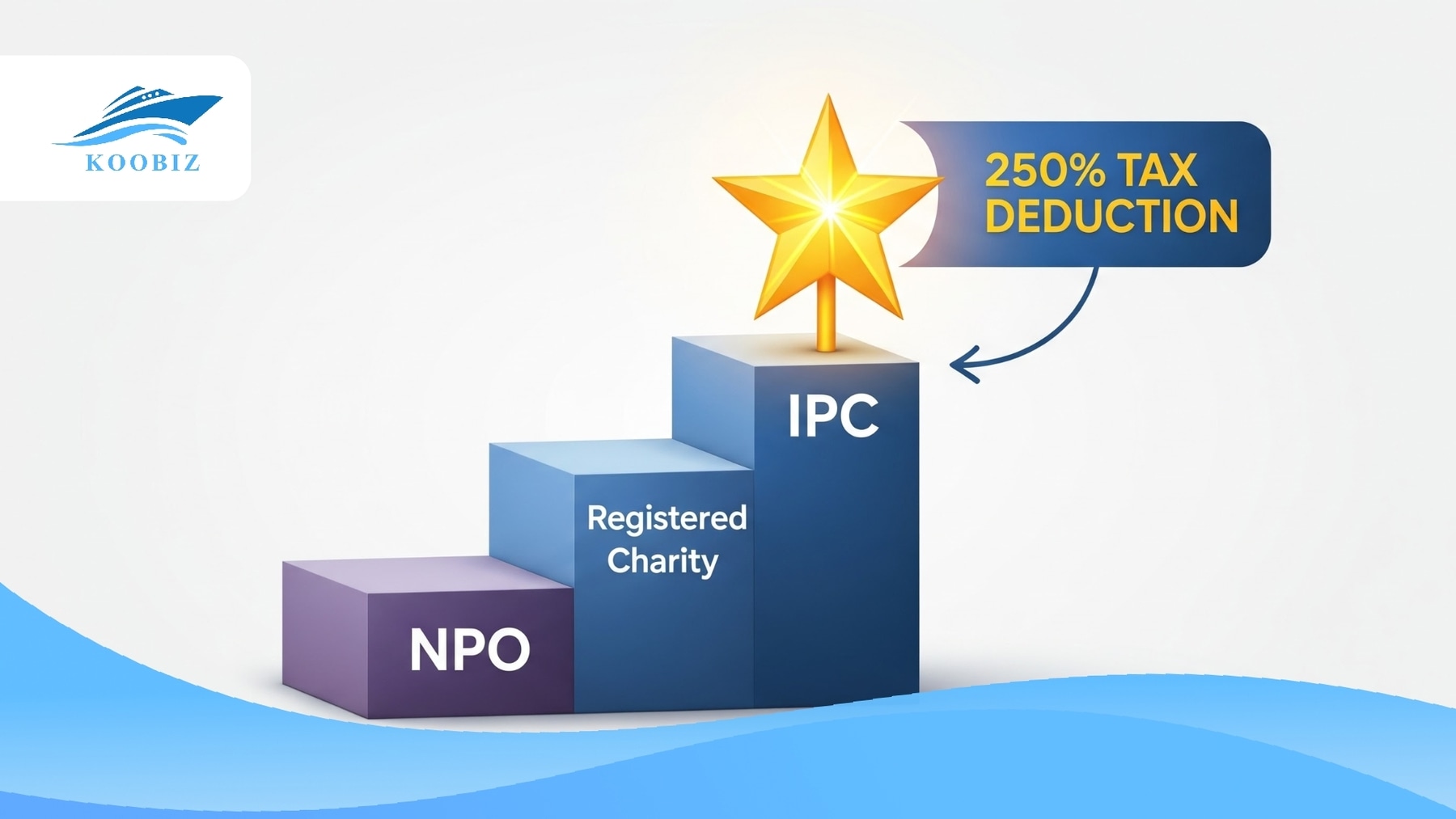
This is crucial. Think of it as a ladder with three steps, each giving you more benefits (and responsibilities).
| Status | Income Tax Exemption? | Can Issue Tax-Deductible Receipts? |
|---|---|---|
| Non-Profit Organisation (NPO) | No (Generally Taxable) | No |
| Registered Charity | Yes (Automatic) | No |
| Institution of a Public Character (IPC) | Yes | Yes (250% Deduction) |
Understanding this hierarchy is essential for your fundraising strategy.
Non-Profit Organisation (The Base)
As discussed, this is the baseline: you have registered your CLG or Society and are legally an NPO. However, being an NPO does not automatically grant tax exemption. You’re still treated as a taxable entity unless you advance to the next step.
Registered Charity (The Status)
Once your NPO is established, you can apply to the Commissioner of Charities (COC) to obtain Registered Charity status. This marks a significant milestone.
- Primary Benefit: Full income tax exemption.
- Requirement: Your activities must fall within beneficial charitable categories (e.g., relief of poverty, advancement of education).
- Observation: Without this status, any surplus your NPO generates (even from donations) could be subject to corporate tax. Koobiz assists entities in preparing the necessary governing instruments to meet the COC’s strict requirements for registration.
Institution of a Public Character – IPC (The Gold Standard)
IPC status is a specialized subset of registered charities. It is considered the “gold standard” because it directly incentivizes donors.
- Primary Benefit: Only IPCs can issue tax-deductible receipts.
- Distinction: All IPCs are Registered Charities, but not all Registered Charities are IPCs.
- Impact: If you are a Registered Charity without IPC status, a donor gives you $100, and it costs them $100. If you are an IPC, a donor gives you $100, and they can deduct $250 from their taxable income.
Is Income Generated by NPOs Taxable?
Yes, income earned by a nonprofit organization is taxable by default unless the entity successfully secures registered charity status. A common misconception is that “non-profit” automatically means “tax-free.” In reality, the Inland Revenue Authority of Singapore (IRAS) treats a CLG or Society like any other body of persons unless specific criteria are met. Below is a breakdown of the three key tax scenarios:
- Scenario A: Standard NPO (No Charity Status)If you are a CLG or Society but not a registered charity, any surplus income (from trade, business, or donations) is subject to the standard Corporate Income Tax rate (currently 17%).
- Scenario B: Registered CharityOnce registered under the Charities Act, your organization enjoys automatic income tax exemption on income used strictly for charitable objectives. You do not need to file tax returns unless specifically requested.
- Scenario C: Charity with Business IncomeEven registered charities can be taxed if they engage in trade or business activities unrelated to their primary charitable objectives (for example, running a commercial cafe that isn’t a training ground for beneficiaries).
However, moving from a standard NPO to a tax-exempt charity requires rigorous documentation and adherence to statutory requirements. This serves as a contextual border where we shift from understanding the basic structure to mastering the advanced benefits and compliance required to sustain an impactful organization.
About Koobiz
Koobiz is your trusted partner for corporate services in Singapore. We specialize in helping social entrepreneurs and businesses establish the appropriate legal structures, including Companies Limited by Guarantee for NPOs. Beyond incorporation, we provide comprehensive support for opening bank accounts, tax filing, accounting, and audit services to help your organization stay compliant and focused on its mission.
Ready to start your non-profit journey? Contact Koobiz today for a consultation.