

For many aspiring changemakers, the traditional dichotomy between “doing good” (charity) and “doing well” (business) is no longer sufficient. In Singapore’s evolving economic landscape, a new hybrid model is gaining traction: the Social Enterprise. This model offers a sustainable path for entrepreneurs who wish to address critical social gaps without relying solely on philanthropic donations.
The sector is growing rapidly. Since 2015, raiSE Singapore has disbursed millions in funding and empowered over 1,200 social enterprises to achieve sustainable growth.
At Koobiz, we have observed a significant rise in inquiries regarding this unique business structure. Whether you are looking to support marginalized communities, promote environmental sustainability, or preserve cultural heritage, establishing a social enterprise requires a precise balance of mission and margin. This guide serves as your comprehensive roadmap to understanding, establishing, and scaling a social enterprise in Singapore.
What Defines a Social Enterprise in Singapore?
A Social Enterprise (SE) in Singapore is a business entity that uses commercial strategies to maximize improvements in human and environmental well-being, rather than maximizing profits for external shareholders. Unlike a conventional company where profit is the end goal, for an SE, profit is a means to an end—that end being a specific social outcome.
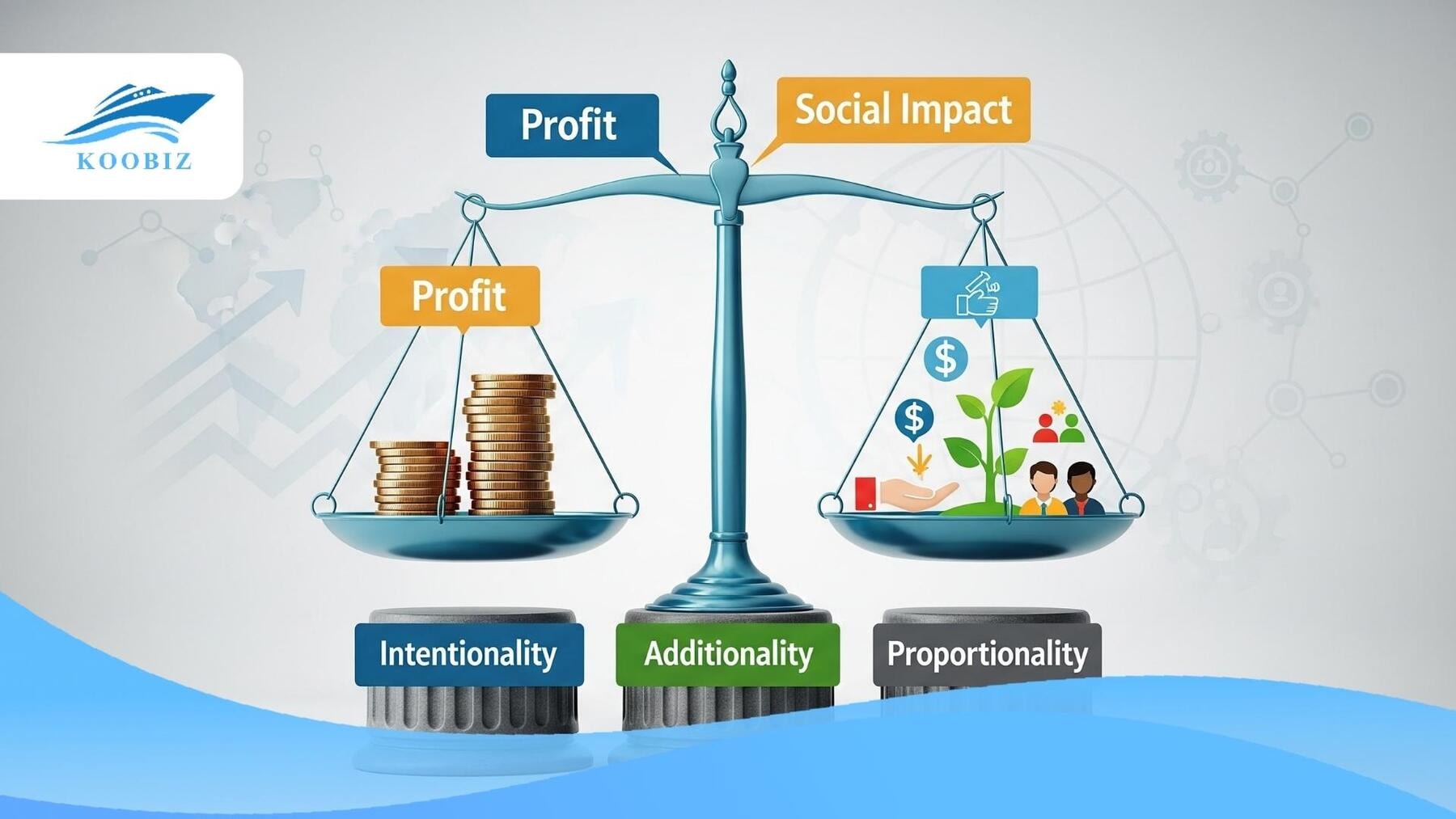
To understand this deeply, we must look at the framework provided by the Singapore Centre for Social Enterprise (raiSE). A legitimate SE is defined by three Core Evaluation Pillars: Intentionality, Additionality, and Proportionality.
- Intentionality: The social mission is not incidental; it is formally codified in the corporate constitution and operational strategy from inception.
- Additionality: The business provides specific value to a beneficiary group that would not otherwise exist.
- Proportionality: Resources and profits are allocated fairly between business growth and social impact.
Differentiating Social Enterprises (SE) from Non-Profit Organizations (NPO)
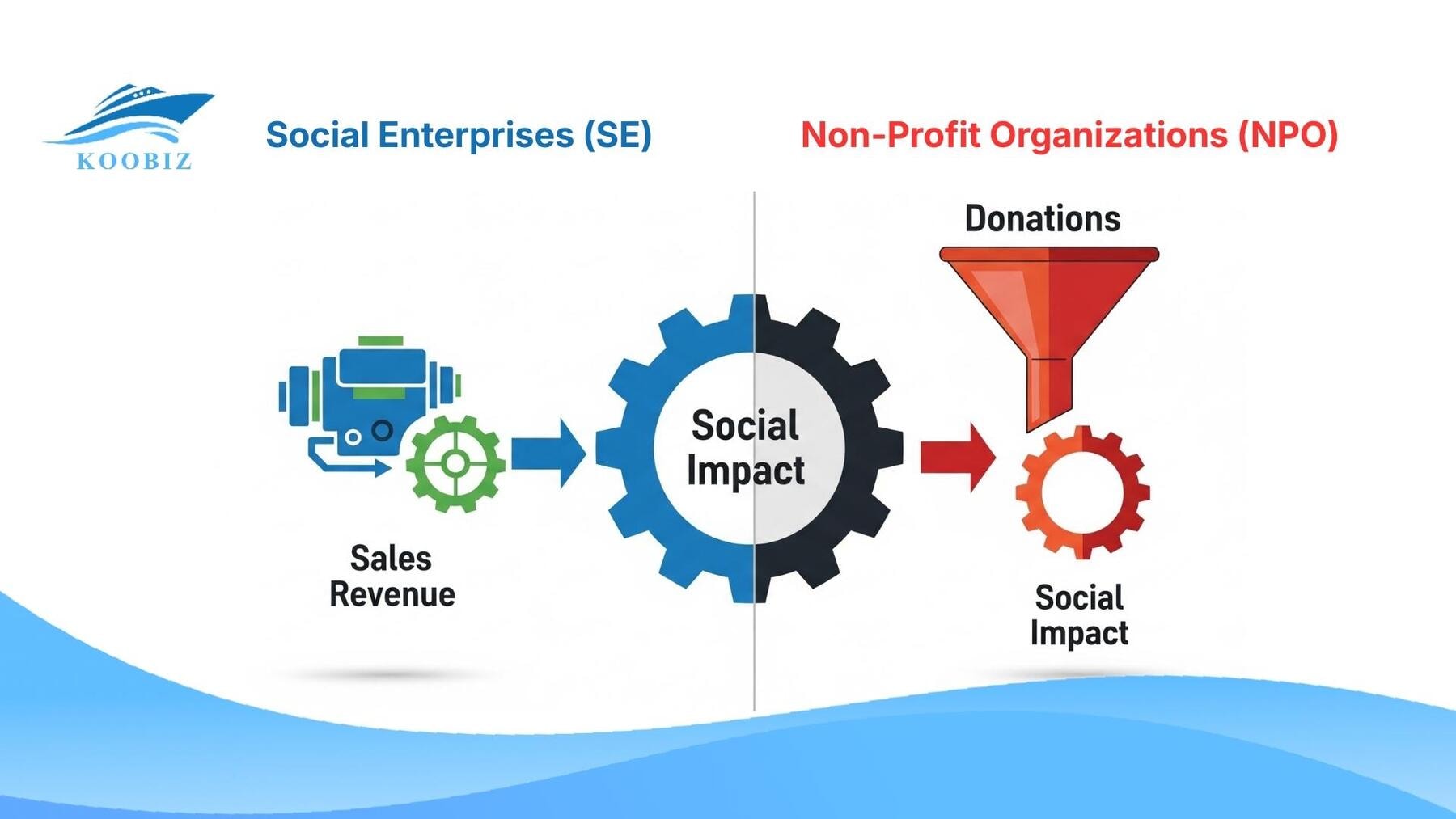
No, a social enterprise is distinct from a non-profit organization (NPO). While both aim to do good, they differ fundamentally in how they sustain themselves.
- Financial Sustainability: Unlike NPOs, which are often vulnerable to donor fatigue, SEs utilize a revenue-centric model by trading goods and services in the competitive market.
- Operational Mindset: An NPO focuses on fundraising to fund programs. An SE operates with a business mindset, competing in the open market (e.g., a cafe hiring youth-at-risk) to fund its social mission.
- Resilience: This financial independence allows SEs to be more sustainable in the long run, whereas charities may struggle during economic downturns when donations dry up.
Social Enterprise vs. Charity vs. Commercial Business
Social Enterprises (SEs) operate at the intersection of philanthropic impact and commercial viability, while traditional charities rely on philanthropic capital to drive their social mandates.
To visualize where a social enterprise sits in the ecosystem, it is helpful to compare these three entities across key operational metrics.
| Feature | Social Enterprise | Charity / Non-Profit | Commercial Business |
|---|---|---|---|
| Primary Goal | Social Impact + Financial Sustainability | Social Impact | Financial Profit |
| Funding Source | Sales Revenue, Grants, Investment | Donations, Grants | Sales Revenue, Investment |
| Surplus Allocation | Reinvested into scaling operations and amplifying social impact. | 100% Reinvested/Spent on Cause | Distributed to Shareholders |
| Fiscal Obligations | Subject to corporate tax, with eligibility for Tax-Exempt status upon fulfilling specific IPC/Charity criteria. | Tax-Exempt (usually) | Taxable |
Koobiz often advises clients that while SEs function like commercial businesses in terms of operations—needing marketing, sales, and HR strategies—their decision-making process is fundamentally different. In a commercial business, a decision is made if it increases profit. In an SE, a decision is made if it increases profit without compromising the social mission, or ideally, while enhancing it.
How to Set Up a Social Enterprise in Singapore?
Establishing a Social Enterprise (SE) requires a strategic two-tier approach: formal legal incorporation followed by sector-specific accreditation.
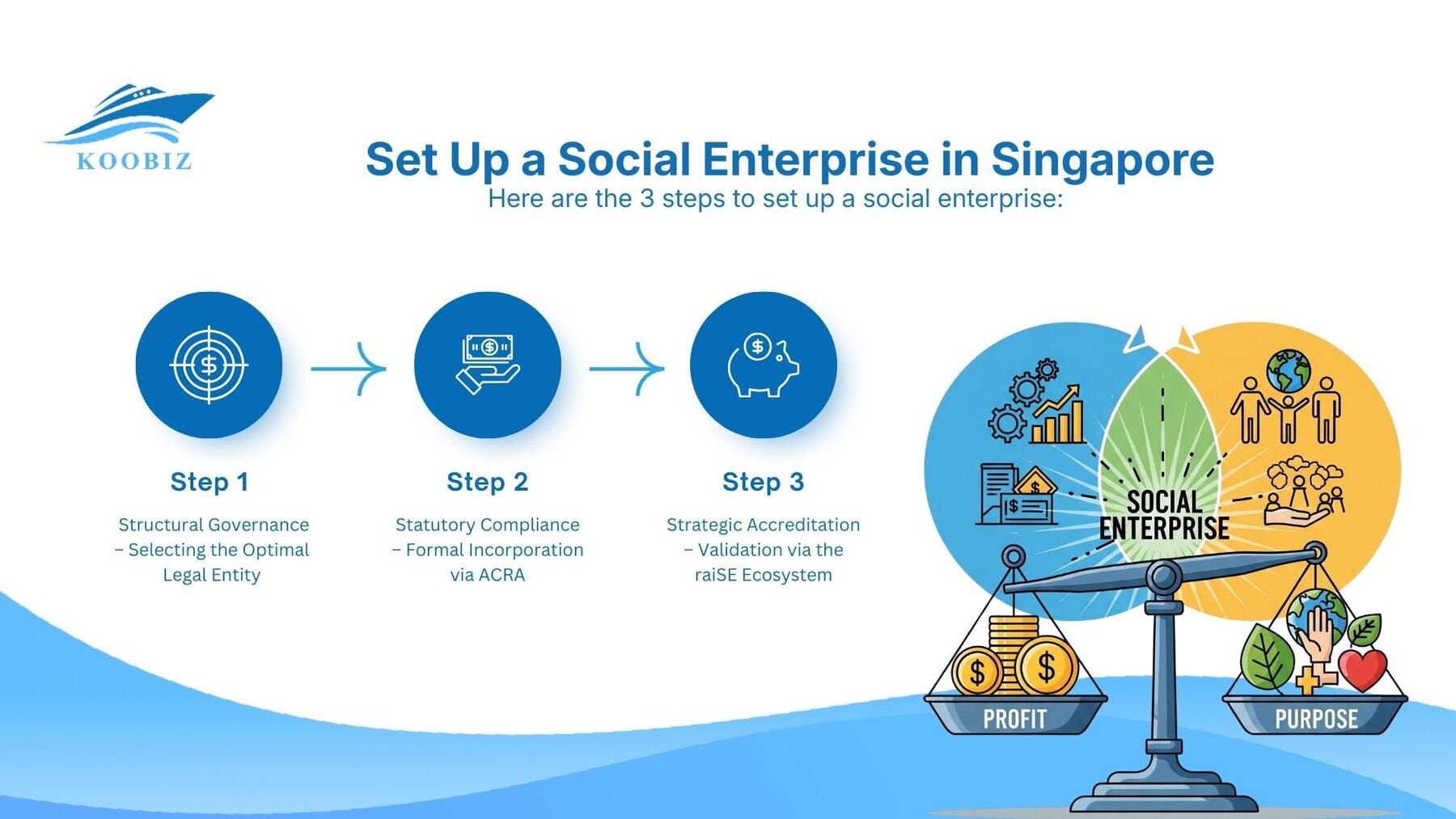
Step 1: Structural Governance – Selecting the Optimal Legal Entity
There are two primary legal structures adopted by social enterprises in Singapore: the Private Limited Company (Pte Ltd) and the Company Limited by Guarantee (CLG). Your choice depends on your vision for ownership and funding.
Private Limited Company (Pte Ltd): This is the most common structure for SEs (shares limited by liability).
- Pros: Enables a share-based capital structure, significantly lowering the barrier for impact investors and VC participation.
- Cons: It is a taxable entity, and there can be public skepticism about “profiting from a cause.”
- Best for: SEs that have a strong product/service to sell and aim for rapid growth (e.g., an eco-tech startup).
Company Limited by Guarantee (CLG): This is a non-profit entity classification often used for charities, but also for SEs. It has members instead of shareholders.
- Pros: Commands high public and donor trust due to its non-distribution constraint, ensuring all surpluses are locked for social mandates.
- Cons: Cannot raise capital by selling shares; administrative compliance can be stricter.
- Best for: SEs focused heavily on community building where profit is purely incidental.
Koobiz Pro Tip: If you intend to raise private capital (VC or Angel investment) later, a Pte Ltd is almost always the required structure. Investors cannot take equity in a CLG.
Step 2: Statutory Compliance – Formal Incorporation via ACRA
Once you have decided on your structure, you must formally incorporate your entity with the Accounting and Corporate Regulatory Authority (ACRA).
This is the standard business registration process in Singapore. Whether you chose Pte Ltd or CLG in Step 1, you will receive a Unique Entity Number (UEN). The Unique Entity Number (UEN) acts as your corporate identity, essential for establishing banking relationships and executing commercial contracts.
Step 3: Strategic Accreditation – Validation via the raiSE Ecosystem
Registering with raiSE is the definitive step that validates your business as a recognized Social Enterprise in the Singapore ecosystem.
raiSE was set up to develop the social enterprise sector in Singapore. Membership is not automatic; applicants must submit a proposal detailing their social objectives and business model. Being a raiSE member provides credibility. It signals to consumers and partners that your claim of “doing good” has been vetted by a third-party authority. Furthermore, membership unlocks access to mentorship, business clinics, and crucial funding schemes.
Key Grants and Funding Schemes for Social Enterprises
There are several key funding avenues available for Singapore-based social enterprises, primarily anchored by the Venture for Good (VFG) grant and private impact investing networks.
Capital Strategy: Leveraging Grants and Impact Investment. While commercial startups focus on exponential ROI, SEs prioritize long-term systemic impact to attract targeted impact capital. Singapore’s government and private sectors have bridged this gap with specific schemes.
Venture for Good and Other raiSE Grants
Venture for Good (VFG): A cornerstone funding mechanism designed for capacity scaling, infrastructure procurement, and strategic marketing.
- Venture For Good (New & Existing): This grant supports the setup and expansion of SEs. Historically, it has provided capital (e.g., up to SGD 300,000 depending on the tranche and impact potential) to cover manpower, equipment, and marketing.
- Capacity Building Grants: These are smaller grants aimed at helping SEs improve operational efficiency, such as adopting new technology or training staff.
Important Note: Grant amounts and eligibility criteria are subject to change. Always verify the latest tranches and application windows on the official raiSE website.
To secure these grants, the SE must demonstrate a viable business model. The Singapore government seeks to invest in fiscally resilient models rather than subsidizing non-viable projects. This is where professional financial projection—a service Koobiz specializes in—becomes vital for the application.
We have established the “what” (Definition) and the “how” (Setup and Funding) of a Social Enterprise. However, to truly succeed, one must navigate the operational complexities that arise after the company is formed. The following section delves into the micro-semantics of sustainability, measurement, and advanced strategic challenges.
Measuring Success: The Concept of the Double Bottom Line
The Double Bottom Line is a business metric that measures fiscal performance alongside positive social impact, ensuring that the enterprise remains sustainable on both financial and humanitarian fronts.
While traditional firms focus on fiscal solvency, SEs adopt a Double Bottom Line framework to balance net profit with verified social dividends. Conversely, if you help thousands but go bankrupt, the mission dies. Success necessitates an Integrated Reporting dashboard where Social Impact KPIs are audited with the same rigor as financial statements.
Tools for Social Impact Measurement
Social impact measurement tools involve frameworks like the Theory of Change and Social Return on Investment (SROI), which help quantify the qualitative changes an enterprise creates.
- Theory of Change (ToC): A causal framework mapping the trajectory from Resource Inputs to Systemic Social Transformation.
- Social Return on Investment (SROI): A methodology that monetizes qualitative social value, providing stakeholders with a tangible ratio of impact-per-dollar spent.For example, “For every $1 invested in this program, $3 of social value is created in the community.” Using these tools is essential when reporting to stakeholders and grantmakers.
Advanced Challenges for Social Entrepreneurs in Singapore
Social entrepreneurs must navigate a complex risk landscape, characterized by institutional skepticism and operational friction inherent in hybrid models. To navigate this landscape, it is vital to understand the following distinct challenges:
The “Purity Test” and Public Skepticism
One major challenge is the perception of “profiting from a cause.” To mitigate reputational risk, SEs must articulate a narrative where profitability is a proxy for impact scalability, rather than a sign of mission dilution. Entrepreneurs must communicate transparently that profit is the fuel for the mission, not a sign of greed.
Balancing Impact Scale vs. Mission Drift
Strategic Integrity vs. Mission Drift: Scaling necessitates a delicate equilibrium to prevent mission-atrophy, where commercial imperatives overshadow social mandates. For example, a cafe set up to train youth-at-risk might be tempted to hire experienced baristas to speed up service and increase sales, thereby neglecting its original training mission.
Talent Acquisition and Retention
The Talent Paradox: SEs must attract high-caliber professionals by offering a Value Proposition centered on ‘Social ROI’ to bridge the gap in financial compensation.Retaining this talent requires building a strong culture where the “social ROI” compensates for the gap in financial compensation.
Financial Governance: Managing Hybrid Cash Flows
SEs navigate a multifaceted fiscal environment, balancing taxable commercial revenue with restricted-use grant funding. Managing this requires sophisticated accounting to ensure compliance with both tax authorities and grant providers.
Comparison: B Corp Certification vs. Social Enterprise Status
B Corp Certification is a global standard for high levels of social and environmental performance, while raiSE Social Enterprise status serves as the foundational local credential for navigating the Singapore ecosystem.
| Feature | B Corp Certification | raiSE Social Enterprise Status |
|---|---|---|
| Geographic Scope | Global
Recognized worldwide; beneficial for exporting products. |
Singapore-Centric
Local validation; key for navigating the SG ecosystem. |
| Rigor | Comprehensive Audit
A data-intensive evaluation across ESG parameters: Governance, Workers, Community, and Environment. |
Mission-Centric Vetting
A proposal-driven evaluation focused on the triad of Intentionality, Additionality, and Proportionality.” |
| Primary Benefit | International Prestige
Builds trust with global consumers and investors. |
Grant Access
Unlock national funding (Venture for Good) and incubation support. |
| Necessity | Optional
A powerful value-add but not required to operate. |
Essential
The standard validation for operating as an SE in Singapore. |
Can a Social Enterprise Distribute Dividends to Shareholders?
Yes, a social enterprise can distribute dividends, but it is often governed by a Dividend Cap or Asset Lock mechanism to preserve mission integrity.
While a Private Limited (Pte Ltd) entity has the legal autonomy to distribute 100% of dividends, raiSE compliance often mandates a surplus reinvestment threshold.However, to maintain raiSE membership or qualify for certain tax exemptions (if applicable to specific charitable arms), you may need to commit to reinvesting a significant percentage (e.g., 50% or more) of profits back into the company or the cause. This fiscal discipline is the key differentiator between a dedicated Social Enterprise and a traditional firm practicing Corporate Social Responsibility (CSR).
Examples of Successful Social Enterprises in Singapore
Case Studies: Exemplifying the Double Bottom Line in Singapore.
1. The Social Space
- The Mission: Providing employment to individuals who face higher barriers to employment (e.g., ex-offenders, persons with disabilities).
- The Business: A multi-concept lifestyle store featuring a cafe, a fair-trade retail area, and a nail salon.
- Strategic Success Factor: Leveraging a premium, ‘lifestyle-centric’ brand to ensure operational self-sufficiency.
2. Edible Garden City
- The Mission: Improving Singapore’s food resilience and promoting environmental sustainability.
- The Business: Designing, building, and maintaining urban farms for hotels, schools, and residences.
- Why it works: They tapped into the national “30 by 30” food security goal, securing government and corporate contracts while educating the public.
3. Foreword Coffee
- The Mission: Empowering persons with disabilities and special needs by providing training and employment in the specialty coffee industry.
- The Business: A chain of specialty coffee outlets.
- Why it works: They focus on ability, not disability, proving that an inclusive workforce can deliver top-tier service and product quality.
Conclusion
Closing Insights: Architecting a Legacy of Impact and Profit. Building an SE requires navigating the technicalities of ACRA registration, understanding the nuances of the Pte Ltd vs. CLG structure, and rigorously measuring your Double Bottom Line. However, for those who succeed, the reward is the creation of a legacy that offers both economic value and positive societal change.
The Koobiz Advantage: Your Institutional Partner in Social Innovation. We understand the challenges you face, and that is why we offer specialized services to handle the backend of your social enterprise. From Singapore company formation and ensuring your M&A aligns with social enterprise requirements, to opening corporate bank accounts and managing tax, accounting, and audit compliance, Koobiz is your trusted partner. We help you build a compliant, efficient foundation so you can focus on balancing profit with purpose.
Visit Koobiz.com today to start your journey of impact.