

“What is bookkeeping?” is often the first and most critical question new business owners ask when establishing a company in Singapore. It serves as the bedrock of financial health, yet it is frequently confused with the broader practice of accounting.
At Koobiz, we understand that for Singapore SMEs, distinguishing between mastering daily financial records and high-level accounting strategy is not just about terminology—it is essential for ACRA compliance and avoiding costly penalties.
What Is Bookkeeping?
Bookkeeping is the systematic process of recording, organizing, and tracking every financial transaction of a business on a day-to-day basis.
For Singapore businesses bookkeeping is a statutory requirement therefore, functions as the administrative phase of accounting. It involves the documentation of revenue and expenses. A bookkeeper ensures that every invoice, receipt, and payment is logged into the company’s ledgers. This creates a clear financial trail that allows business owners to see exactly where their money is going, serving as the raw data upon which all financial reports and tax filings are built.
What Are the Key Responsibilities of a Bookkeeper?
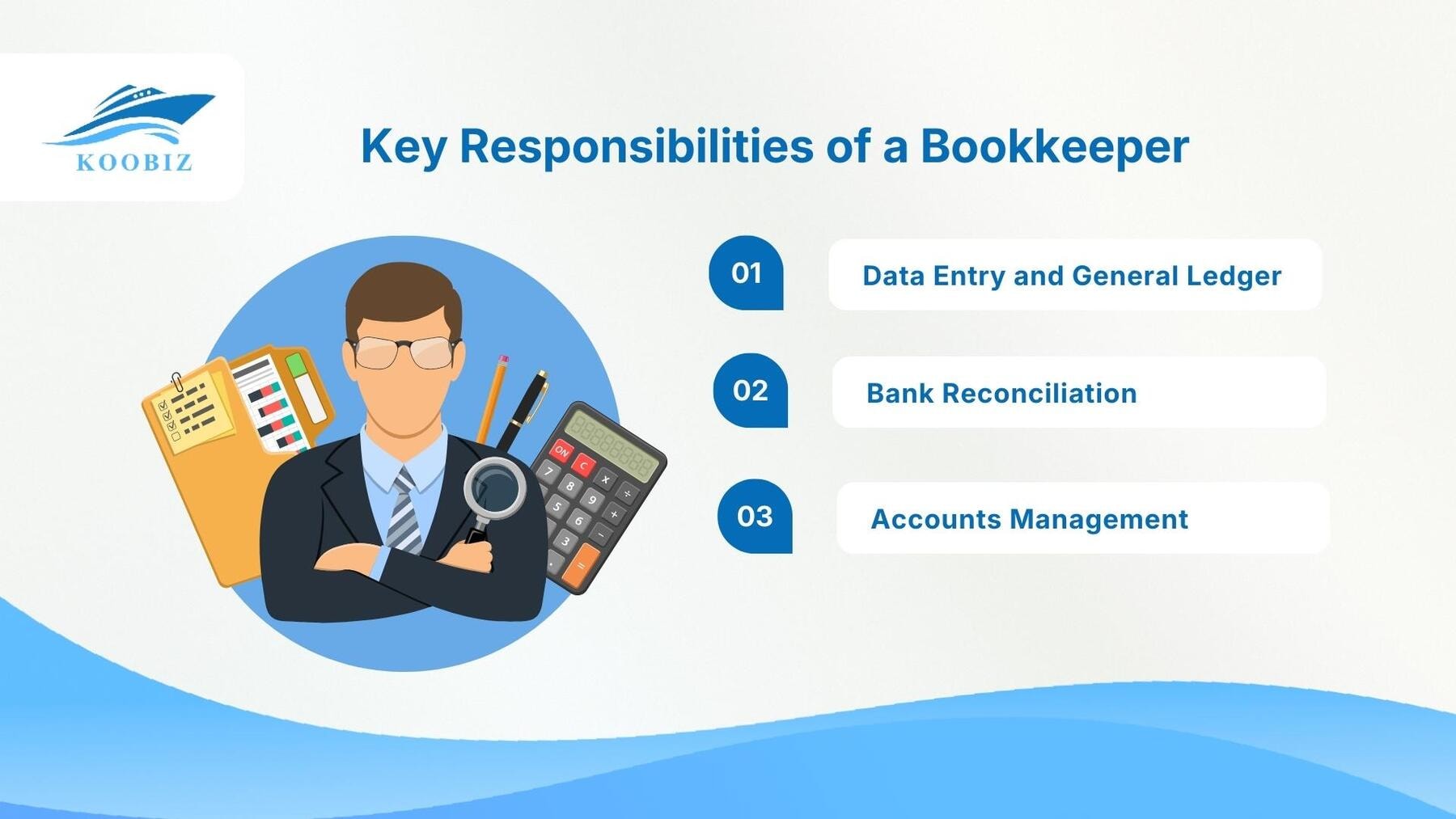
A professional bookkeeper handles three core categories of responsibilities: data entry, reconciliation, and accounts management.
These tasks ensure the accuracy and integrity of financial data before it reaches an accountant.
- Data Entry and General Ledger: Daily sales and expenses will be recorded in the General Ledger. This includes verifying source documents like receipts and invoices to ensure they are valid business expenses.
- Bank Reconciliation: Comparison between the company’s internal records with the bank statement to ensure they match. It identifies discrepancies, missing entries, or potential fraud.
- Accounts Management: Management of Accounts Receivable (tracking who owes the business money and sending invoices) and Accounts Payable (tracking what the business owes to suppliers and ensuring timely payments).
Bookkeeping vs. Accounting: What Is the Difference?
Bookkeeping excels at accumulating accurate data, while accounting focuses on analyzing that data for strategic decision-making and tax planning.
They have both distinctive and interdependent functions within the financial cycle. Bookkeeping is objective and administrative; it focuses on the “what” and “when” of transactions. In contrast, accounting is subjective and analytical; it focuses on the “why” and “how” the business is performing.
The table below outlines the key differences between the two roles:
| Feature | Bookkeeping | Accounting |
|---|---|---|
| Primary Goal | Recording financial transactions faithfully. | Analyzing financial data for growth & compliance. |
| Nature of Work | Administrative & Objective (Data Entry). | Analytical & Subjective (Strategy). |
| Focus | The “What” and “When” (Daily records). | The “Why” and “How” (Business health). |
| Key Output | General Ledger, Trial Balance. | Financial Statements (P&L), Tax Returns. |
| Frequency | Daily or Weekly. | Monthly, Quarterly, or Annually. |
| Tools Used | Cloud Bookkeeping programs (Data Input). | Financial models, Tax software (Analysis). |
Case Study: Bookkeeping vs. Accounting in Action
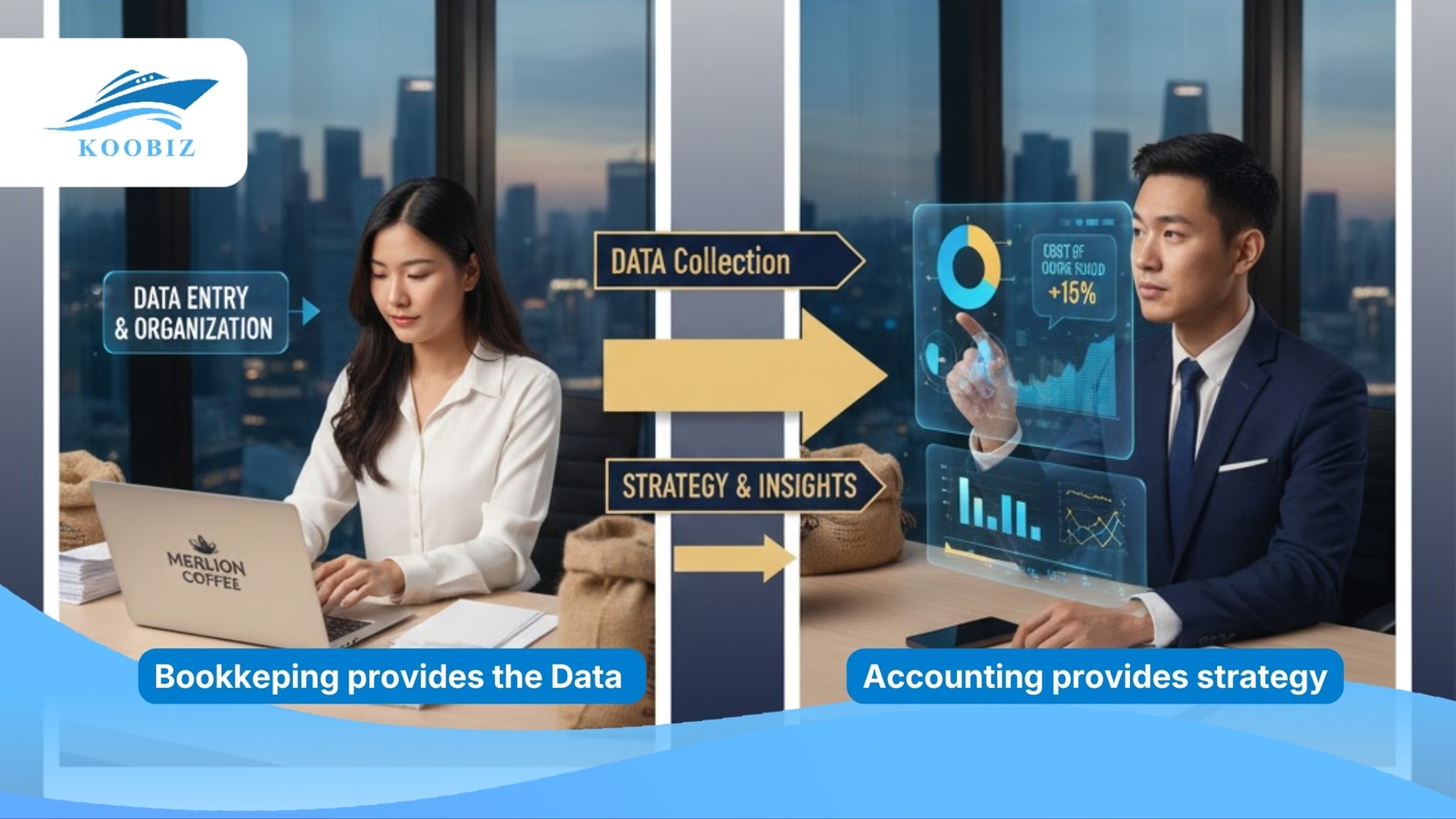
To clearly illustrate the distinction in the case of a fictional Singapore cafe, “Merlion Coffee.”
- The Scenario: The cafe purchases $1,000 worth of premium coffee beans from a supplier.
- The Bookkeeper’s Role: They record the transaction date, vendor, and amount ($1,000) into the accounting software . They categorize the expense under “Cost of Goods Sold” and file the digital invoice for future reference. Their job is done once the data is accurately captured.
- The Accountant’s Role: At the end of the quarter, the accountant reviews the reports generated from the bookkeeper’s data. They notice that the “Cost of Goods Sold” has increased by 15% compared to the previous quarter. The accountant then advises the cafe owner to either renegotiate prices with the supplier or adjust the menu pricing to maintain profit margins.
This demonstrates how bookkeeping provides the necessary data, while accounting provides the strategy based on that data.
Is Bookkeeping Mandatory for Singapore Companies?
Yes, bookkeeping is mandatory for all Singapore companies under the Singapore Companies Act to ensure transparency and accurate tax assessment according to ACRA (Accounting and Corporate Regulatory Authority) regulations.
The law requires companies to maintain “proper books of accounts” that sufficiently explain the transactions and financial position of the company.
- Record Retention: According to IRAS and ACRA regulations, companies must retain all financial records and source documents for at least 5 years. You can refer to the official IRAS Record Keeping Guide for specific requirements.
- Proper Accounts: Failure to keep proper records can result in penalties, fines, or even disqualification of directors. These records are crucial when IRAS conducts a tax audit.
What Are the Different Methods of Bookkeeping?
There are two primary methods of bookkeeping: the Single-entry system for simple businesses and the Double-entry system for corporations.
Single-entry vs. Double-entry System
- Single-entry System: This is similar to a checkbook register. It is simple but does not track assets or liabilities effectively, making it suitable only for very small sole proprietorships.
- Double-entry System: This is the standard for Pte Ltd companies in Singapore. Every transaction affects at least two accounts (a debit and a credit), satisfying the accounting equation: Assets = Liabilities + Equity. This method provides a self-balancing mechanism that reduces errors and detects fraud.
Manual vs. Cloud Bookkeeping Software: Which Is Better?
Cloud software outperforms manual methods through superior automation, accessibility, and security.
In the modern Singapore business landscape, cloud accounting software allows for direct bank feeds, automated invoice chasing, and real-time visibility.
- Automation: Cloud software can automatically categorize transactions and scan receipts via OCR technology.
- Compliance: Most localized software is updated with the latest Singapore GST and tax rates, reducing compliance risk.
How Does Bookkeeping Affect GST and Tax Filing?
Accurate bookkeeping ensures precise Input and Output tax calculations, preventing costly penalties during quarterly GST filing.
- ECI Filing: Bookkeeping records allow for the estimation of the company’s taxable income. This is required for filing the Estimated Chargeable Income (ECI) within 3 months of the financial year-end.
- Audit Trail: Without clear bookkeeping, claiming tax deductions or GST refunds becomes impossible as there is no valid audit trail for IRAS to verify.
Common Bookkeeping Mistakes Singapore SMEs Make
Common errors include mixing up between personal and business funds, losing physical receipts, and failing to reconcile accounts monthly.
- Commingling Funds: Using a business account for personal expenses violates the separate legal entity concept of a Pte Ltd company.
- Irregular Reconciliation: Waiting until the end of the year to reconcile bank statements often leads to forgotten transactions and unfixable errors.
When Should You Outsource Bookkeeping Services?
You should outsource when transaction volume exceeds your internal capacity or when you lack the technical knowledge of Singapore’s evolving tax laws.
For many SMEs, hiring a full-time in-house accountant is too expensive. Outsourcing to a Corporate Service Provider (CSP) offers a cost-effective solution. You gain access to a team of experts who ensure your financial records are compliant under the Singapore Law , allowing you to focus on growing your business rather than stressing over data entry.
About Koobiz
Koobiz is your trusted partner for navigating the Singapore business landscape. We specialize in comprehensive corporate services, including Company Incorporation, Bank Account Opening, Tax, Accounting, and Auditing. Our team ensures your bookkeeping is not just a compliance task, but a strategic asset.
-
- Visit us: koobiz.com