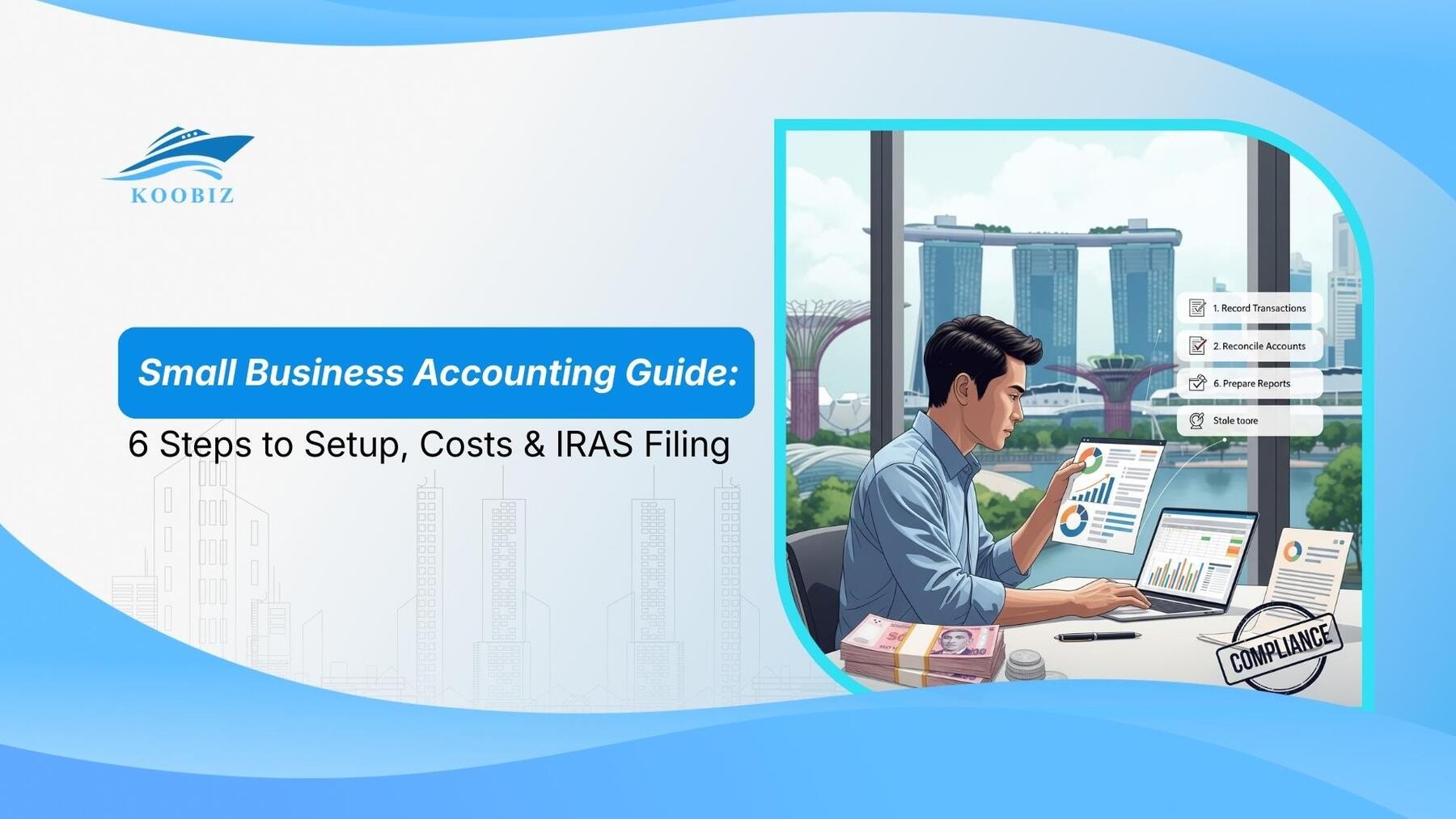


Many Singapore entrepreneurs confuse Accounting vs. Bookkeeping, yet the distinction is vital: bookkeeping records history (Data Entry), while accounting plans your future (Financial Strategy). Correctly managing both ensures accurate ledgers and full compliance with ACRA and IRAS. At Koobiz, we help SMEs master these roles for long-term stability. This guide breaks down the key differences, salaries, and compliance impacts to help you make informed business decisions.
What is Bookkeeping?
Bookkeeping is the systematic recording and organization of daily financial transactions, serving as the essential “Data Entry” phase of the business cycle.
Ideally, this foundational work ensures that every dollar entering or leaving the company is accounted for accurately. It is administrative and transactional in nature, acting as the bedrock of business data. Without this accuracy, a company lacks a reliable history of its operations, making future analysis impossible.
What is Accounting?
Accounting is the analysis, summarization, and interpretation of financial data, representing the “Financial Strategy” phase that aids in decision-making and regulatory compliance.
Once the data is recorded by bookkeepers, accounting transforms it into financial statements, tax returns, and actionable business insights. This function is advisory and analytical, focusing on the “why” and “how” behind the numbers. Accounting takes the raw inputs to ensure the business meets ACRA standards, optimizes its tax position with IRAS, and assesses overall financial health for future growth.
Key Differences Between Accounting and Bookkeeping
Both are crucial for financial integrity, their operational differences become clearer when we compare their nature, scope, and ultimate goals. The “Records to Strategy” concept illustrates this shift perfectly. Bookkeeping is objective; 100 SGD spent on office supplies is a fact that must be recorded. Accounting is often subjective and analytical; it asks why 100 SGD was spent, whether it is tax-deductible under Singapore law, and how it affects the company’s bottom line.
| Aspect | Bookkeeping (Data Entry) | Accounting (Financial Strategy) |
|---|---|---|
| Nature | Administrative & Transactional | Advisory & Analytical |
| Scope | Focuses on details (Receipts, Invoices, Ledgers) | Focuses on the big picture (P&L, Balance Sheets) |
| Goal | Balanced Books & Accuracy | Tax Optimization, Profitability & Growth |
Clients at Koobiz often realize that while they can perform basic bookkeeping themselves, the strategic oversight of accounting requires professional expertise.
Professional Comparison: Education, Salary & Career Outlook
Beyond the daily tasks, the educational background, required credentials, and career trajectories for bookkeepers and accountants in Singapore differ significantly.Understanding these professional differences helps business owners gauge the level of expertise they are paying for.
| Feature | Bookkeeper | Accountant |
|---|---|---|
| Education | Diploma (Polytechnic), LCCI (Level 1-3), or CAT (Certified Accounting Technician). | Bachelor’s Degree in Accountancy or Professional Qualification (ACCA). |
| Credentials | No mandatory license to practice basic bookkeeping. | CA (Singapore) via ISCA, CPA, or ACCA Member. Often required for signing off audits. |
| Key Skills | Attention to detail, data entry speed, organization, software proficiency. | Financial analysis, tax law (SFRS), strategic planning, critical thinking. |
| Avg. Salary (SG) | S$2,800 – S$4,500 per month (Entry to Senior level). | S$4,500 – S$8,500+ per month (Associate to Manager level). |
Note: Salaries are estimated based on Singapore market standards (2024/2025) and vary by industry.
Roles and Responsibilities of Bookkeepers vs. Accountants
To ensure your business runs smoothly and remains compliant with Singapore regulations, it is essential to assign the right tasks to the right professionals. Mixing these roles can lead to inefficiencies or compliance errors.
Bookkeeper Roles
- Invoicing & Billing: issuing invoices to clients and recording payments received.
- Expense Management: Tracking receipts and categorizing daily expenses.
- Payroll: Calculating employee salaries and CPF contributions.
- Bank Reconciliation: Ensuring the company ledger matches the bank statement.
Accountant Roles
- Financial Reporting: Preparing statutory financial statements for ACRA.
- Tax Planning: optimizing corporate tax positions and filing ECI/Form C-S with IRAS.
- Auditing: Reviewing financial systems for accuracy and fraud prevention.
- Advisory: Analyzing costs and revenue to suggest growth strategies.
Do Singapore SMEs Need Both Functions?
Yes, Singapore SMEs need both functions because bookkeeping ensures accurate data foundation for legal compliance, while accounting provides the financial roadmap and strategic oversight necessary for sustainable growth and tax optimization.
Many business owners wonder if they can cut costs by eliminating one, but understanding the chain of value reveals why they are inseparable. If bookkeeping is neglected, the accountant receives inaccurate data , which leads to flawed financial reports and potential penalties from IRAS for incorrect tax filings . Conversely, if a business has perfect bookkeeping but no accounting, they have data but no insight—they know how much money they have, but not how to make it grow.
For Koobiz clients, we emphasize that bookkeeping keeps you out of trouble, while accounting helps you get ahead.
How Accounting and Bookkeeping Impact Singapore Compliance (ACRA & IRAS)
Proper financial management impacts Singapore compliance in three key areas: Annual Return filing with ACRA, Estimated Chargeable Income (ECI) submission, and the accurate preparation of Corporate Income Tax returns for IRAS.
In Singapore, the regulatory framework is strict. ACRA requires companies to maintain proper accounts and records for at least 5 years. Failure to do so can result in fines or disqualification for directors..
- ACRA Compliance: Your bookkeeping feeds directly into the financial statements required for the Annual General Meeting (AGM) and Annual Return (AR).
- IRAS Compliance: Accountants use bookkeeper records to calculate taxable income and file Form C-S/C.
What is the Role of SFRS in Your Accounts?
Singapore Financial Reporting Standards (SFRS) is a set of accounting standards based on IFRS that defines how financial transactions and events should be recognized, measured, and presented in financial statements.
To ensure your financial statements are globally comparable and locally compliant, adherence to SFRS is mandatory for most Singapore companies. While bookkeepers do not need to be experts in SFRS, the data they record must be categorized correctly so that the accountant can apply these standards. For example, how revenue is recognized or how leases are treated under SFRS can significantly impact your reported profit. Koobiz accountants ensure that your transition from raw data to final report strictly adheres to these standards, protecting your company’s reputation.
Can Cloud Software Replace a Human Accountant?
Cloud software like Xero or QuickBooks excels at automating the manual data entry of bookkeeping, but it cannot replace the strategic judgment, tax expertise, and complex problem-solving capabilities of a human accountant.
Software is fantastic for the “Records” part of our title—it automates bank feeds, invoices, and basic categorization. However, for the “Strategy” part, you need a human. Software can tell you that your profit dropped by 10%, but only an accountant can explain why (e.g., pricing strategy vs. cost of goods) and advise on how to fix it within the context of the Singapore market.
When Should You Outsource vs. Hire In-House?
This decision is often a tipping point for growing businesses.
- Outsourcing (The Koobiz Model): You pay a monthly fee for a team that handles everything from bookkeeping to tax. You get continuity (no staff turnover issues) and expert compliance knowledge without paying CPF or office rental for an employee.
- In-House: You have immediate access to a staff member, but you bear the full cost of employment and software licenses. Unless your business requires a bookkeeper on-site to handle physical cash or daily inventory continuously, outsourcing remains the most strategic choice for Singapore SMEs.
Is “Catch-up Bookkeeping” Necessary Before Tax Season?
Yes, “Catch-up Bookkeeping” is absolutely necessary before tax season because IRAS requires tax filings to be based on accurate, reconciled financial records, and filing based on estimates or disorganized data can lead to severe penalties and audits.
Attempting to file taxes without first cleaning up the books is dangerous. Catch-up services involve going back through months (or years) of bank statements to reconstruct the financial history. This ensures that every deductible expense is claimed—saving you tax money—and that every dollar of revenue is reported. For Koobiz’s clients, we often perform catch-up bookkeeping to bring them into compliance before tackling their strategic accounting needs.
With Koobiz
Navigating the regulatory landscape of Singapore doesn’t have to be a solo journey. We specialize in comprehensive corporate services, from Singapore company incorporation and opening corporate bank accounts to ongoing tax, accounting, and auditing support. Bridging the gap between meticulous record-keeping and high-level financial strategy, ensuring your business is not just compliant, but competitive.
Visit koobiz.com today to streamline your financial operations.