


Incorporating a company does not automatically protect your brand name, a common misconception we often see at Koobiz. To legally protect your brand and prevent misuse, you must register a trademark with the Intellectual Property Office of Singapore (IPOS). This guide explains how to register a trademark in Singapore, including the 5-step registration process, expected costs, timelines, and options for international trademark protection.
What Is a Trademark in Singapore? (IPOS Definition)
In Singapore, a trademark is a “sign” used in the course of trade to distinguish your goods or services from those of other traders. It may consist of a letter, word, name, signature, numeral, logo, label, shape, colour, aspect of packaging, or any combination of these elements.
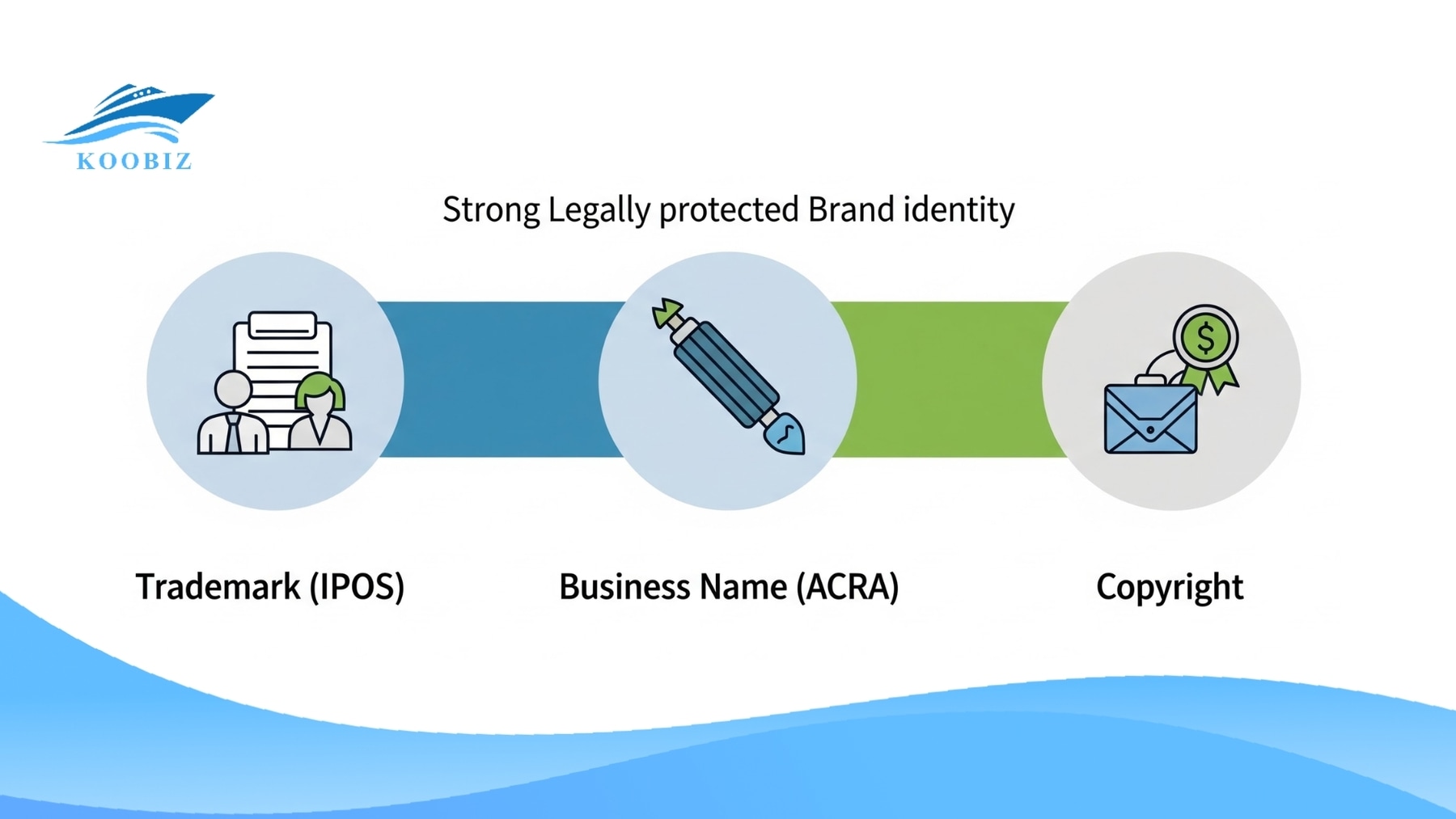
To better understand the value of a trademark, it is helpful to compare it with other common business identifiers used in Singapore.
| Feature | Business Name (ACRA) | Trademark (IPOS) | Copyright |
|---|---|---|---|
| Primary Purpose | Identifies the brand of goods or services to distinguish them from competitors. | Identifies the brand of goods/services to distinguish from competitors. | Protects original creative works (art, literature, code). |
| Registration Authority | Accounting & Corporate Regulatory Authority (ACRA). | Intellectual Property Office of Singapore (IPOS). | No formal registration required (automatic protection upon creation). |
| Protection Scope | Prevents others from registering the exact same company name. | Prevents others from using identical or confusingly similar marks in the same or related industries. | Prevents unauthorized copying of the work. |
Common Misconception: Business Name (ACRA) vs. Trademark (IPOS)
As we regularly advise our clients at Koobiz, registering your business name with ACRA does NOT give you ownership of the brand.
- ACRA Registration: Allows you to legally operate under the name “Koobiz Pte Ltd”.
- IPOS Registration: Gives you the legal right to stop others from using the brand “Koobiz” on similar goods or services.
Without a trademark, you have limited recourse if a competitor copies your brand name.
Is Your Trademark Eligible for Registration in Singapore?
A trademark may be eligible for registration in Singapore if it meets the requirement of distinctiveness and does not conflict with existing registered marks.
However, not every brand name or logo can be registered as a trademark. To be accepted by IPOS, your mark must pass the “distinctiveness” test.
A mark that is purely descriptive or generic will be rejected.
Use this “Dos and Don’ts” table to quickly assess your brand name:
| Eligible (Strong Marks) | Not Eligible (Weak Marks) |
|---|---|
| Invented Words: Unique names with no prior meaning.
(e.g., “Kodak”, “Xerox”) |
Descriptive Terms: Words describing the product’s quality, quantity, or function.
(e.g., “Super Fast” for delivery, “Best Apple” for fruit) |
| Arbitrary Words: Common words used in an unrelated context.
(e.g., “Apple” for computers, “Shell” for petrol) |
Generic Terms: Common names for the product itself.
(e.g., “Computer” for selling laptops, “Cafe” for a coffee shop) |
| Unique Logos: Stylized graphics designed specifically for the brand. | Deceptive Marks: Marks that mislead consumers about the nature of the goods.
(e.g., “Organic” for 100% synthetic products) |
In addition, the mark must not be identical or confusingly similar to an existing registered trademark. This is why the preliminary search step is critical.
Real-World Trademark Case Studies in Singapore: Success vs. Failure
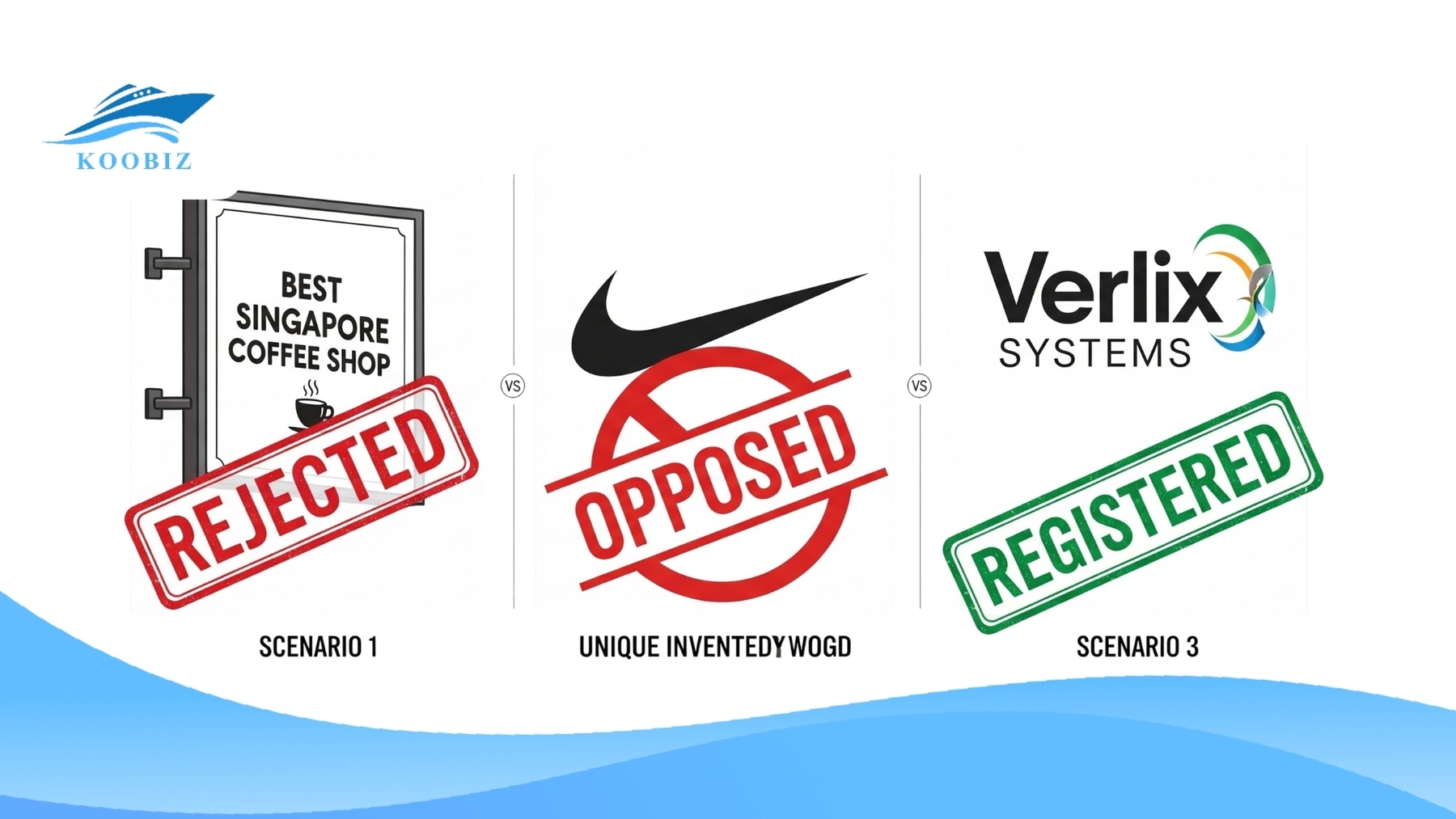
To illustrate the legal concepts above, let’s examine three hypothetical scenarios commonly seen in the Singapore market. These examples illustrate why applications pass or fail during the IPOS examination.
Case Study 1: The “Descriptive” Trap (Failure)
- Business: A new cafe opening in Bugis.
- Proposed Mark: “Best Singapore Coffee Shop”.
- Outcome: Rejected by IPOS.
- Why? The name is purely descriptive of the goods (“Coffee Shop”), the location (“Singapore”), and the quality (“Best”). If IPOS granted this, it would unfairly stop other cafes in Singapore from using these common words to describe their business.
- Lesson: Avoid names that merely describe what you sell.
Case Study 2: The “Look-Alike” Problem (Conflict)
- Business: A sportswear retailer.
- Proposed Mark: “Adidazz” (used together with a three-stripe logo).
- Outcome: Opposed by Adidas and likely rejected.
- Why? Although the spelling is different, the mark is phonetically similar and visually confusing when compared to a well-known existing brand. This falls under “Relative Grounds for Refusal.”
- Lesson: A “Priority Search” (Step 1 below) would have revealed this conflict, saving the business the application fee.
Case Study 3: The “Invented Word” Strategy (Success)
- Business: A software consulting firm, similar to many technology clients served by Koobiz.
- Proposed Mark: “Verlix Systems”.
- Outcome: Registered Successfully.
- Why? “Verlix” is an invented word with no dictionary meaning. It is highly distinctive, does not describe the software, and does not clash with existing marks.
- Lesson: Creating a unique, made-up name is the safest and fastest route to registration.
5 Steps to Register a Trademark in Singapore
The trademark registration process consists of five sequential steps mandated by IPOS to ensure legal clarity and fairness.
Below is an overview of the key actions involved and the estimated timeline for each step:
| Step | Action Required | Estimated Timeline |
|---|---|---|
| 1. Search | Check IPOS database for conflicting marks | 1 Day |
| 2. Classify | Select goods/services category (Nice Class) | 1 Day |
| 3. File | Submit Form TM4 & pay fees via SingPass | ~1 Hour |
| 4. Process | IPOS Examination & Public Journal Publication | 4-6 Months |
| 5. Result | Issuance of Registration Certificate | Total estimated timeline: 9–12 months |
Navigating the IPOS trademark system can be challenging for first-time applicants. Below is a detailed breakdown of the procedure to help you secure your intellectual property rights efficiently.
Step 1: Conduct a Priority Search
Before filing, you must determine if a similar mark already exists. You can do this via the IPOS Digital Hub. This step is non-negotiable; filing an application for a mark that conflicts with an existing one will result in rejection and the forfeiture of your application fees. A thorough search should cover similar phonetics and visual elements, not just identical spellings.
Step 2: Classify Your Goods/Services
You must categorize your goods or services according to the International Classification of Goods and Services (Nice Classification). There are 45 classes in total (Classes 1-34 for goods, Classes 35-45 for services). For instance, if you are a Koobiz client running a coffee shop that also sells branded t-shirts, you might need to register under Class 43 (Food and Drink Services) and Class 25 (Clothing). Correct classification is vital because your trademark is only protected within the classes you register.
Step 3: File the Application (Form TM4)
Once searched and classified, submit your application online via the IPOS Digital Hub using Form TM4. You will need a SingPass account to access the portal. The application requires:
- Your personal/company details.
- A clear graphical representation of the mark.
- The list of goods/services and designated classes.
- Payment of the application fee.
Step 4: Examination & Publication
After filing, IPOS examiners will review your application to ensure it meets legal requirements. If there are no objections (or if you resolve them), your trademark will be published in the Trade Marks Journal for two months. During this period, third parties (e.g., competitors) can oppose your registration if they believe it infringes on their rights.
Step 5: Registration Certificate
If there is no opposition after the two-month publication period, IPOS will issue a Certificate of Registration. Once registered, your trademark is protected for 10 years from the date of application.
How Much Does It Cost to Register a Trademark in Singapore?
There are two main categories of costs involved: the official government fees and potential professional service fees.
Understanding these costs is essential for proper budgeting. The fees payable to IPOS depend on whether you file online via the IPOS Digital Hub and whether you select items from the pre-approved database.
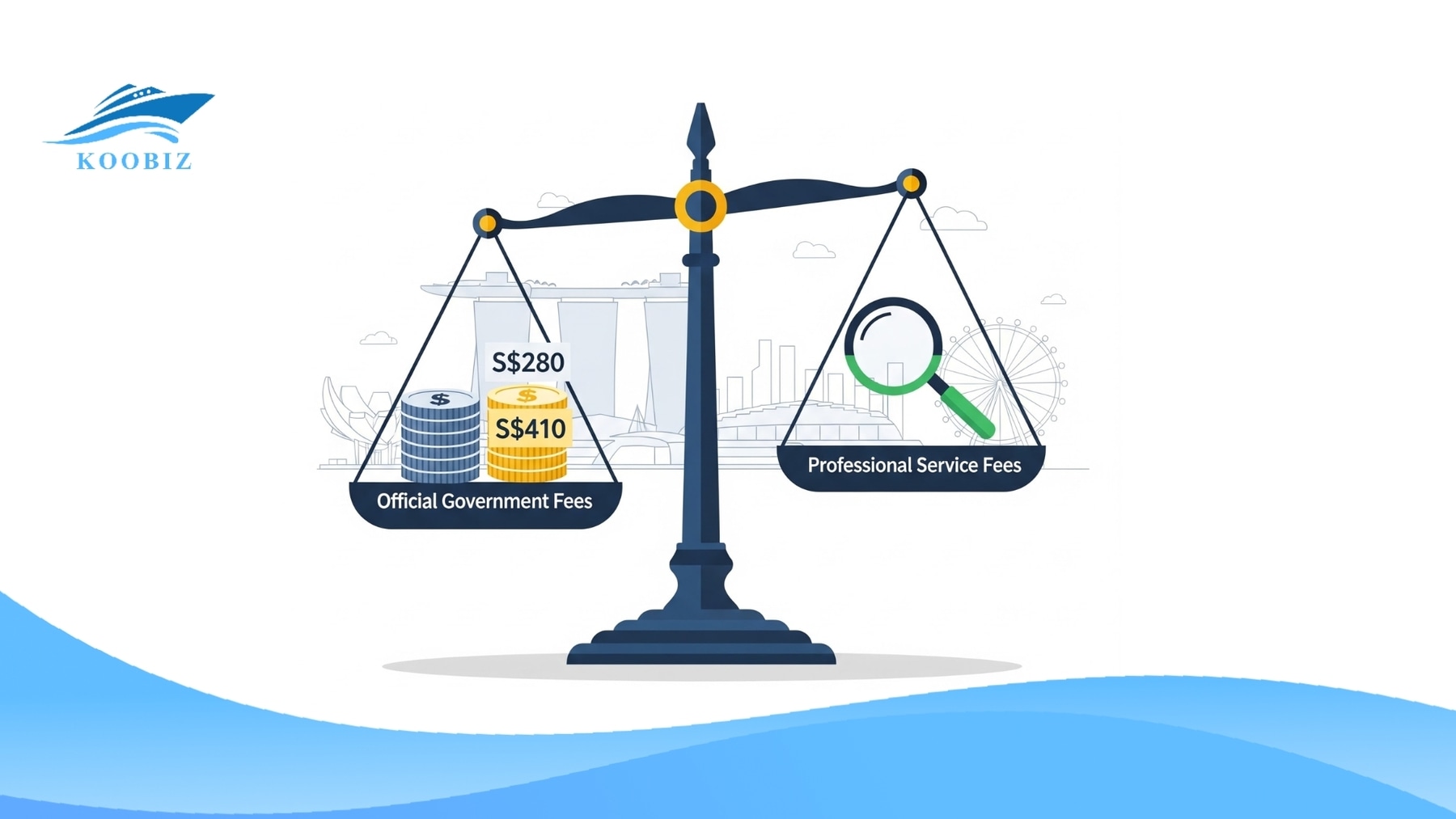
1. Official Government Fees (Payable to IPOS)
Fees are subject to change. Always refer to the IPOS Digital Hub for the latest rates.
| Filing Method | Condition | Fee (per class) |
|---|---|---|
| Online (IPOS Digital Hub) | Description selected from pre-approved database | S$280 |
| Online (IPOS Digital Hub) | Description entered manually (non-standard) | S$410 |
Note: Manual (paper) filing is no longer encouraged, as IPOS has largely shifted to digital services.
2. Professional Service Fees (Optional but Recommended)
While you can file yourself to save money, it comes with risks.
- Government fees are non-refundable. If your application is rejected due to incorrect classification or an undiscovered conflict, you lose the S$280+ immediately.
- Correction costs can also arise, as fixing errors after submission often costs more than getting it right the first time.
Koobiz Insight: Many businesses attempt DIY filing to reduce upfront costs, only to discover their application is rejected several months later. IPOS strongly encourages using their pre-approved database to minimize objections. Engaging a professional helps ensure your trademark search is thorough and your classifications are accurate, protecting your investment.
How Long Is the Trademark Registration Process?
The trademark registration process in Singapore typically takes approximately 9 to 12 months from the application date to the issuance of the certificate.
To help you manage your expectations, here is the estimated timeline for each stage of the process:
| Stage | Estimated Duration | What Happens? |
|---|---|---|
| 1. Examination | 4 – 6 Months | IPOS checks if your mark complies with the Trade Marks Act. |
| 2. Publication | 2 Months (Fixed) | Your mark is published in the Trade Marks Journal for public scrutiny. |
| 3. Certification | 1 – 2 Months | If no opposition arises, the registration certificate is issued. |
| Total | ~ 9 – 12 Months | Assuming a straightforward application. |
The “Bumpy Road” Scenario (18+ Months)
If your application faces an objection (from IPOS examiners regarding distinctiveness) or an opposition (from a competitor), the timeline can extend significantly. This highlights why thorough preparation in the Search and Classification steps is crucial to avoid delays.
Once your trademark is successfully registered and the certificate is issued, the journey does not end there. A trademark is a living asset that requires active management to maintain its validity and value.
Managing Your Trademark in Singapore: Maintenance, Growth & Risk Management
Securing the certificate is just the beginning. To maximise the value of your intellectual property, business owners should focus on three strategic pillars: maintenance, growth, and risk management.
Neglecting these post-registration duties can lead to the loss of your rights or missed opportunities for expansion.
Pillar 1: Maintenance – Renewing Your Rights
A Singapore trademark is valid for 10 years from the date of filing. It is not a “register once, keep forever” asset and requires active maintenance.
- The Process: You can renew your mark indefinitely for subsequent periods of 10 years.
- The Fees (Updated 2026):
- On-time Renewal: S$480 per class (filed within 6 months before expiry).
- Late Renewal: S$700 per class (filed within 6 months after expiry).
- Restoration: S$770 per class (after the grace period; approval is not guaranteed).
- Critical Deadline: Always mark your calendar for the 10-year mark to avoid hefty penalty fees.
Pillar 2: Growth – Expanding Globally (Madrid Protocol)
Your Singapore trademark is territorial—it only protects you within Singapore. If your business plans to export or expand, you need a global strategy.
- The Solution: Singapore is a member of the Madrid Protocol, managed by WIPO.
- The Benefit: Instead of filing separate applications in each country (which is costly and administratively complex), you can file a single international application via IPOS.
- The Cost:
- IPOS Handling Fee: S$250.
- WIPO Fees: Variable (payable in Swiss francs), depending on the countries designated.
- The Reach: This allows you to designate protection in over 130 countries (including the US, EU, China, Australia, and Vietnam) based on your Singapore registration.
Note: In practice, international trademark filings are often coordinated alongside regional expansion to ensure brands enter new markets with adequate protection.
Pillar 3: Risk Management – Handling Rejections & Oppositions
Even with a registered mark, you may face challenges. Understanding common pitfalls helps you mitigate risks early.
1. Dealing with Rejections (Objections) If IPOS examiners refuse your application, it is usually due to:
- Descriptiveness: Trying to trademark generic terms like “Super Fast Delivery”.
- Deceptiveness: Using a mark that implies a quality the product doesn’t have (e.g., “Organic” for synthetic goods).
- Similarity: Clashing with an existing mark on the register.
2. Dealing with Oppositions Opposition occurs during the 2-month publication stage when a third party (usually a competitor) formally objects.
- Why it happens: They believe your mark is too similar to theirs and will cause market confusion.
- What to do: Opposition proceedings are formal legal processes. You must file a Counter-Statement to defend your rights. This requires professional legal assistance.
Conclusion
Registering a trademark in Singapore is a strategic step that transforms your brand from a mere logo into a legally protected asset. By following the 5-step process—Search, Classify, File, Examine, and Register—you ensure that the goodwill you build belongs exclusively to you.
At Koobiz, we understand that building a business involves many moving parts, from Singapore company incorporation and corporate banking to ongoing tax and accounting compliance. While you focus on growing your business and brand value, let us handle the foundational corporate services to ensure your entity is compliant and ready for success.
Visit Koobiz.com today to learn how we can support your business journey in Singapore.