


Navigating Singapore’s administrative compliance landscape necessitates a clear distinction between statutory certification and notarial acts. Whether you are a foreigner setting up a company with Koobiz, opening a corporate bank account, or applying for a work visa, understanding how to correctly certify documents is not just a formality—it is a critical compliance requirement. Failure to choose the right verification method can lead to rejected applications, delayed business operations, and wasted fees. This guide will clarify the definitions, outline the specific authorities involved, and provide a clear roadmap for securing your documents in Singapore.
What is a Certified True Copy (CTC) in Singapore?
A Certified True Copy (CTC) is a duly attested reproduction of a primary document, validated by a qualified professional. This form of certification is primarily utilized for intra-jurisdictional compliance within Singapore, including submissions to ACRA and local financial institutions.

To fully grasp the scope of a CTC, here are its specific attributes and legal standing:
- Operational Efficiency: It facilitates administrative processing while ensuring the security of the original primary documents.
- Professional Liability: When a professional, such as a lawyer or a company secretary from Koobiz, stamps a document, they are essentially staking their professional license on the fact that they have sighted the original and that the copy has not been altered in any way.
- Statutory Validity and Recency Requirements: The validity is typically tied to the requirements of the requesting agency. For example, banks often require CTCs of incorporation documents to be dated within the last 3 to 6 months to ensure the company structure hasn’t changed.
- Required Elements: According to standard legal practices, a CTC must include the clear name of the certifier, their designation, the date of certification, and their signature. Without these elements, the document is technically incomplete and likely to be rejected.
Structural Comparison: Local Compliance vs. International Recognition
Certified True Copy is the optimal choice for local Singaporean administrative use, whereas Notarisation is the statutory requirement for extra-jurisdictional legal recognition.While CTCs focus on the accuracy of the reproduction, Notarisation verifies the authenticity of execution and the legal capacity of the signatories.
However, knowing the difference is only half the battle; evaluating the procedural intricacies and cost-benefit implications is essential for effective corporate planning.
This distinction is the most common point of confusion for our clients at Koobiz. The table below breaks down the critical differences to help you choose the right service:
| Feature | Certified True Copy (CTC) | Notarisation |
|---|---|---|
| Legal Recognition & Scope | Local (Singapore). Suitable for IRAS, local banks (DBS/OCBC), and Singapore government agencies. | International (Overseas). Mandatory for foreign subsidiaries, buying property abroad, or foreign court submissions. |
| The Certifier | Authorized Certifiers. Issued by practicing lawyers, Chartered Accountants, and Company Secretaries (like Koobiz). | Exclusive Authority. Must be issued by a Notary Public—a senior lawyer specifically appointed by the Singapore Academy of Law. |
| Cost Implications | Transactional Basis. Typically SGD 10 – SGD 50 per page. Often included in corporate service packages. | Statutory Scale. Typically starts from SGD 40-75 per document + mandatory Notarial Certificate fee + SAL fees (approx. SGD 87.20). |
| Verification Level | Faithful Replication. Attests that the copy is an unaltered replica. | Verification of Execution. Witnessing of signatures and attestation of capacity. |
| International Verification | None. Not recognized outside Singapore. | Apostille or Legalisation. Required for the document to be valid abroad. |
| Processing Time | Fast. Often same-day or instant service. | Longer. 1–3 days (depending on Apostille/Embassy processing). |
For instance, if you are incorporating a Singapore company with Koobiz but residing overseas, your passport copy sent to us usually needs to be notarised in your home country or certified by a professional that Singapore authorities recognize.
Authorized Certifiers: Determining the Competent Authority

There are three main categories of professionals authorized to issue Certified True Copies in Singapore: Lawyers/Advocates, Notaries Public, and registered professionals like Chartered Accountants or Company Secretaries. The selection of a certifier is governed by the compliance mandate of the recipient institution.
Selecting the right professional is crucial to ensure your document is accepted on the first try.
Practicing Advocates & Solicitors: Domestic Certification Experts
Practicing lawyers in Singapore are the most common providers of CTC services. They have the authority to certify documents for use within the Singapore legal system and for most local administrative matters. If you walk into a standard law firm, any advocate and solicitor with a valid practicing certificate can perform this service. They are the standard certifiers for statutory identity verification in local transactions.
Notary Public: The Competent Authority for International Attestation
As mentioned, a Notary Public is a senior lawyer with at least 15 years of experience, specifically appointed to notarise documents for use outside Singapore. While they can issue a simple Certified True Copy for local use, this may result in unnecessary cost escalation for simple domestic filings.
Corporate Professionals: Gatekeepers of Statutory Compliance
For corporate compliance, Company Secretaries play a pivotal role in maintaining corporate governance integrity. Under Singapore law, Company Secretaries (like the team at Koobiz) are authorized to certify corporate documents such as the Memorandum & Articles of Association (M&A), BizFiles (Business Profiles), and Directors’ Resolutions.
Note: While they are excellent for business documents, Company Secretaries limitations exist regarding non-corporate instruments, such as personal identity verification for external use, unless they are specifically authorized to issue statutory certifications for core corporate instruments.
How to Get a Certified True Copy in Singapore?
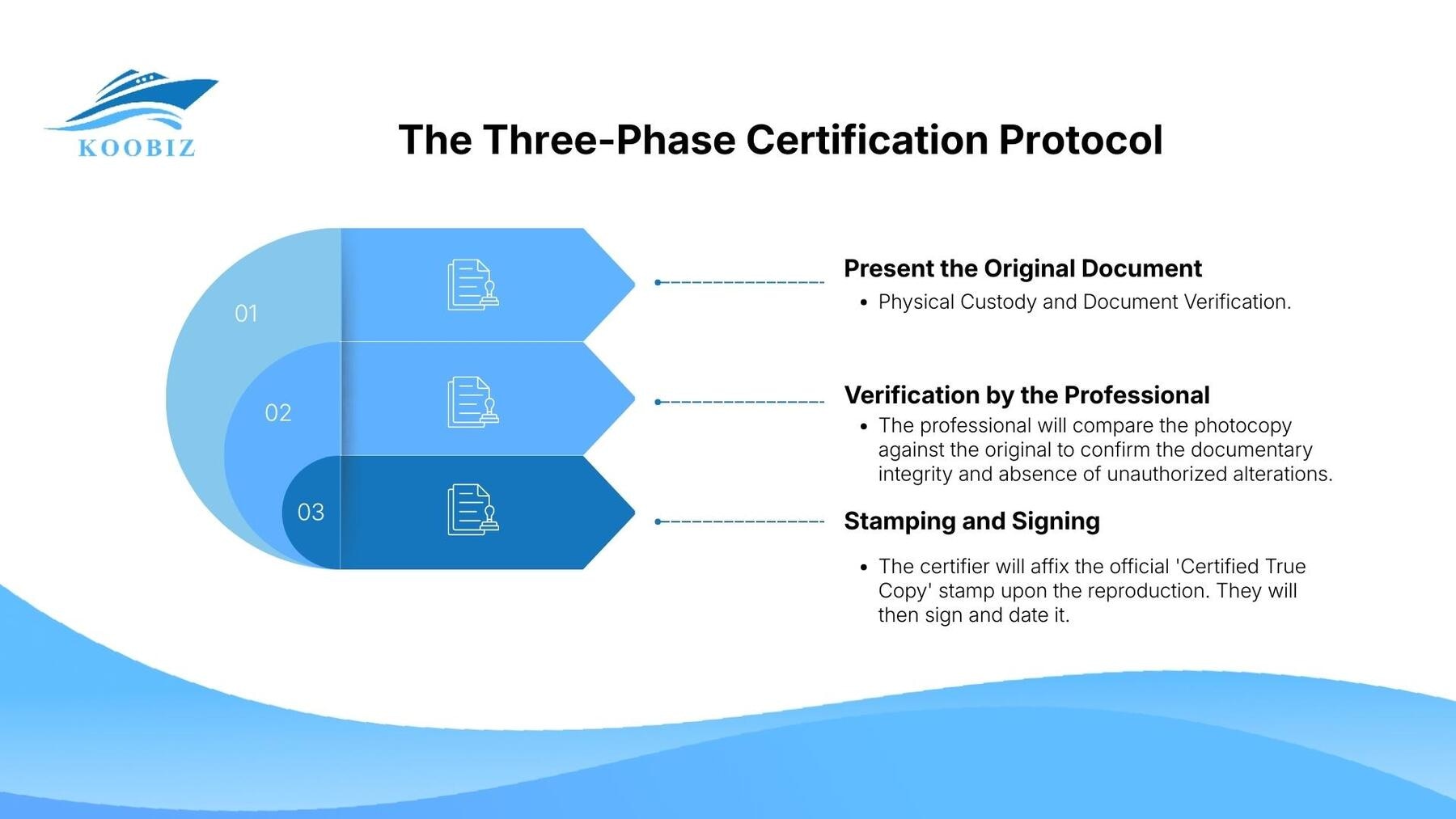
Procedural Roadmap: The Three-Phase Certification Protocol. This involves verifying the original document, engaging the appropriate professional, and applying the official stamp and signature. This standardized procedure ensures the preservation of the evidentiary chain and mitigates fraudulent risks.
Once you understand the workflow, obtaining a CTC becomes a quick and straightforward task.
Step 1: Present the Original Document
Physical Custody and Document Verification: A lawyer or company secretary cannot legally certify a copy if they have not seen the original. For digital-first documents (like ACRA BizFiles), the corporate secretary who generated them can certify them directly leveraging their role as authorized digital custodians of the primary corporate record.
Step 2: Verification by the Professional
The professional will compare the photocopy against the original to confirm the documentary integrity and absence of unauthorized alterations. At Koobiz, when we assist clients with bank account openings, this step is rigorous to prevent compliance issues with financial institutions.
Step 3: Stamping and Signing
The certifier will affix the official ‘Certified True Copy’ stamp upon the reproduction. They will then sign and date it. Crucially, they should also include their professional stamp (e.g., “Advocate & Solicitor” or “Company Secretary”) and contact details. This ensures accountability and facilitates due diligence by the receiving institution.
Do You Need a Certified True Copy or Notarisation?
Strategic Selection: Jurisdictional Requirements and Recipient Compliance While both methods verify documents, they serve different legal jurisdictions and cannot always be substituted for one another.
For extra-jurisdictional applications, the process transitions from mere certification to formal legalization.
Scenario A: Domestic Compliance (Intra-Jurisdictional Use)
If you are applying for a Permanent Residency (PR) with the ICA, applying for a grant with Enterprise Singapore, or opening a local DBS corporate account, a Certified True Copy is usually sufficient. In fact, for many government transactions, bringing the original to the counter for the officer to inspect is the free alternative to a CTC.
Scenario B: International Recognition (Cross-Border Legalization)
If you are setting up a branch office in Indonesia, buying land in Australia, or managing inheritance in the UK using Singapore documents, you almost certainly need Notarisation. Foreign courts do not recognize a standard Singapore lawyer’s signature.
Navigating Global Standards – The Apostille vs. Legalisation Framework.
- Hague Countries (e.g., UK, USA, Australia, China): Facilitates expedited authentication through a unified statutory certificate.
- Non-Hague Countries (e.g., Vietnam, Thailand, UAE): Requires Consular Legalisation, a multi-tiered validation by the recipient’s diplomatic mission.
We have established the fundamentals of Certified True Copies for local use and the basic distinction of Notarisation for international use. However, for documents traveling overseas, necessitates a transition to multi-agency validation involving the Singapore Academy of Law (SAL). This involves the Singapore Academy of Law (SAL), the Apostille Convention, and handling modern digital formats.
Strategic Global Authentication – Navigating the Apostille & Legalisation Framework
The path your document takes depends entirely on whether the destination country is a member of this convention.
Understanding the role of the SAL is critical for this advanced stage of document processing.
1. For Hague Convention Countries (The “Apostille” Route)
If your document is going to a member country (like the USA, UK, India, or China), the process is simplified.
- Step 1: Notarisation by a Notary Public.
- Step 2: The Notary submits the certificate to the Singapore Academy of Law (SAL).
- Step 3: SAL issues an Apostille Certificate.
Result: Achievement of Statutory Validity without further consular intervention.
2. For Non-Hague Countries (The “Chain Legalisation” Route)
If your document is going to a non-member country (like Vietnam, UAE, or Thailand), the traditional chain applies.
- Step 1: Notarisation by a Notary Public.
- Step 2: Authentication by SAL.
- Step 3: Legalisation by the Embassy of the destination country in Singapore.
- Result: Only after the Embassy stamp is the document valid.
Cost Note: The SAL Apostille/Authentication fee is approximately SGD 87.20 (inclusive of GST), payable in addition to the Notary’s fees.
Certified True Copy for Digital Documents (OpenCerts)
Singapore increasingly issues “born-digital” documents, such as OpenCerts for degrees or ACRA Business Profiles. Technically, traditional physical certification is being superseded by cryptographic verification.
- Strategic Insight: Leveraging Blockchain-Based Verification. The recipient can verify it instantly at opencerts.io without any need for stamps, fees, or lawyers.
- Physical Requirement: If a foreign agency insists on a physical stamp, a Notary Public can witness you logging into the official portal (e.g., SingPass), verify the digital record, and certify the printout as a true reflection of the electronic original.
Risk Mitigation: Avoiding Jurisdictional and Procedural Errors
To ensure your process is smooth, avoid these frequent mistakes:
- Self-Certification: You generally cannot certify your own documents or those of family members.
- Wrong Jurisdiction: Don’t use a CTC for overseas matters; it will likely be rejected.
- Skipping Translation: Non-English documents must be translated before notarisation.
- Ignoring Apostille Eligibility: Check if your destination country accepts Apostilles to save time on embassy visits.
Conclusion
Navigating the difference between a Certified True Copy and Notarisation is essential for the smooth operation of your business and personal affairs in Singapore. While a CTC suffices for most local administrative needs, international matters almost always require the enhanced authority of a Notary Public and adherence to the Apostille process.
At Koobiz, we understand that administrative requirements should not impede your strategic focus. Whether you need a simple certification… our experienced team provides comprehensive corporate services to ensure flawless documentation.
Contact Koobiz today to streamline your document certification and compliance needs.