

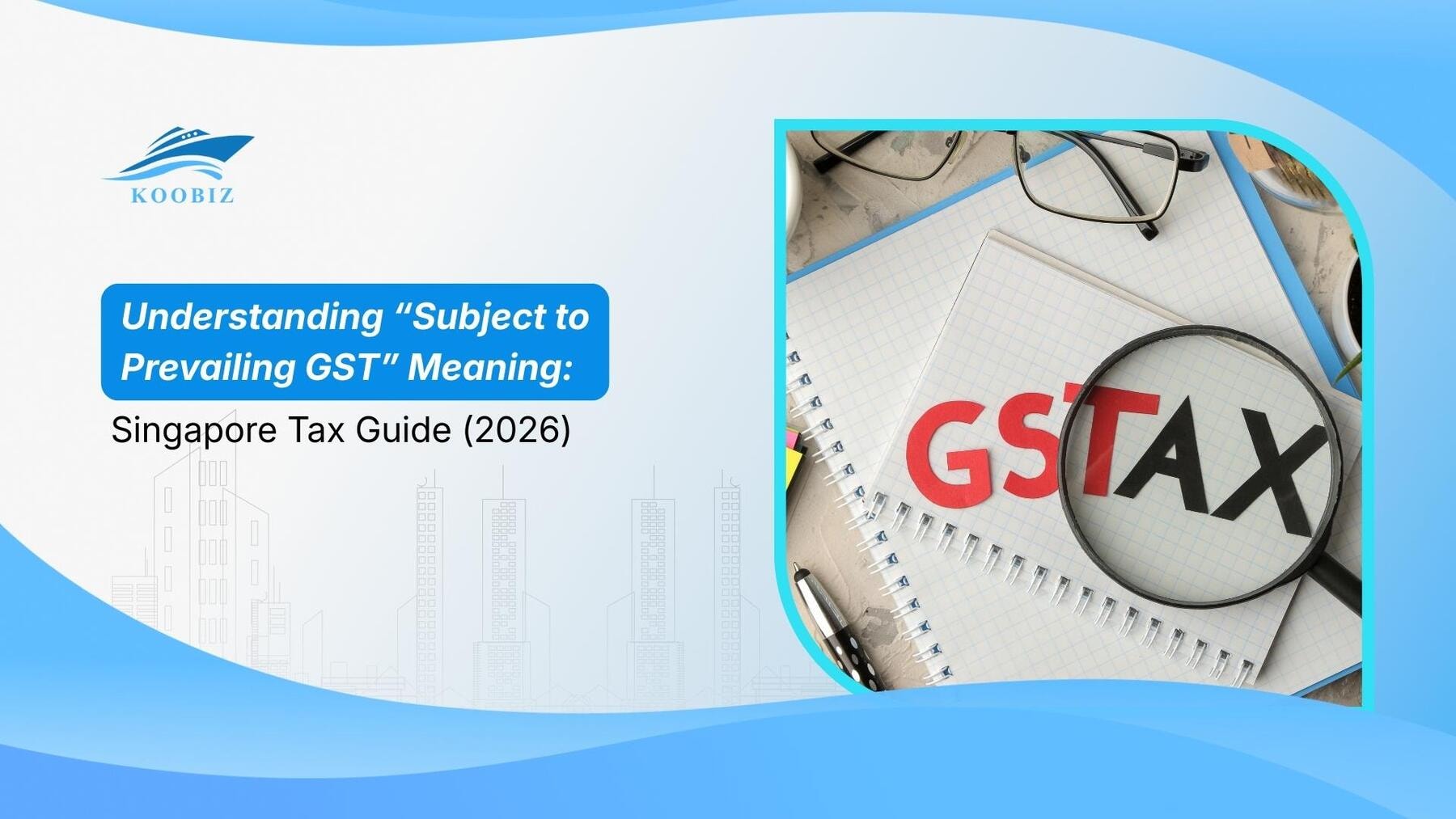
The phrase “subject to prevailing GST” on Singapore invoices or menus simply means the listed price excludes tax, with the current 9% Goods and Services Tax added at payment. Whether you are calculating a “++” restaurant bill or drafting future-proof contracts, understanding this term is key to accurate costing. Koobiz, your trusted partner for Singapore incorporation and tax services, explains its meaning, the stable 2026 rate, and the correct calculation methods.
What Does “Subject to Prevailing GST” Mean?
“Subject to prevailing GST” is a pricing condition defining that the listed cost is exclusive of tax, and the final payable amount will include the Goods and Services Tax rate effective at the specific time of supply.
Key features include: the GST rate applied is the one effective when the transaction is completed or invoiced; the tax liability is determined at payment rather than contract date; and any future GST increase is passed to the buyer, not absorbed by the seller. This pricing model is commonly used by hotels, higher-end restaurants, and professional service providers.
This differs from “nett” pricing-typical in hawker centres and retail – where the displayed price is final. For international entrepreneurs working with Koobiz, understanding this distinction is fundamental to accurate and compliant financial planning in Singapore.
The current GST rate in 2026: Is it still 9%?
Yes, the prevailing GST rate in Singapore remains stable at 9% throughout 2026, maintaining the ceiling established after the final scheduled hike in 2024.
To provide context, here is the timeline of recent and projected GST rate adjustments:
| Period | GST Rate | Status |
|---|---|---|
| Before 2023 | 7% | Historical Rate |
| Jan 1, 2023 | 8% | 1st Stage Increase |
| Jan 1, 2024 | 9% | 2nd Stage Increase |
| 2025 – 2030 | 9% | Current & Stable* |
*Note: Stability is based on current government projections and is subject to economic conditions.
Although “prevailing” suggests variability, the GST rate for 2026 is effectively fixed. Current government guidance indicates no further GST increases are expected before 2030, though policy changes may still arise through future Budgets or major economic developments.
This stability provides a reliable planning baseline and removes the uncertainty seen during the 2023–2024 transition. Nonetheless, invoices and contracts will continue to reference the “prevailing rate” for legal accuracy. For Koobiz clients, our accounting team ensures all invoices correctly apply the 9% GST, keeping you fully compliant with IRAS requirements.
How to calculate the final bill (The “++” Rule)
To calculate the final bill under the “++” (Plus Plus) pricing model, you must first apply the 10% service charge to the base price, and then calculate the 9% GST on that combined total.
Many consumers and even some new business owners make the mistake of calculating the 10% service charge and the 9% GST separately on the base price. This is incorrect. In Singapore’s F&B and hotel sectors, GST is a tax on the value of the service provided, and the service charge is considered part of that value. Therefore, the tax is compounded.
The Breakdown of “++”:
- First “+” (Service Charge): 10% of the menu price.
- Second “+” (GST): 9% of the (Menu Price + Service Charge).
Mathematical Formula:
Final Bill = (Base Price x 1.10) x 1.09
Let’s illustrate this with a concrete example for 2026.
If you order a meal listed at SGD 100++:
- Step 1: Calculate Service Charge: $100 x 10% = $10.
- Subtotal: $110.
- Step 2: Calculate Prevailing GST (9%) on the Subtotal: $110 x 9% = $9.90.
- Final Payable Amount: $100 + $10 + $9.90 = $119.90.
If you simply added 10% and 9% to the base ($19 total), you would calculate a final bill of $119.00, which is short by $0.90. While small on a single meal, for businesses processing thousands of transactions, this calculation error can lead to significant tax filing discrepancies. Koobiz advises all F&B clients to configure their Point-of-Sale (POS) systems to adhere strictly to this compounding logic to satisfy IRAS audit requirements.
“GST Inclusive” vs. “Subject to GST”: Visual Comparison
“GST-inclusive” pricing shows the final amount payable upfront, while “subject to GST” displays a base price that increases at payment. This is not merely a pricing choice but an IRAS-regulated requirement.
In general, retailers such as supermarkets and fashion stores must display GST-inclusive prices, while the “subject to GST” model is permitted mainly in the F&B and hotel sectors where service charges apply.
| Feature | GST Inclusive (Nett) | Subject to Prevailing GST (++) |
|---|---|---|
| Industry | Retail, Hawkers, Transport | Hotels, Restaurants, B2B Services |
| Transparency | High: What you see is what you pay | Low: Final price is higher than listed |
| Psychology | “Honest” pricing | “Optical” pricing (appears cheaper) |
| Calculation | Price includes the 9% tax component | Tax added on top of the price |
For instance, shoes priced at $109 nett generate $100 in revenue, with $9 remitted as GST. By contrast, a $100 fee quoted “subject to GST” results in a total charge of $109 to the client.
This distinction is critical for cash flow management. For Koobiz retail clients, we ensure price displays comply with GST-inclusive rules to avoid consumer protection breaches. For B2B clients, quoting fees “subject to GST” remains the standard approach to safeguard margins.
Why do contracts still use “Prevailing Rate” if the rate is stable?
Businesses retain the “prevailing GST” clause in long-term contracts to future-proof agreements against post-2030 legislative changes without renegotiation. While the rate is stable at 9% in 2026, leases or service retainers often span many years.
If a contract were to state “plus 9% GST” and the rate later increased, the supplier could be forced to absorb the difference. Using “subject to prevailing GST” allows the contract to automatically reflect the legally applicable rate at invoicing, protecting margins. At Koobiz, we routinely review for this clause when drafting or vetting contracts to safeguard clients from future tax exposure.
Time of supply rules (General application)
The “Time of Supply” rules determine which prevailing GST rate applies, based on the earlier of the invoice date or the payment date. This tax point is decisive, regardless of when a contract was signed or work commenced.
For example, a contract signed in December 2025 but invoiced in January 2026 is subject to the January 2026 rate of 9%. For high-volume businesses, errors in identifying the Time of Supply can result in under-declared GST. Koobiz accounting services help audit these timelines to ensure accurate and compliant GST returns.
Tourist refunds & export exceptions
The “subject to prevailing GST” rule mainly applies to domestic consumption, but international visitors can offset this cost through the Tourist Refund Scheme (TRS). Tourists may reclaim the 9% GST (less a handling fee) on eligible purchases above $100 from participating retailers when goods are taken out of Singapore – an important mechanism for the retail and luxury sectors.
Likewise, B2B exports are zero-rated, meaning exported goods are subject to 0% GST. Understanding these exceptions can deliver significant savings for both businesses and visitors.
Real-World Case Studies: Putting It All Together
To help you visualize how “Subject to Prevailing GST” applies in daily life and business, here are three common scenarios you might encounter in Singapore.
Case Study 1: The Company Annual Dinner (F&B “++”)
Scenario: You are hosting a company dinner at a hotel restaurant. The menu price is listed as $1,000++.
The Confusion: You budget $1,190, assuming you just add 10% and 9% ($190) to the bill.
The Reality: The restaurant charges the 10% Service Charge first ($100), creating a subtotal of $1,100. The 9% GST is then applied to this $1,100, which is $99 (not $90).
Final Bill: $1,199.00.
Lesson: Always account for the compounding effect when budgeting for corporate events.
Case Study 2: The 5-Year Office Lease (Contract Clauses)
Scenario: A startup signs a 5-year office rental agreement in 2026. The monthly rent is stated as “$5,000 subject to prevailing GST.”
The Logic: The landlord uses this clause even though the rate is stable at 9%. If the government unexpectedly raises the GST to 10% in 2029, the startup will automatically pay $5,500 (Rent + 10%) starting that month.
Lesson: The clause protects the landlord from absorbing future tax hikes. As a tenant, this means your costs could theoretically rise if tax laws change, without the lease being renegotiated.
Case Study 3: The Cross-Year Consultant (Time of Supply)
Scenario: A consultant completes a project in December 2025 but issues the invoice in January 2026.
The Application: Even though the work was finished in 2025, the Time of Supply is triggered by the invoice date (January 2026). Therefore, the GST rate applicable is the one prevailing in January 2026.
Lesson: While the rate is 9% in both years, this rule is critical for accurate tax filing. The consultant must declare this revenue in their 2026 GST return, not 2025.
Conclusion
Understanding the phrase “Subject to Prevailing GST” is more than just a math exercise; it is about navigating the legal and financial norms of Singapore’s vibrant economy. In 2026, while the rate is stable at 9%, the implications of calculation methods and contractual phrasing remain vital for financial health. Whether you are calculating the cost of a business dinner or drafting a ten-year lease agreement, clarity on these terms prevents unexpected costs and ensures compliance.
About Koobiz
Navigating Singapore’s tax and corporate landscape can be complex, but you don’t have to do it alone. Koobiz is your premier partner for Singapore company incorporation, corporate secretary services, and opening corporate bank accounts in Singapore. Our team of experts also provides comprehensive accounting, tax, and auditing services to ensuring your business stays compliant with IRAS regulations while optimizing your tax position.
Ready to start or grow your business in Singapore? Visit koobiz.com today for a consultation.
Disclaimer: This guide is provided for general informational purposes only and does not constitute professional legal or tax advice. While all information is accurate based on IRAS announcements as of January 2026, tax regulations are subject to change. Readers should consult with IRAS or a qualified tax professional at Koobiz for advice specific to their business situation.