

Seeing a “zero” balance on your final payslip due to tax withholding can be stressful, especially for foreign employees preparing to leave Singapore. Are you stuck in Singapore? At Koobiz, we understand that for foreign employees, Tax Clearance (Form IR21) is more than just paperwork—it directly affects your final salary and departure plans. This guide explains Singapore’s mandatory tax withholding rules, the expected timeline for releasing your salary, and how to track your tax clearance status via myTax Portal—so you can leave Singapore compliantly and with peace of mind.
Why is Your Employer Withholding Your Salary?
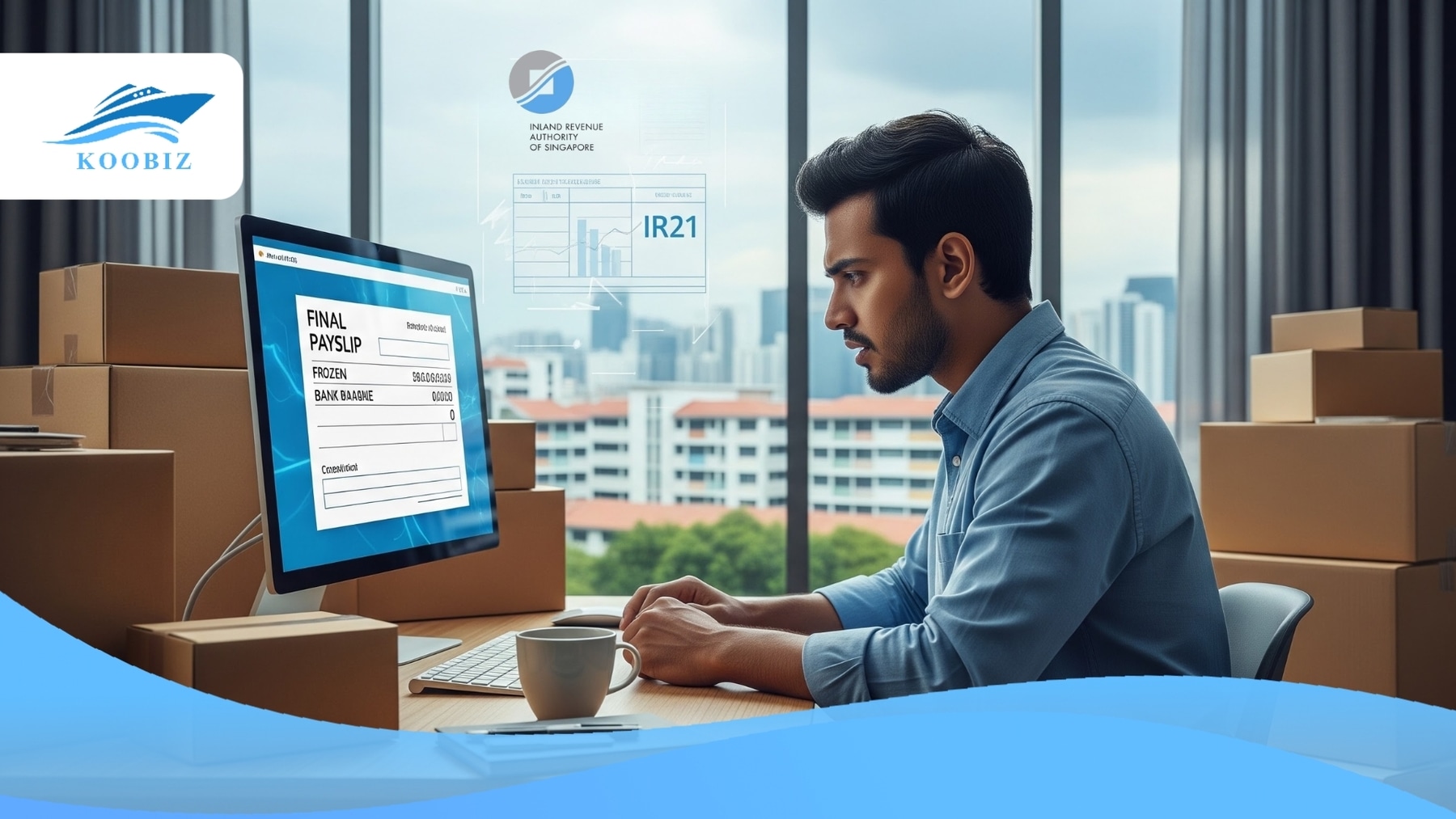
It’s a stressful moment: you’re packing up your life, bills are due, and suddenly your final paycheck is frozen. It feels personal, but in reality, it isn’t.
Your employer is complying with the Singapore Income Tax Act, specifically Section 68(5). This law requires employers to withhold all payments—salary, bonuses, overtime, and leave encashment—when a foreign employee resigns or leaves Singapore.
The Logic: Since you are leaving the country, IRAS needs a guarantee that your final tax bill will be paid. Your withheld salary serves as a form of security for your final tax assessment If your employer releases the money to you and you leave without paying tax, they become legally liable to pay your tax debt. Because of this strict legal liability, HR departments generally have no discretion to make exceptions.
Under IRAS regulations, employers who fail to file Form IR21 or properly withhold salary may face a fine of up to SGD 1,000 or imprisonment of up to six months. This explains why your request for an early release of funds is almost always denied.
Can You Leave Singapore While Tax Clearance is Processing?
Whether you can leave Singapore depends on your tax clearance status. Below are the most common scenarios:
Scenario A: Form IR21 Filed, Money Withheld
- Can I Leave? YES.
- Why? Your withheld salary serves as security for the tax. You are free to travel.
Scenario B: Tax Bill Issued, Shortfall Paid
- Can I Leave? YES.
- Why? You have settled your debts. Keep your receipt handy just in case.
Scenario C: Outstanding Tax Debt or Suspected Non-Compliance
- Can I Leave? NO.
- Why? IRAS may issue a Stop Payment Order (SPO) or travel restriction notice to Immigration & Checkpoints Authority (ICA). You will be prevented from leaving Singapore until the tax is paid in full.
The “Release of Monies” Timeline: When Do You Get Paid?
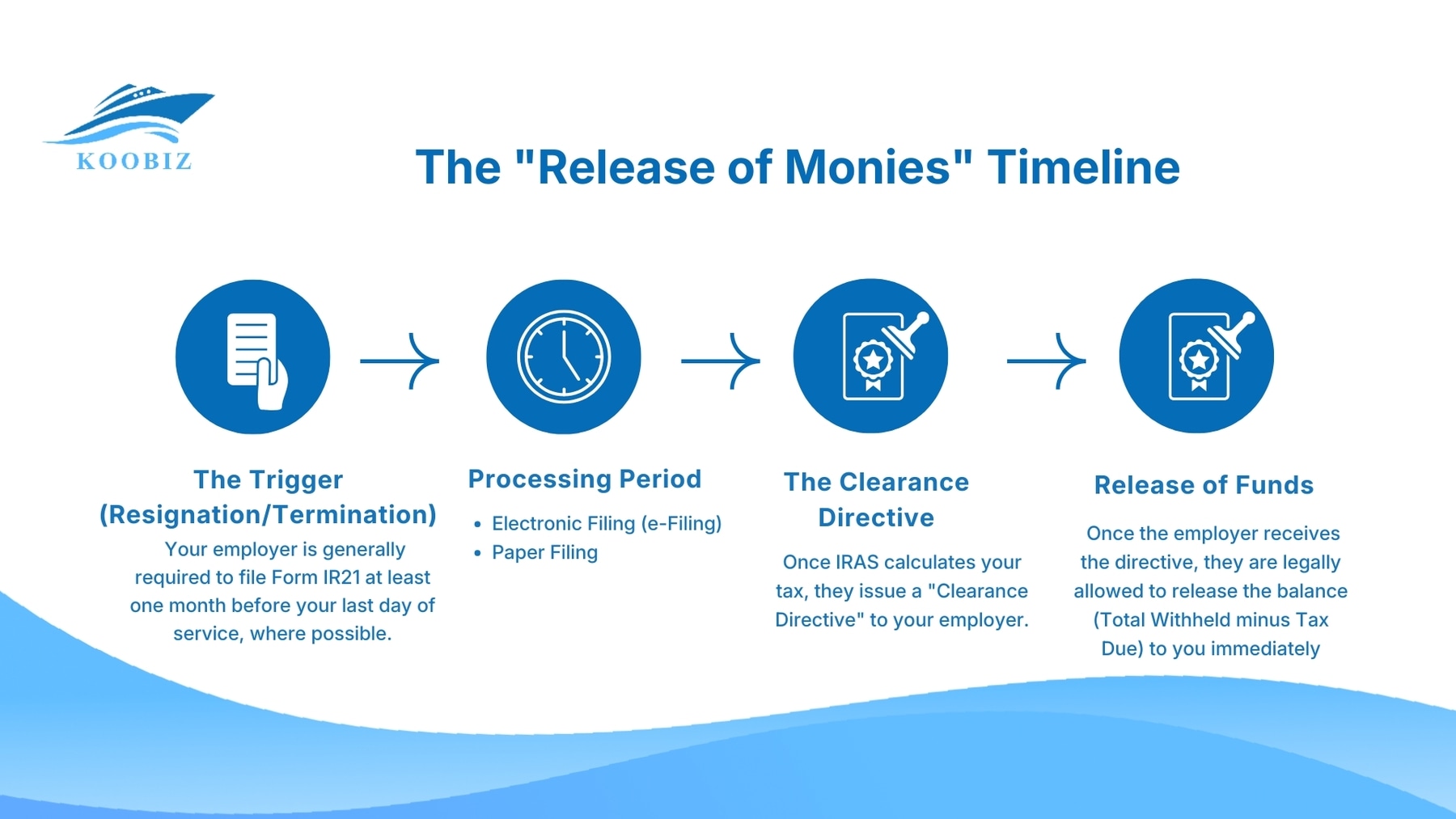
The release of withheld salary follows a clear timeline involving three key stages: resignation, IRAS processing, and the issuance of the Clearance Directive. Understanding this flow is essential for managing your cash flow, especially if you need funds for relocation costs or flight tickets.
Here is the typical chronological breakdown:
- The Trigger (Resignation/Termination): Your employer is generally required to file Form IR21 at least one month before your last day of service, where possible. From the moment resignation or termination notice is given, your employer will typically begin withholding your payments.
- Processing Period:
- Electronic Filing (e-Filing): If your employer files online via the myTax Portal, IRAS typically processes the clearance within about 7 working days.
- Paper Filing: If your employer uses physical forms, the processing time can extend to 21 days or longer.
- Note for 2026: IRAS is actively shifting towards a fully digital tax clearance process. Paper filing is becoming obsolete and may result in significantly longer delays.
- The Clearance Directive: Once IRAS calculates your tax, they issue a “Clearance Directive” to your employer. This document clearly states how much must be paid to IRAS and how much of the withheld salary can be released to you.
- Release of Funds: Once the employer receives the directive, they are legally allowed to release the balance (Total Withheld minus Tax Due) to you immediately.
In an ideal e-filing scenario, you can typically expect to receive your remaining salary about one week after your employer submits the form. If you are leaving in a rush, asking your employer to e-file is the single most effective way to speed up your payment.
How to Check Your IR21 Status via myTax Portal
You don’t need to wait for HR to email you. You can track the progress of your tax clearance directly through the IRAS system. This is the fastest way to know when your money is ready to be released.
Prerequisite: You must have a valid SingPass.
Note: If you cancel your Employment Pass (EP), your SingPass remains active only while you hold a valid immigration pass (such as the Short-Term Visit Pass issued upon cancellation). This is typically valid for 30 days (standard) to 90 days (maximum, if approved). It is advisable to log in as soon as possible to verify your contact details before your access expires.
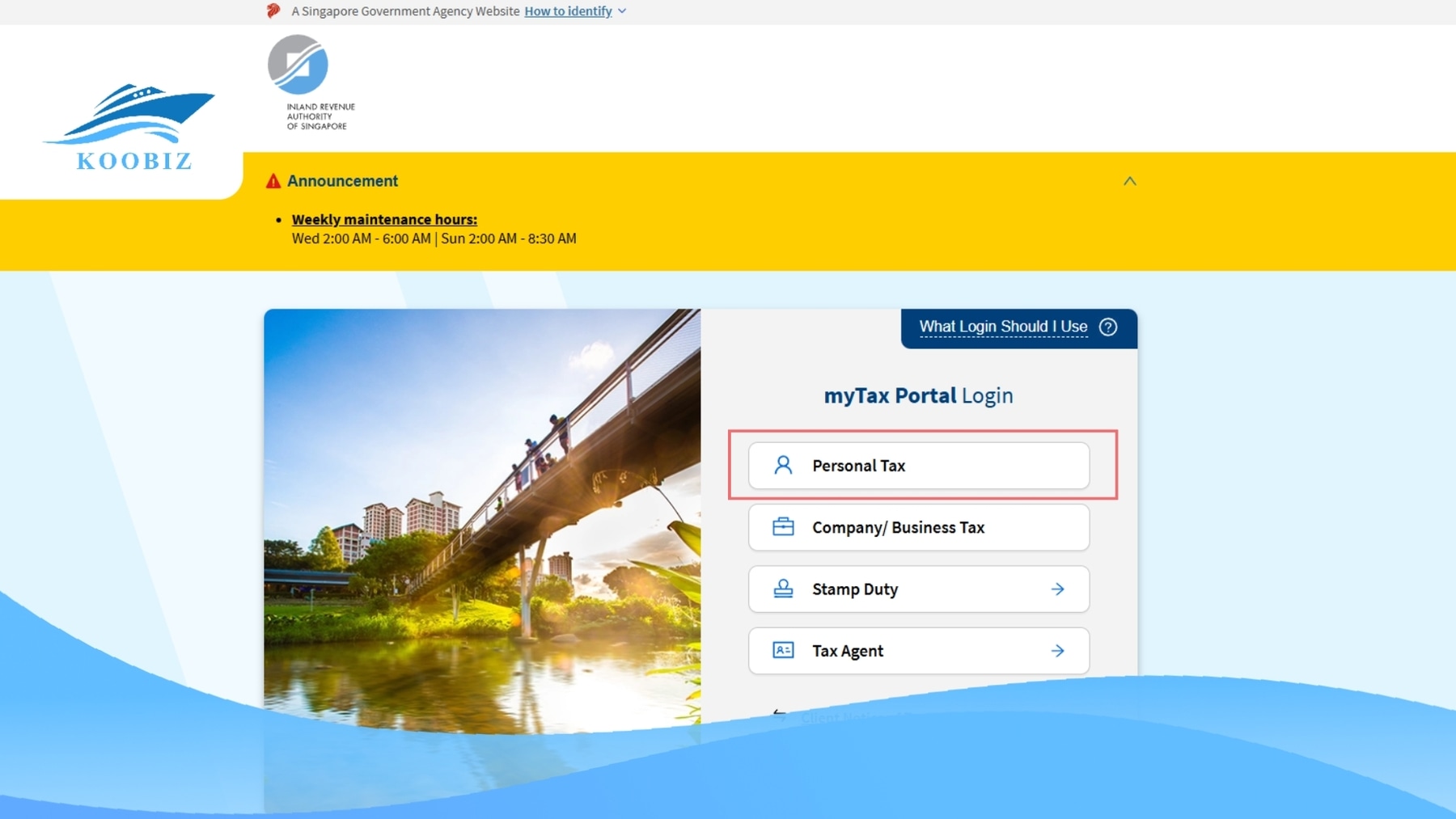
The 3-Step Check:
- Log In to myTax Portal
- Go to mytax.iras.gov.sg and select “Personal Tax”.
- Log in using your SingPass app or password.
- Navigate to “Notices/Letters”
- On the top menu or dashboard sidebar, look for the section labelled “Notices”, “Letters”, or “Correspondence”.
- This section archives all official documents sent by IRAS to you.
- Check for the “Clearance Directive”
- Look for a recent document titled “Clearance Directive” or “Notification of Computation”.
- If you see it: Your tax clearance is complete. Click to open the PDF. It will show your final tax liability.
- If you DON’T see it: The application is likely still “Processing”.
Pro Tip: Once the Clearance Directive appears in your myTax Portal, the same directive will also have been issued to your employer. Sharing a screenshot with your HR or payroll team can help prompt the timely release of your remaining salary.
Understanding Your Final Tax Bill: Payment vs. Refund
The Clearance Directive will result in one of two outcomes. Check your Directive to see which applies to you:
| Outcome | What it Means | Action Required |
|---|---|---|
| Scenario A: SHORTFALL
(Tax Due > Withheld) |
You owe more tax than your employer held back. | PAY IMMEDIATELY.
Use the Payment Slip to pay via Internet Banking/AXS. Failure to pay risks a travel ban. |
| Scenario B: REFUND
(Tax Due < Withheld) |
You overpaid (via withholding). The employer owes you the balance. | WAIT FOR EMPLOYER.
Your employer will release the remaining funds to your bank account. No action needed with IRAS. |
Complex Scenarios and Post-Departure Tips
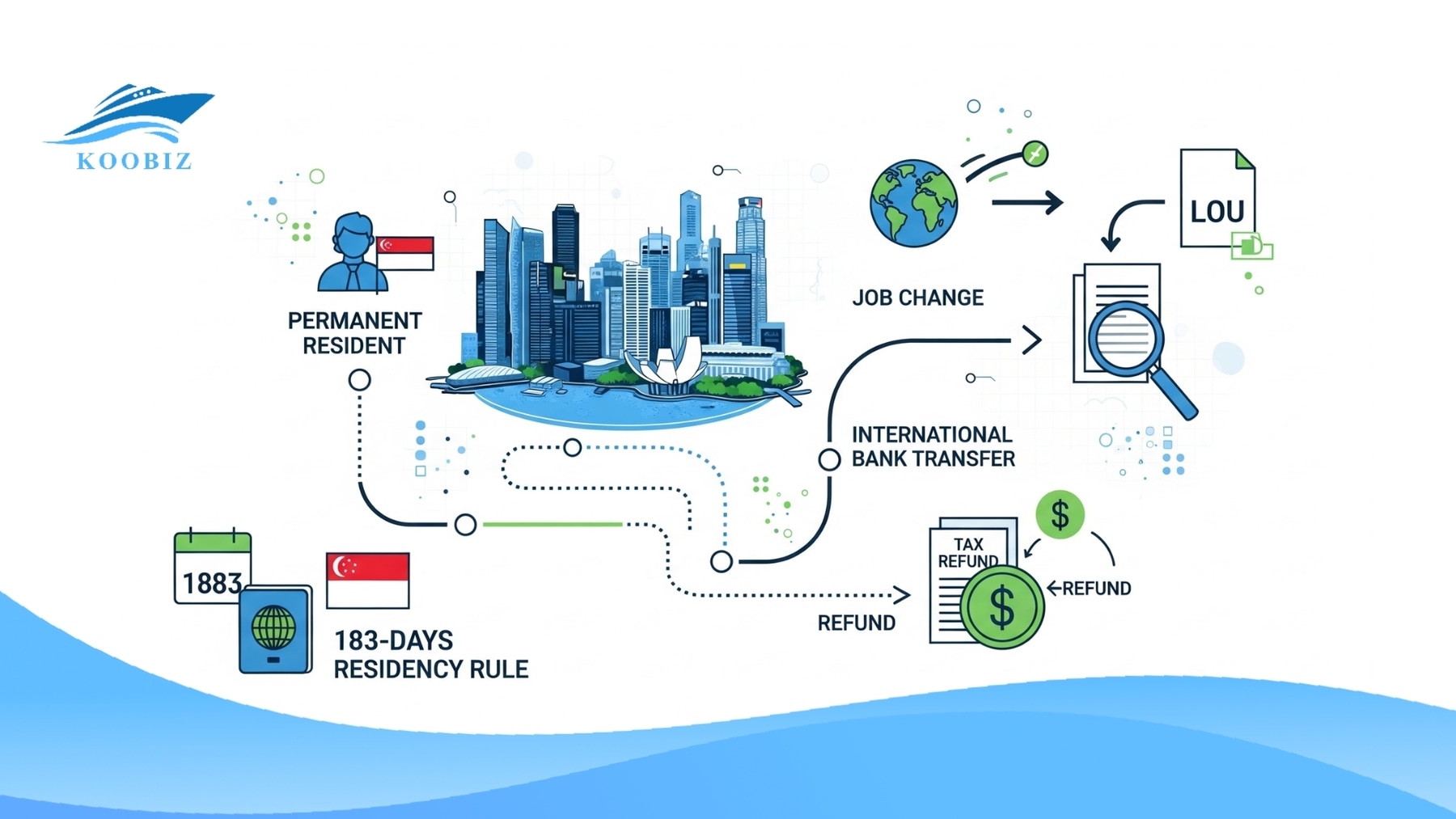
While the standard procedure applies to most, many foreign employees face unique circumstances. While the standard process applies to most cases, foreign employees often encounter specific edge cases. Being aware of these scenarios can help prevent unnecessary tax exposure, delays, and administrative complications.
Situation 1: The “183-Day” Residency Trap
- The Issue: If you leave early in the year (e.g., April), you might not meet the 183-day requirement to be a tax resident.
- The Impact: You could be taxed at the higher Non-Resident rate (flat 15% or higher) instead of the lower Resident rates (0-22%).
- The Fix: Review whether the administrative concession applies, particularly if your employment spans two calendar years. If not, be prepared for a higher tax assessment under the non-resident tax regime.
Situation 2: Permanent Residents (SPR) Changing Jobs Without Leaving Singapore (LOU)
- The Issue: You are a Permanent Resident (SPR) changing jobs, but your employer wants to withhold your salary anyway.
- The Fix: Sign a Letter of Undertaking (LOU). This indemnifies the employer against liability and allows them to release your full salary without filing Form IR21.
Situation 3: Refunds after Bank Closure
- The Issue: IRAS owes you a refund, but you have already closed your Singapore bank account.
- The Fix: Update your contact and banking details in the myTax Portal as soon as possible to request a Telegraphic Transfer (TT) to your overseas account. Please note that international bank charges may apply.
Conclusion
Leaving Singapore marks the close of an important chapter, and tax clearance is often the final administrative step before you move on. While salary withholding can be frustrating, it is a standard legal requirement rather than a punitive measure. By understanding the clearance timeline, actively tracking your status through the myTax Portal, and being aware of how residency rules affect your final tax bill, you can manage the process with greater certainty and avoid unnecessary delays.
At Koobiz, we specialize in simplifying business and financial compliance in Singapore. While this guide focuses on the employee’s perspective, we also assist companies in managing their employer obligations, from accurate Form IR21 filing to corporate tax planning and accounting. If you are a business owner or HR manager needing assistance with tax clearance procedures or general corporate compliance, visit Koobiz.com to see how our expert team can support your operations.