


Managing your Self-Employed CPF Contribution is important for staying legal and saving money in Singapore. For freelancers and sole proprietors, CPF is not just a rule—it’s a smart move to lower taxes and earn safe interest. At Koobiz, we make this process easy, helping you turn rules into financial benefits.
This guide explains your Mandatory MediSave obligations for 2025 and practical steps to use CPF for the best Tax Relief. It covers how to calculate Net Trade Income and how to optimize voluntary top-ups, giving you a clear plan to secure your financial future while remaining compliant.
Are You Required to Pay CPF as a Self-Employed Person?
Yes, you are required to pay CPF contributions specifically to your MediSave Account if you are a Singapore Citizen or Permanent Resident and earn an annual Net Trade Income (NTI) exceeding SGD 6,000.
To figure out your obligation, there are three key conditions:
- Citizenship: Foreigners working as freelancers on an Employment Pass or S-Pass are not covered by this scheme.
- Income: The NTI must be exactly SGD 6,000 or more. If it’s below 6,000, the contribution is voluntary.
- Self-employment: You must run your own trade, business, profession, or vocation. This is different from being an employee, where your employer handles CPF.
If you don’t meet these rules, you could face penalties. Koobiz urges all clients to avoid penalties by checking these requirements on time.

A Self-Employed Person (SEP) is defined broadly and includes:
- Freelancers (writers, designers, consultants)
- Hawkers and stall owners
- Taxi drivers and private-hire car drivers
- Commission agents (like property or insurance agents)
- Private tutors and coaches
What Is the Mandatory MediSave Contribution Rate for 2025?
The Mandatory MediSave Contribution Rate for 2025 is a tiered percentage of your Net Trade Income, ranging from 4% to 10.5%, determined by your age group and income band.
Understanding these rates matters because SEPs (self-employed people) don’t have fixed rates like employees. SEP rates are progressive, meaning they go up with age and with income. Older individuals need more healthcare savings, so the rate increases as you get older, and the rate also rises with higher NTI.
Important Update for 2025: The contribution percentages stay the same, but the maximum annual income used to calculate contributions has risen to SGD 88,800 (up from the previous cap of SGD 6,800 per month).
Here is the general breakdown of the contribution rates for SEPs based on age and income (assuming NTI > SGD 18,000 for maximum tier):
- Age 35 and below: Capped at 8% of NTI.
- Age 35 to 45: Capped at 9% of NTI.
- Age 45 to 50: Capped at 10% of NTI.
- Age 50 and above: Capped at 10.5% of NTI.
Note: For NTI between SGD 6,000 and SGD 18,000, lower phase-in rates apply.
How to Calculate and Declare Your Net Trade Income (NTI)
The method to calculate and declare NTI involves three key steps: deducting allowable business expenses from your gross revenue, filing your income tax return with IRAS, and awaiting the Notice of Computation (NOC).
This process is the basic workflow that links your business activity to the CPF Board. If you don’t declare your NTI correctly, the CPF Board can’t determine how much you must pay into MediSave, which could lead to penalties or missed tax relief opportunities.
Step 1: Calculate Net Trade Income
Your NTI is simply your Gross Trade Income minus Allowable Business Expenses.
- Gross Trade Income: The total amount earned from your business or vocation.
- Allowable Business Expenses: Costs incurred strictly for earning income (e.g., equipment, rental, transport). Alternatively, qualifying SEPs can opt for the Fixed Expense Deduction Ratio (FEDR) to simplify claims.
Step 2: File with IRAS
You must declare your NTI to the Inland Revenue Authority of Singapore (IRAS) during the annual tax filing exercise (typically between March and April).
- Log in to the myTax Portal using Singpass.
- Fill in Form B (for business owners) or Form B1.
- Koobiz Tip: Ensure your classification code is correct to avoid administrative errors.
Step 3: Receive Notice of Computation (NOC)
Once IRAS assesses your income, they will transmit the NTI data to the CPF Board.
- The CPF Board will then send you a Notice of Computation (NOC) stating the exact amount of MediSave payable.
- You generally have 30 days from the date of the NOC to make the payment.
Comparison: Mandatory MediSave vs. Voluntary CPF Top-Ups
Mandatory MediSave focuses strictly on basic healthcare security, whereas Voluntary CPF Top-Ups allow you to allocate funds to all three accounts (OA, SA, MA) to optimize interest accumulation and housing eligibility.
While following the rules only requires the MediSave contribution, improving your financial health usually means going beyond the minimum. The comparison below shows why many successful freelancers choose to contribute more than what’s required.
| Feature | Mandatory MediSave | Voluntary CPF Contribution (VC) |
|---|---|---|
| Destination | 100% goes into the MediSave Account (MA). | Split between Ordinary (OA), Special (SA), and MediSave (MA) accounts. |
| Purpose | Hospitalization, approved medical insurance (MediShield Life). | Housing (OA), Retirement (SA), and Healthcare (MA). |
| Interest Rate (2025) | 4.0% p.a. (Floor rate). | Blended. OA earns 2.5%, while SA and MA earn 4.0%. |
| Flexibility / Advantage | Low. Funds are strictly locked for medical use. | High. Crucial for SEPs who want to buy an HDB flat or invest using CPF OA funds. |
However, you must be aware of the Annual Limit. The total mandatory + voluntary contributions cannot exceed the CPF Annual Limit (currently SGD 37,740 per year). Exceeding this will result in the refund of the excess amount without interest.
How Does CPF Contribution Reduce Your Income Tax?
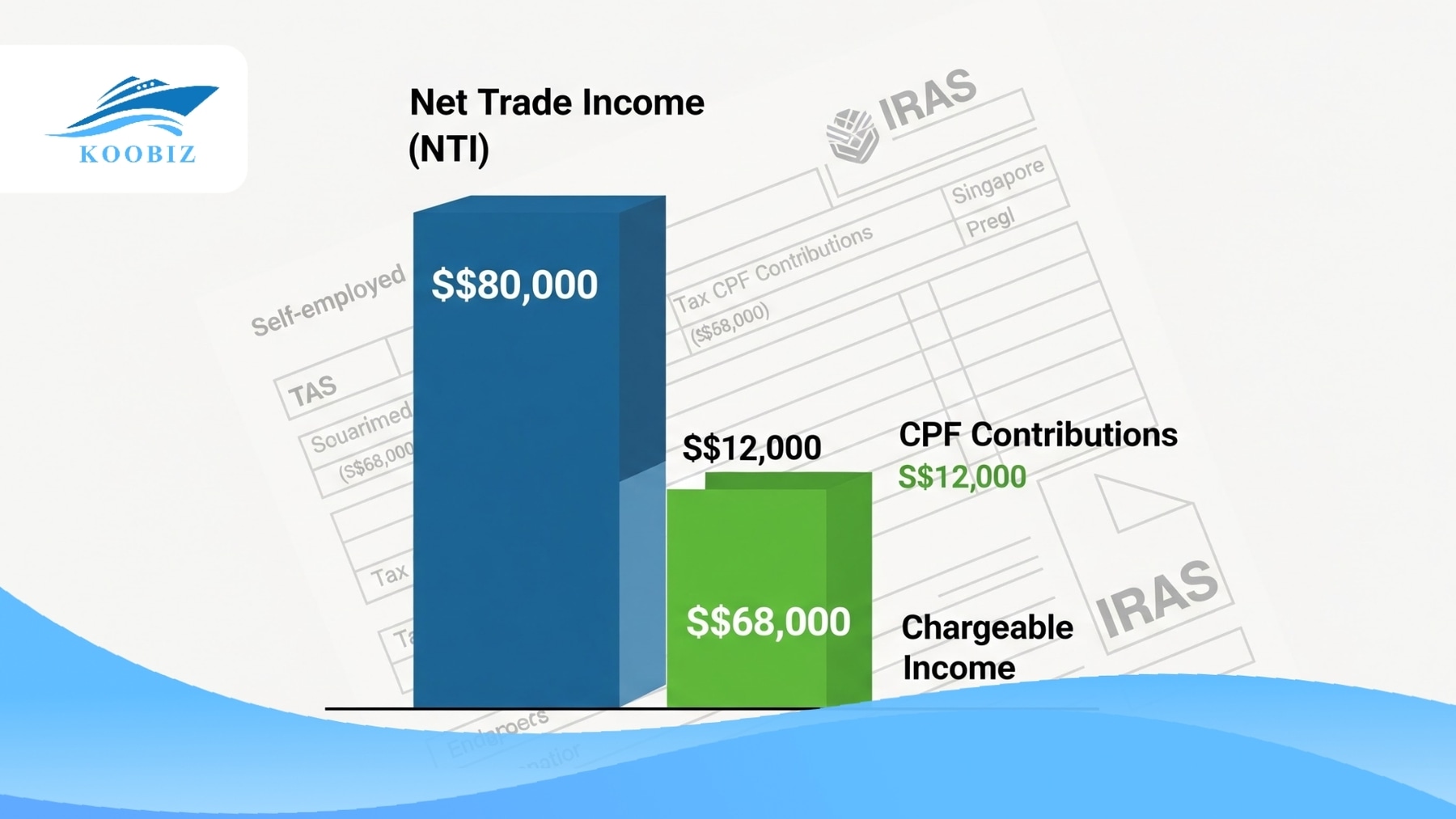
CPF Contribution reduces your income tax by lowering your chargeable income dollar-for-dollar, subject to a relief cap of SGD 37,740 or 37% of your Net Trade Income, whichever is lower.
Tax relief is arguably the most immediate financial incentive for making CPF contributions. For high-earning freelancers, the progressive tax rates in Singapore can be steep, and CPF Relief is one of the most effective tools to mitigate this tax bill.
To illustrate, the relief works in two ways:
- Mandatory MediSave Relief: Any amount you contribute to your MediSave account under the mandatory scheme is automatically tax-deductible.
- Voluntary Contribution (VC) Relief: If you make voluntary cash top-ups to your 3 accounts (OA, SA, MA), these are also tax-deductible, provided you stay within the limit.
The “37% Rule” & Separate Limits:
- VC Limit: The total tax relief for your CPF contributions (Mandatory + Voluntary) is capped at 37% of your NTI or the Annual Limit of SGD 37,740.
- RSTU Limit: This is separate from the limit above. You can claim additional relief of up to SGD 8,000 for top-ups to your own Special/Retirement Account and another SGD 8,000 for loved ones (Total SGD 16,000).
Therefore, strategic planning involves calculating your NTI early in the year and making voluntary contributions that maximize this 37% limit without trapping liquidity unnecessarily.
Case Study: Real-Life Tax Optimization Scenario (YA 2026)
Strategic tax planning can reduce your final tax bill by over 70%, as demonstrated in the scenario of “Sarah,” a 30-year-old freelance Graphic Designer.
To clearly illustrate the financial impact, let’s examine Sarah’s situation using Year of Assessment 2026 tax rates.
Profile:
- Job: Freelance Graphic Designer
- Net Trade Income (NTI): SGD 60,000
- Mandatory MediSave (8%): SGD 4,800
- Relief Cap (37% of NTI): SGD 22,200
Scenario A vs. Scenario B Comparison:
| Financial Detail | Scenario A: Mandatory Only | Scenario B: Maximized Contribution |
|---|---|---|
| Mandatory MediSave | SGD 4,800 | SGD 4,800 |
| Voluntary Top-Up | $0 | SGD 17,400 (Top up to 37% Cap) |
| Total CPF Relief | SGD 4,800 | SGD 22,200 |
| Chargeable Income | SGD 55,200 | SGD 37,800 |
| Estimated Tax Payable | ~SGD 1,614 | ~SGD 473 |
| Total Cash Saved | $0 | SGD 1,141 (Tax Savings) |
The Analysis:
In Scenario A, Sarah pays taxes on SGD 55,200. Based on progressive tax rates (0% on first $20k, 2% on next $10k, 3.5% on next $10k, 7% on excess), her bill is roughly SGD 1,614.
In Scenario B, Sarah tops up SGD 17,400 to hit her 37% relief cap. Her taxable income drops to SGD 37,800. Her new tax bill is only SGD 473.
- Result: She saves SGD 1,141 in taxes.
- Asset Growth: The SGD 17,400 she contributed is not an expense; it is now an asset in her CPF accounts growing at 2.5% – 4.0% interest.
Managing Payment Difficulties and Compliance Issues

Managing payment difficulties involves prioritizing compliance to avoid compounding penalties, utilizing instalment plans like GIRO, and understanding the legal implications of non-payment.
For many self-employed people, income isn’t steady. But ignoring the Notice of Computation is a terrible idea. Dealing with these issues ahead of time helps you stay in good standing with the government, which is important for renewing your licenses.
What Happens If You Miss the CPF Contribution Deadline?
Missing the CPF contribution deadline results in a late payment penalty of 1.5% interest per month (approx. 18% p.a.) on the outstanding amount, along with potential fines.
The enforcement is strict because MediSave is considered a social safety net.
- Step 1: Reminder Letter: You will receive a reminder to pay.
- Step 2: Late Payment Interest: Interest of 1.5% per month starts accruing immediately after the deadline.
- Step 3: Enforcement: Continued non-payment can lead to fines up to SGD 5,000 for first-time offenders, court action, or the refusal of license renewal for certain trades.
Can You Apply for GIRO Instalments for MediSave?
Yes, you can apply for a GIRO instalment plan to split your mandatory MediSave payable into monthly deductions, significantly easing cash flow pressure.
This is a highly recommended approach for freelancers.
- Eligibility: Generally available to all SEPs with a local bank account.
- How to Apply: Submit the GIRO application via the CPF website or your bank’s internet banking portal.
- Benefit: As long as the instalment plan is active and payments are being made, you are considered compliant.
How Does CPF Contribution Affect Your HDB Housing Loan?
CPF contributions directly affect your HDB housing loan eligibility because only funds in the Ordinary Account (OA) can be used for down payments and monthly mortgage installments.
This is a common pitfall for new freelancers.
- The Problem: Mandatory SEP contributions go 100% into MediSave. This means your OA balance remains $0 if you rely solely on mandatory payments.
- The Consequence: You cannot service a housing loan using CPF, forcing you to pay cash for your mortgage.
- The Solution: You must make Voluntary Contributions to the 3 accounts. This will channel a portion of your contribution into the OA (roughly 60% for younger members).
Is Voluntary Contribution Refundable?
No, Voluntary Contributions to your CPF accounts are generally irrevocable and non-refundable, meaning the liquidity is locked until you reach the withdrawal age or meet specific payout criteria.
- Liquidity Risk: Once money is transferred to CPF, it cannot be withdrawn for business emergencies.
- Planning: Only contribute funds that you are certain you will not need for short-term working capital.
- Exception: The only exception is if you have accidentally contributed above the CPF Annual Limit (SGD 37,740). The excess amount will be refunded to you without interest.
Conclusion
For the self-employed in Singapore, CPF is much more than a rule to follow. By strategically managing your contributions, you can:
✅ Ensure your healthcare needs are covered (via MediSave).
✅ Build a robust, low-risk retirement fund.
✅ Substantially reduce your yearly income tax.
✅ Potentially qualify for housing financing.
By mastering your CPF strategy, you transform a mandatory requirement into a cornerstone of your personal financial growth.
At Koobiz, we specialize in helping entrepreneurs and self-employed professionals navigate the complexities of Singapore’s corporate and financial landscape. From company incorporation to tax filing and accounting services, our team ensures you remain compliant while optimizing your financial efficiency. If you need assistance with your NTI declaration or setting up a tax-efficient structure for your business, visit Koobiz.com to explore our services today.
Disclaimer: The information in this guide is based on policies as of December 2025. CPF and tax regulations are subject to change. We recommend consulting a qualified tax advisor or visiting the official CPF and IRAS websites for the most current information.