

Running a business in Singapore requires navigating a robust regulatory landscape governed by ACRA and IRAS. However, maintaining accurate financial statements is more than just a matter of compliance – it is a strategic tool for unlocking your company’s growth potential. From the four essential types of reports to filing deadlines and step-by-step preparation, this guide provides everything you need to stay ahead.
What is a Financial Statement?

A financial statement is a formal record that provides a structured overview of a company’s financial activities and performance over a specific period. In Singapore’s business environment, these statements are far more than mere documentation; they are vital for:
- Strategic Management: Monitoring profitability, controlling cash flow, and driving data-backed business decisions.
- Securing Funding: Demonstrating financial stability to attract potential investors or secure credit facilities from banks.
- Statutory Compliance: Fulfilling mandatory annual filing requirements with ACRA and tax obligations with IRAS.
In short, an accurate financial statement is a non-negotiable asset for measuring success and ensuring your business remains in good standing.
What are the 4 Types of Financial Statements?
Under the Singapore Financial Reporting Standards (SFRS), a complete set of financial statements provides a multi-dimensional view of a company’s financial health. To ensure statutory compliance and facilitate informed decision-making, directors and stakeholders rely on these four primary components:
Statement of Financial Position (Balance Sheet)
The Balance Sheet provides a point-in-time snapshot of a company’s financial standing, typically at the end of the financial year (FYE). It details:
- Assets: Resources owned (cash, inventory, property).
- Liabilities: Obligations owed (loans, accounts payable).
- Equity: The shareholders’ residual interest. This statement is essential for evaluating a company’s liquidity, solvency, and overall net worth.
Statement of Comprehensive Income (Profit and Loss Statement)
This statement summarizes revenues, costs, and expenses incurred over a specific reporting period. By deducting total expenses from total revenue, it reveals the net profit or loss. It is the primary tool for assessing a company’s operational efficiency and earnings sustainability.
Statement of Cash Flows
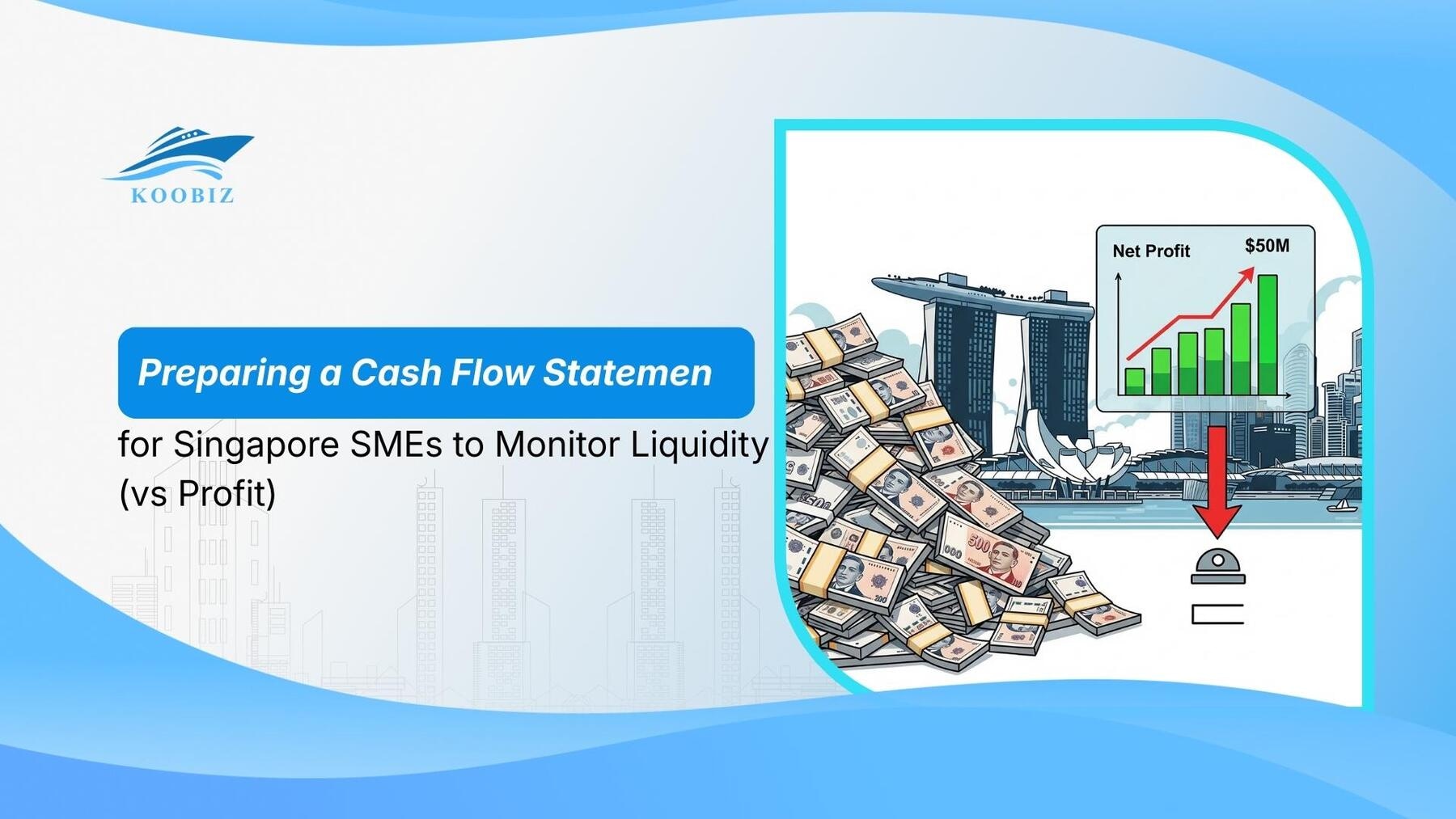
While the income statement tracks profitability, the Cash Flow Statement tracks the actual inflow and outflow of cash. It categorizes movements into:
- Operating Activities: Cash from core business functions.
- Investing Activities: Cash used for or generated from assets/investments.
- Financing Activities: Cash flow related to debt, equity, and dividends. It is a critical indicator of a company’s short-term viability and its ability to fund operations without external capital.
Statement of Changes in Equity
This document outlines the movements in a company’s equity over the reporting period. It reconciles the opening and closing balances by detailing:
- Net profits or losses.
- Dividend distributions.
- Issuance or redemption of shares. It provides transparency into how profits are either distributed to shareholders or reinvested into the business.
Which Accounting Standard is Used in Singapore?

To maintain its status as a leading global financial hub, Singapore enforces a strict, transparent, and internationally recognized accounting framework. All companies incorporated in Singapore are required to prepare their financial statements in accordance with these standards, which are regulated by the Accounting Standards Council (ASC).
Singapore Financial Reporting Standards (SFRS)
The default accounting framework for businesses in Singapore is the SFRS. It is closely modeled after the International Financial Reporting Standards (IFRS), ensuring that financial statements prepared in Singapore are globally comparable, reliable, and transparent. Unless specifically exempted, all Singapore-registered companies must comply with SFRS when preparing their annual financial reports.
SFRS for Small Entities
To reduce the administrative burden and compliance costs for smaller businesses, the ASC introduced the SFRS for Small Entities. This framework offers simplified reporting requirements. A company is eligible to adopt this standard if it meets at least two of the following three criteria for two consecutive financial years:
- Total annual revenue is not more than S$10 million.
- Total gross assets is not more than S$10 million.
- Total number of employees is not more than 50.
Adopting the SFRS for Small Entities is optional. Eligible companies can still choose to file under the full SFRS if preferred by their management or investors.
When IFRS is Applicable
While SFRS is the mandatory domestic standard, the International Financial Reporting Standards (IFRS) may be applicable or preferred in specific corporate scenarios:
- Subsidiaries of Foreign Multinationals: If a Singapore company is a subsidiary of an overseas parent company that uses IFRS, it may adopt IFRS to align financial statements for easier group consolidation.
- Companies Listed on International Exchanges: Singapore companies seeking to list or already listed on certain foreign stock exchanges may be required to prepare their financial statements under IFRS to satisfy international investors and foreign regulatory bodies.
ACRA Financial Statements Requirements

ACRA enforces strict reporting rules to uphold corporate transparency. Mastering these requirements is crucial to avoid severe penalties and streamline your annual filing process.
Who Needs to Prepare vs. File?
While every Singapore-incorporated company must prepare an annual financial statement, the rules for filing differ:
- Filing Required: Most public and private companies must submit their financial statements alongside their Annual Return.
- Filing Exempted: Solvent Exempt Private Companies (EPCs) (private companies with max 20 individual shareholders) are exempt from filing. However, they must still prepare and retain these records for potential ACRA/IRAS audits.
Audit Exemption Criteria
Statutory audits can be costly. Fortunately, private companies are audit-exempt if they qualify as a “Small Company” by meeting at least two of these three criteria for the past two consecutive financial years:
- Annual revenue $\le$ S$10 million.
- Total gross assets $\le$ S$10 million.
- Full-time employees $\le$ 50.
Note: Audit-exempt companies must still prepare an unaudited financial statement compliant with SFRS.
The XBRL Format Requirement
To facilitate digital data analysis, ACRA requires many companies to file statements in XBRL (eXtensible Business Reporting Language) format:
- Full XBRL: Mandatory for public companies and most non-EPCs.
- Simplified XBRL: Available for smaller non-EPCs meeting specific financial thresholds.
- Exempt from XBRL: Solvent EPCs are generally exempt but may need to submit a PDF copy or Financial Highlights depending on their status.
Deadlines and Penalties for Financial Statements
Timely submission is vital for maintaining your company’s “Good Standing” status. Delayed filings incur unnecessary costs and regulatory scrutiny.
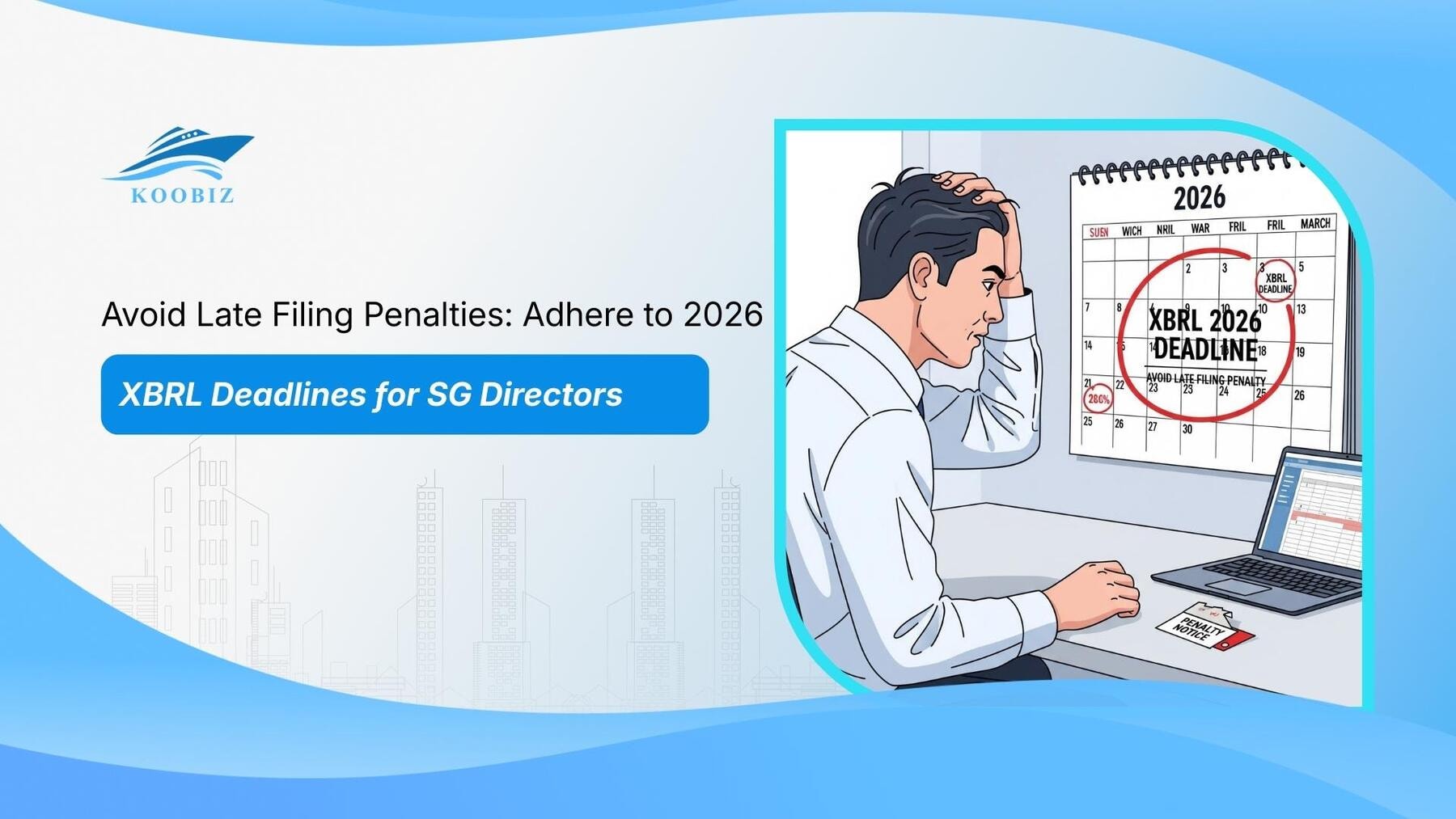
Important Deadlines (AGM & AR)
Compliance timelines depend on your Financial Year End (FYE):
| Requirement | Non-Listed Companies | Listed Companies |
|---|---|---|
| Annual General Meeting (AGM) | Within 6 months post-FYE | Within 4 months post-FYE |
| Annual Return (AR) Filing | Within 7 months post-FYE | Within 5 months post-FYE |
Note: Financial statements must be approved at the AGM before AR filing with ACRA.
Penalties for Non-Compliance
ACRA enforces strict penalties for late submissions. Directors are personally liable for ensuring statutory obligations are met.
- Late Filing Fees: Ranging from S$300 to S$600 per breach.
- Enforcement Actions: Unresolved defaults may lead to Composition Sums or Court Summons.
- Director Liability: Prosecution, fines up to S$5,000, or disqualification for repeat offenders (3 or more convictions within 5 years).
- Striking Off: Persistent non-compliance may result in the company being struck off the register.
A clean compliance record is essential for maintaining business reputation and accessing government grants or credit facilities.
How to Prepare and File Financial Statements in Singapore: Step-by-Step

Navigating the financial reporting process requires precision and a clear understanding of SFRS. Follow these six essential steps to ensure your company remains compliant.
Step 1: Collect Accounting Documents
Gather all supporting financial records for the financial year. This includes sales invoices, purchase receipts, bank statements, payroll records, and loan agreements. Organized documentation is the foundation of an accurate financial statement.
Step 2: Record and Classify Transactions
Enter all gathered data into your accounting system. Transactions must be categorized according to the Singapore Chart of Accounts. Ensure accruals, prepayments, and depreciation are properly adjusted to reflect the true financial position of the business.
Step 3: Prepare Financial Statements
Draft the four core components: the Balance Sheet, Profit and Loss Statement, Cash Flow Statement, and Statement of Changes in Equity. These must include necessary Notes to the Accounts, providing detailed breakdowns of specific line items as required by SFRS.
Step 4: Audit (if required)
If your company does not meet the “Small Company” audit exemption criteria, you must appoint an independent Public Accountant registered with ACRA to audit your financial statements. The auditor will issue an opinion on whether the statements provide a “true and fair” view of the company’s finances.
Step 5: Convert to XBRL
Once finalized, financial data must be mapped and converted into XBRL format. Using ACRA’s BizFinx portal, this digital tagging ensures your data is compatible with regulatory analysis systems.
Step 6: File with ACRA and IRAS
The final step involves two separate submissions:
- ACRA: File your financial statements (in XBRL or PDF as required) together with the Annual Return (AR).
- IRAS: Submit the financial statements as part of your Corporate Income Tax Return (Form C or C-S) to fulfill your tax obligations.
Common Mistakes When Preparing Financial Statements in Singapore
To ensure seamless compliance and avoid ACRA investigations or tax penalties, directors should avoid these frequent pitfalls:
- Data Discrepancies: XBRL data must strictly match the financial statements approved during the AGM.
- Wrong Framework: Using “SFRS for Small Entities” without meeting the specific eligibility criteria.
- Revenue Misrecognition: Failing to align revenue recognition with SFRS standards for milestones or long-term projects.
- Missing Disclosures: Omitting crucial “Notes to the Accounts” such as depreciation policies or related-party transactions.
- Cash-based Accounting: Singapore requires the accrual basis of accounting; recording transactions only when cash moves is a common error.
- Inaccurate XBRL Mapping: Using generic tags instead of specific concepts from the ACRA taxonomy.
Should You Prepare Financial Statements In-house or Outsource in Singapore?
Choosing between in-house management and professional outsourcing is a strategic decision. Given Singapore’s complex regulatory environment, outsourcing is often the most efficient choice for SMEs and MNC subsidiaries.
The Challenges of In-house Preparation
Maintaining an internal team involves significant overheads, including salaries, training, and software costs. Furthermore, as SFRS and XBRL taxonomy evolve, in-house staff may struggle to maintain compliance, increasing the risk of errors and late-filing penalties.
The Strategic Value of Outsourcing
Partnering with a professional firm offers distinct advantages:
- Specialized Expertise: Access to professionals deeply versed in SFRS and ACRA requirements.
- Cost Efficiency: Significant reduction in overhead costs compared to a full-time finance department.
- Risk Mitigation: Ensure 100% accuracy in XBRL tagging, protecting directors from personal liability.
Partner with Koobiz for Seamless Compliance
At Koobiz, we provide expert accounting and filing services tailored to the Singapore corporate landscape. We ensure your financial statement is fully compliant with ACRA and IRAS, serving as a reliable roadmap for your business growth. Focus on your core operations and let Koobiz handle the complexities of compliance. Contact Koobiz today for a professional consultation and streamline your financial reporting.