

Managing Goods and Services Tax (GST) in Singapore requires accurate classification of business supplies. Confusing exempt supplies with zero-rated supplies can result in substantial financial consequences, including lost input tax claims or penalties imposed by IRAS. Although both categories involve charging no GST to customers, they differ significantly in tax treatment, reporting obligations, and entitlement to input tax recovery.At Koobiz, we specialize in assisting companies with Singapore incorporation and tax compliance, and we frequently guide clients through these critical distinctions to protect their cash flow. This guide explains the key differences, highlights common supply classifications, and outlines the compliance rules businesses must follow to remain fully compliant.
Are Exempt and Zero-Rated Supplies the Same in Singapore GST?
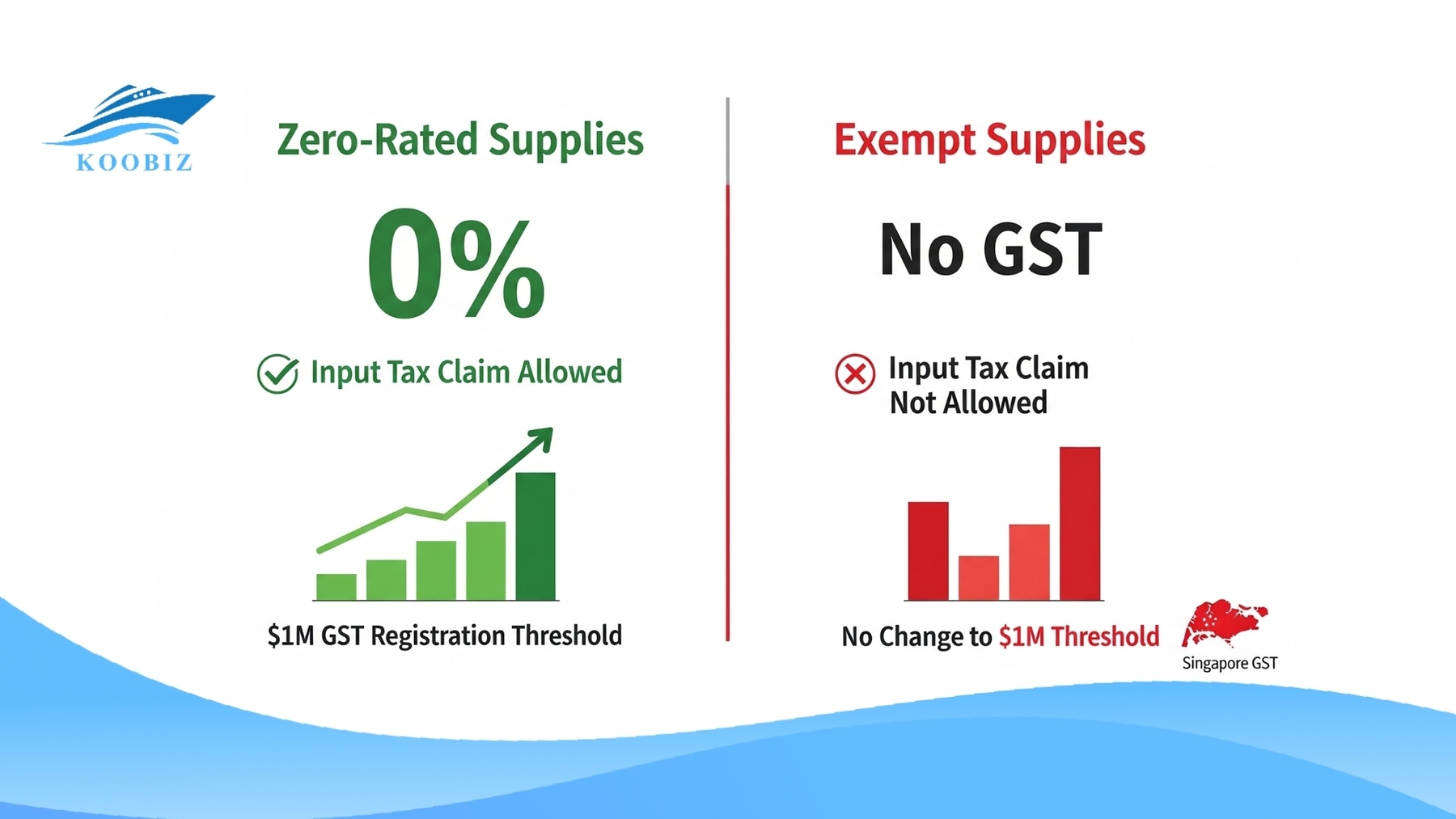
No, exempt and zero-rated supplies are not the same. While both result in no GST collected from the customer, they differ fundamentally in legal status and back-end accounting:
- Legal Status: Zero-rated supplies are taxable (at 0%), while exempt supplies are non-taxable.
- Input Tax: You can claim input tax for zero-rated supplies, but generally cannot for exempt supplies.
- Registration: Zero-rated revenue counts towards the $1M registration threshold; exempt revenue does not.
According to the Inland Revenue Authority of Singapore (IRAS), incorrectly treating an exempt supply as zero-rated is one of the most common GST compliance breaches. Such misclassification can result in penalties of up to two times the amount of GST undercharged, making accurate classification critical for businesses.
What is the Difference Between Zero-Rated and Exempt Supplies?
Zero-rated supplies win on input tax recovery and taxable status, while exempt supplies are advantageous for reducing administrative burdens for specific sectors like residential property. To fully grasp the impact on your business, refer to the comparison below:
| Feature | Zero-Rated Supplies | Exempt Supplies |
|---|---|---|
| GST Rate | 0% | No GST charged (Not applicable) |
| Taxable Status | Taxable supply | Non-taxable supply |
| Input Tax Claim | Allowed (Refundable from IRAS) | Not Allowed (Sunk cost for business) |
| GST Registration | Revenue counts towards $1M threshold | Revenue does not count towards threshold |
| GST Return Reporting | Reported in Box 2 (Zero-rated supplies) | Reported in Box 3 (Exempt supplies) |
| Invoicing | Tax invoice required (showing 0%) | No tax invoice required |
| Common Examples | Exports, International Services | Residential rental, Financial services |
Difference in Taxability and GST Rates
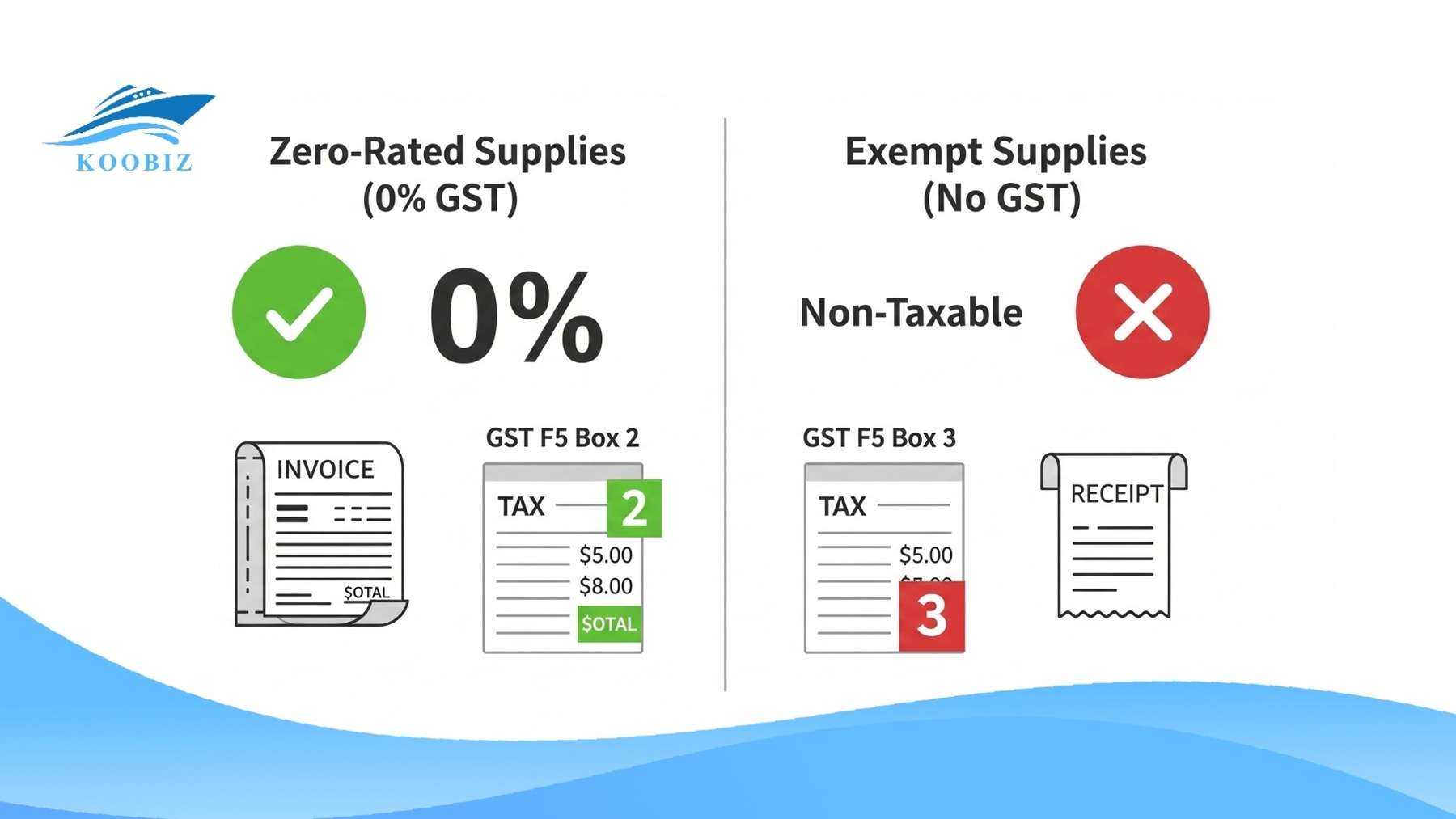
Zero-rated supplies are taxable supplies charged at 0% GST, whereas exempt supplies are non-taxable supplies not subject to GST at all. This legal distinction is paramount:
- Zero-Rated Supplies: These fall within the scope of the GST Act. You must issue tax invoices (indicating 0%) and report the transaction value in your GST F5 return.
- Exempt Supplies: These are non-taxable. You do not charge GST and typically do not issue a tax invoice.
For Koobiz clients operating in international trade, correctly identifying this status ensures seamless audits.
Difference in Input Tax Claims (Crucial for Cashflow)
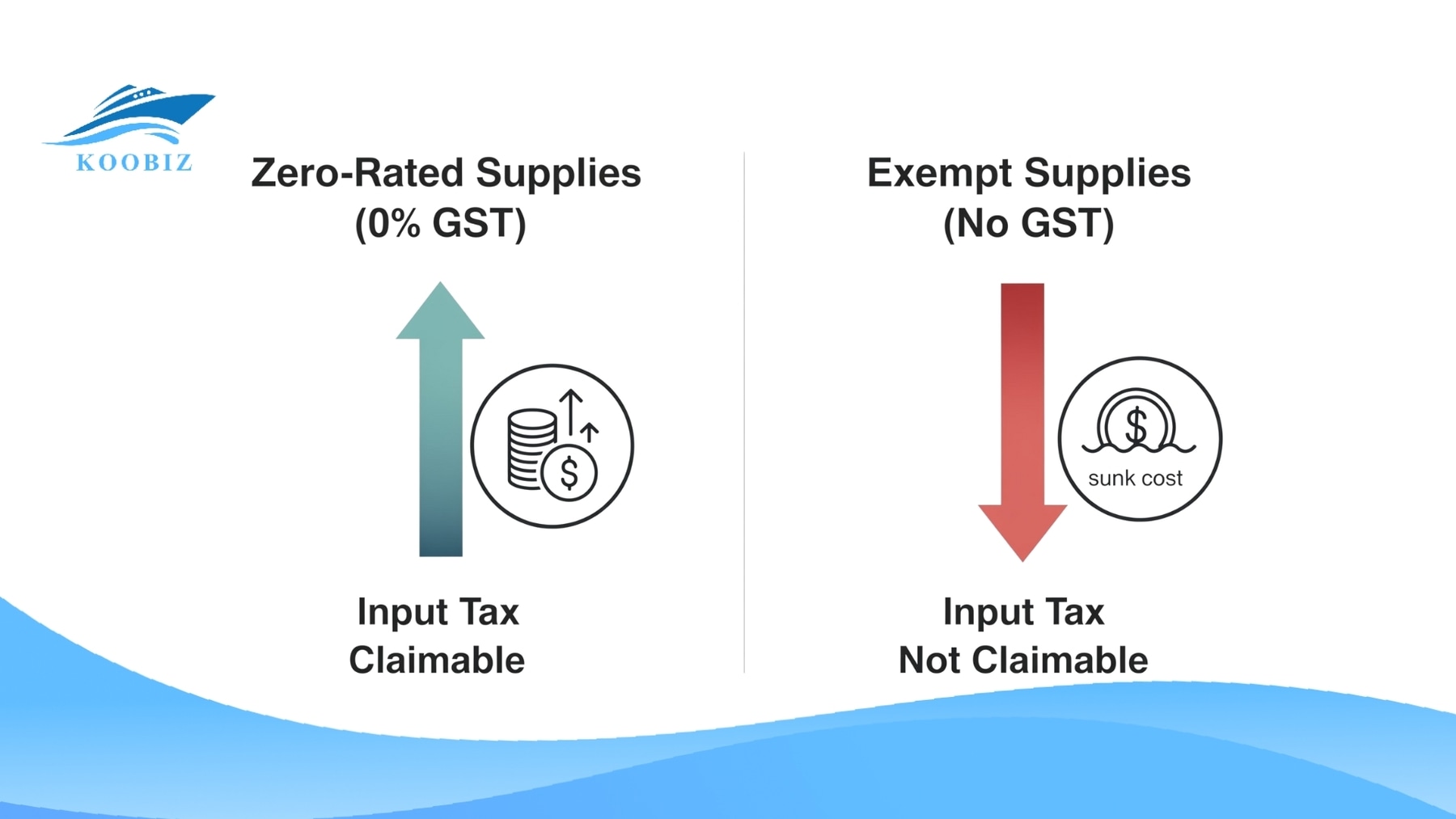
Businesses can claim input tax incurred on making zero-rated supplies, but they generally cannot claim input tax incurred on making exempt supplies. This is the most financially significant difference:
- Zero-Rated Supplies: Input tax is claimable (refundable). You can recover GST paid on business purchases (cost of goods, rent, utilities), ensuring no tax cost “sticks” to the supply chain.
- Exempt Supplies: Input tax is not claimable (sunk cost). The GST paid on maintenance or agent fees becomes a direct business expense.
Impact on GST Registration Threshold
Turnover from zero-rated supplies counts towards the SGD 1 million mandatory registration threshold, while turnover from exempt supplies does not.
- Zero-Rated Supplies: Turnover counts towards the threshold. If you generate SGD 1.2 million purely from zero-rated exports, you must register for GST.
- Exempt Supplies: Turnover does not count. If you generate SGD 1.2 million purely from exempt residential rentals, you are not required to register.
Koobiz often advises startups to monitor this threshold carefully, as voluntary registration might still be beneficial for zero-rated suppliers to reclaim input tax, even if not mandatory.
According to IRAS guidelines, a business is required to register for GST once its taxable turnover—comprising standard-rated and zero-rated supplies, exceeds SGD 1 million. Failure to register when required can lead to serious penalties, including a fine of up to SGD 10,000 and an additional penalty of 10% of the GST payable.
Classification of Supplies: What Falls Under Each Category?
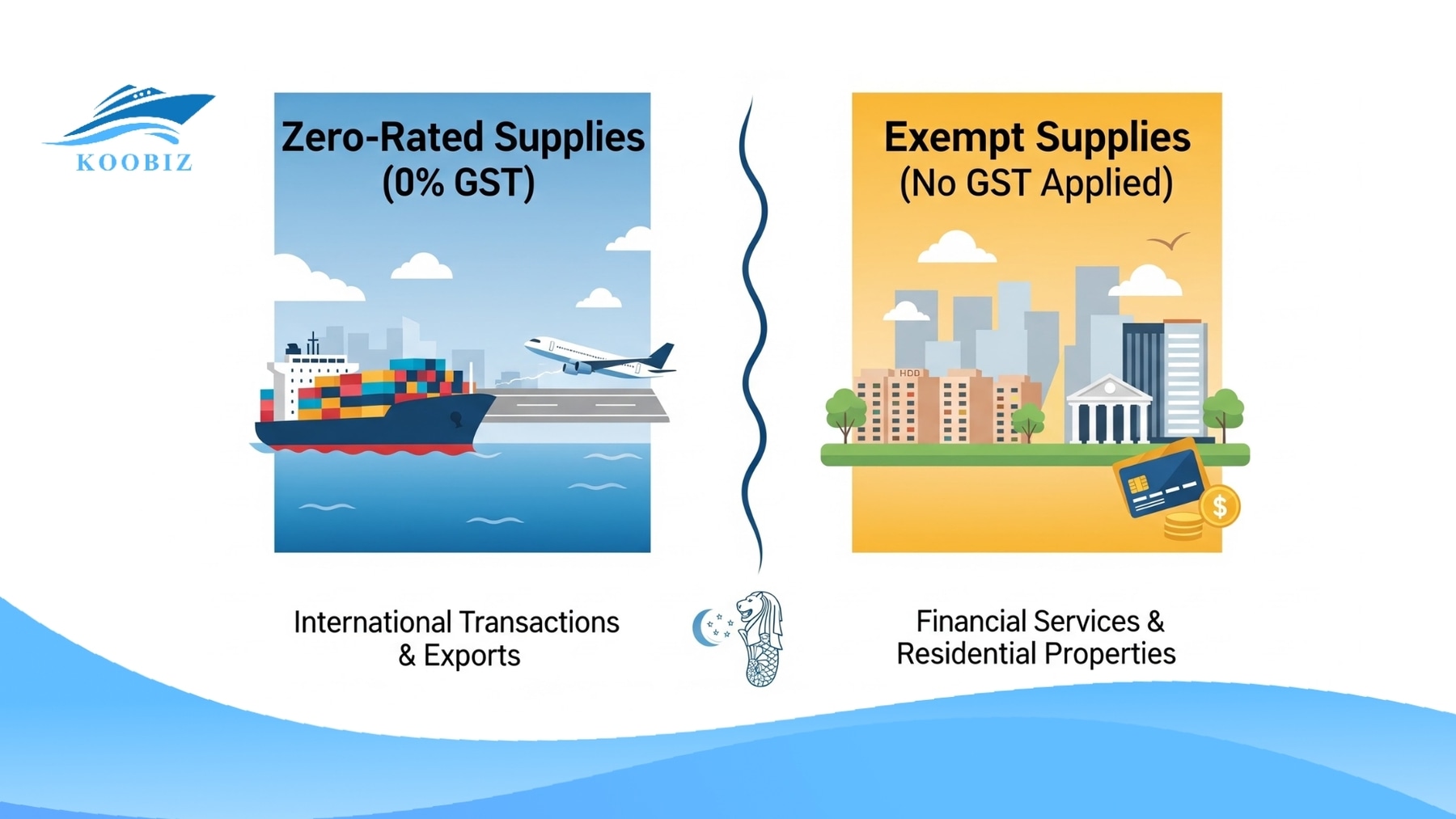
Non-standard supplies in Singapore fall into two distinct categories: Zero-Rated supplies, which mainly relate to international transactions, and Exempt supplies, which apply to specific domestic activities such as financial services and residential property transactions.
Categorizing your goods and services correctly requires looking at the nature of the transaction and the location of the consumer. Grouping these supplies accurately ensures that you apply the correct tax treatment and maintain valid supporting documents. Below is the classification for the most common business activities in Singapore.
List of Zero-Rated Supplies in Singapore
Zero-rated supplies mainly include the export of goods and the provision of “international services” as defined under Section 21 of the GST Act.
To qualify for zero-rating, strict documentary proof is required to show that goods have left Singapore or that services are consumed abroad. The main types include:
- Export of Goods: Goods physically moved from Singapore to an overseas destination (e.g., selling electronics to a client in Vietnam).
- International Services: Services provided to a customer who belongs in a country outside Singapore and benefits from the services outside Singapore (e.g., Koobiz providing consultancy to a foreign entity).
- International Transport: Transport of passengers or goods into, out of, or outside Singapore.
List of Exempt Supplies in Singapore
Exempt supplies primarily consist of financial services, the sale and lease of residential properties, and the supply of investment precious metals (IPM).
These categories are exempt mainly due to the difficulty in valuing the value-added component (in finance) or for social policy reasons (housing). The key groups are:
- Financial Services: Bank charges, issue of equity or debt securities, provision of loans, and life insurance policies.
- Residential Properties: Sale of vacant residential land, and the sale or lease of residential properties (condos, HDB flats).
- Investment Precious Metals (IPM): Sale of gold, silver, and platinum bars/wafers/coins that meet specific purity criteria.
According to the Ministry of Finance Singapore, the exemption of financial services aligns with international GST/VAT norms where intermediation services are hard to tax explicitly.
Common Misconceptions: Exempt vs. Zero-Rated vs. Out-of-Scope Supplies
Many business owners confuse these categories, leading to reporting errors in GST returns. While none attract GST, the distinction in scope and reporting is vital for compliance.
| Feature | Exempt Supply | Zero-Rated Supply | Out-of-Scope Supply |
|---|---|---|---|
| GST Act Jurisdiction | Within Scope (Non-taxable) | Within Scope (Taxable) | Outside Scope |
| GST Chargeable | No | No (0% Rate) | No |
| GST Return Reporting | Report in Box 3 (Exempt Supplies) | Report in Box 2 (Zero-Rated Supplies) | Not Reported in GST Return* |
| Input Tax Claim | Not Allowed | Allowed | Not Allowed (General rule) |
| Typical Example | Interest from local bank, Residential rental | Export of goods, Int’l services | Third-country sales, Dividends, Salary |
*Note: Out-of-scope supplies like “Third-Country Sales” (buying goods from China and shipping directly to the USA without entering Singapore) are completely excluded from the GST F5 return. In contrast, exempt supplies like bank interest must still be declared in Box 3.
Koobiz accountants ensure these figures are segregated correctly in your bookkeeping to prevent IRAS queries regarding turnover discrepancies.
Special Compliance Rules for Mixed Suppliers
Mixed suppliers are businesses that generate both taxable supplies (standard-rated or zero-rated) and exempt supplies, which triggers special GST apportionment rules for input tax claims.
If your business engages in both activities—for example, a property developer selling both commercial offices (taxable) and residential condos (exempt)—you cannot claim all your input tax. You generally can only claim the input tax directly attributable to your taxable supplies. This “Apportionment” rule ensures fairness but adds a layer of complexity to your accounting.
Claiming Input Tax for Mixed Suppliers
For expenses that cannot be directly linked to one type of supply, mixed suppliers must apply the Residual Input Tax method to apportion GST on shared overheads, such as office rent, utilities, professional fees, and audit costs.
Direct attribution is straightforward: GST paid on construction materials for a commercial building is claimable, while GST on materials used for residential development is not. However, for common expenses supporting both activities, the recoverable portion must be calculated based on the proportion of taxable turnover relative to total turnover. Koobiz utilizes specialized accounting software to automate these calculations for our clients, ensuring compliance without the manual headache.
Understanding the De Minimis Rule
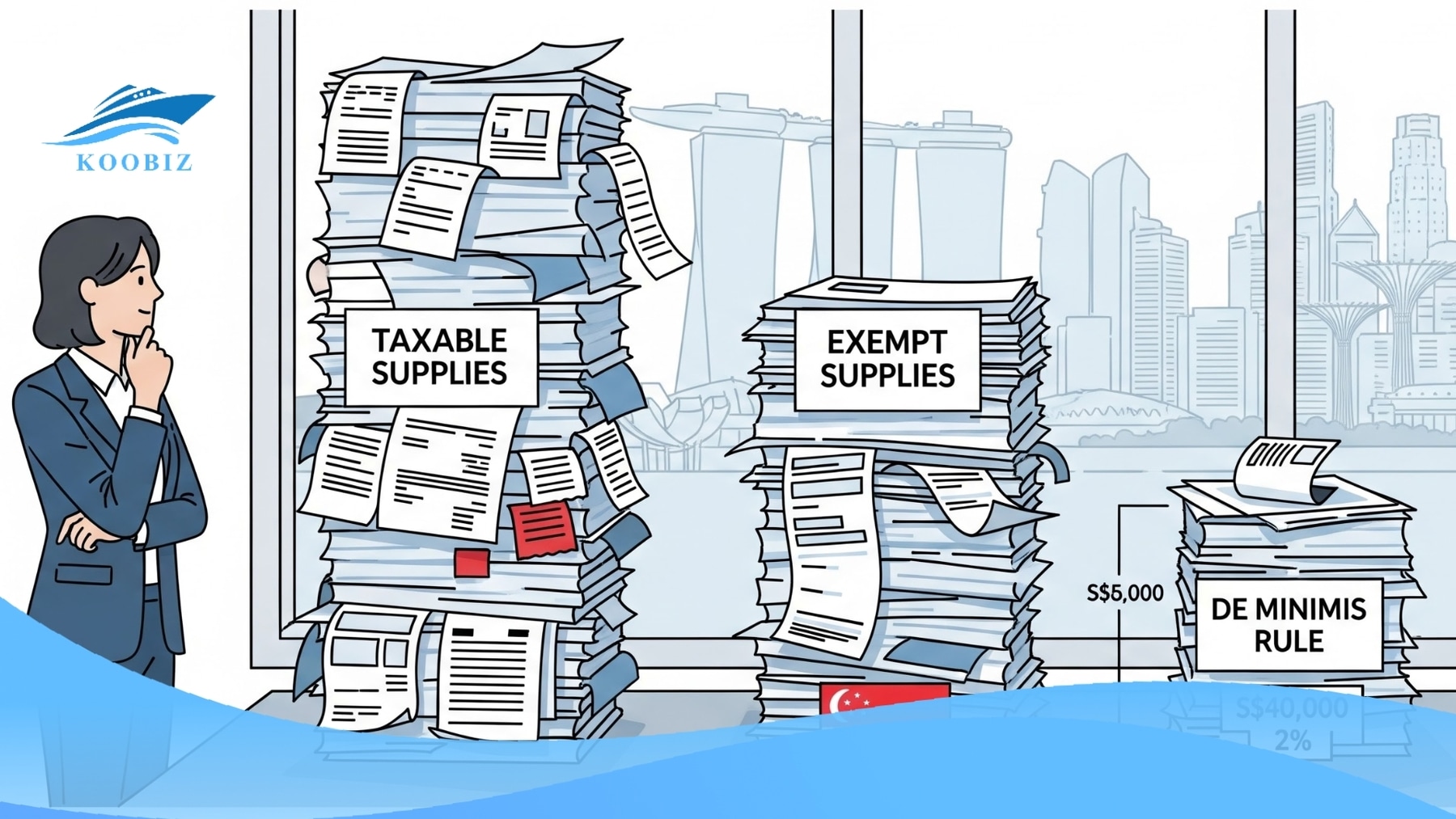
The De Minimis Rule allows a mixed supplier to claim all input tax incurred, including that on exempt supplies, if the total value of exempt supplies is insignificant.
This is a relief provision for businesses that might have incidental exempt supplies (like small interest income or minor forex gains). You can claim full input tax if:
- The value of exempt supplies is less than or equal to an average of SGD 40,000 per month; AND
- The value of exempt supplies is less than or equal to 5% of your total turnover.Meeting these criteria simplifies your tax filing significantly.
Emerging Exemptions: Digital Payment Tokens (DPT)
Digital Payment Tokens (DPTs) are now classified as exempt supplies to encourage the growth of the cryptocurrency and fintech sector in Singapore.
Previously, transactions involving virtual currencies were often treated as barter trades or supplies of services, creating uncertainty and administrative complexity. In response to the evolving digital economy, IRAS revised the GST treatment effective 1 January 2020, providing much-needed clarity for businesses operating in this space. This update brings Singapore in line with other leading financial hubs and offers greater certainty for fintech and blockchain startups navigating GST compliance.
GST Treatment for Cryptocurrency and DPTs
The exchange of Digital Payment Tokens for fiat currency or other DPTs is exempt from GST, while the use of DPTs to pay for goods remains a separate supply event.
Under the current rules:
- Exchange: Using Bitcoin to buy Ethereum, or selling Bitcoin for SGD, is an exempt supply of financial services. You do not charge GST.
- Payment: If you use Bitcoin to pay for a consulting service (standard-rated), the payment itself is not a supply, but the consulting service is still subject to 9% GST.For fintech companies incorporated through Koobiz, this exemption is vital as it removes the risk of double taxation on the token value itself.
Conclusion
Understanding the distinction between Exempt and Zero-Rated GST supplies is not just about compliance, it is a strategic decision that directly impacts your business’s profitability. While zero-rated supplies provide both pricing advantages (0% GST) and the ability to recover input tax, exempt supplies demand tighter cost control since input tax claims are generally disallowed.
Whether you are an exporter, a property investor, or a fintech startup, understanding these distinctions ensures you stay on the right side of Singapore’s tax laws. At Koobiz, we offer end-to-end corporate support, from company incorporation and bank account opening to specialized GST, accounting, and audit services. Our team helps businesses structure GST efficiently, including managing mixed supplies and de minimis calculations.
Visit Koobiz.com today to schedule a consultation with our tax experts and ensure your Singapore business is built on a solid, compliant foundation.