

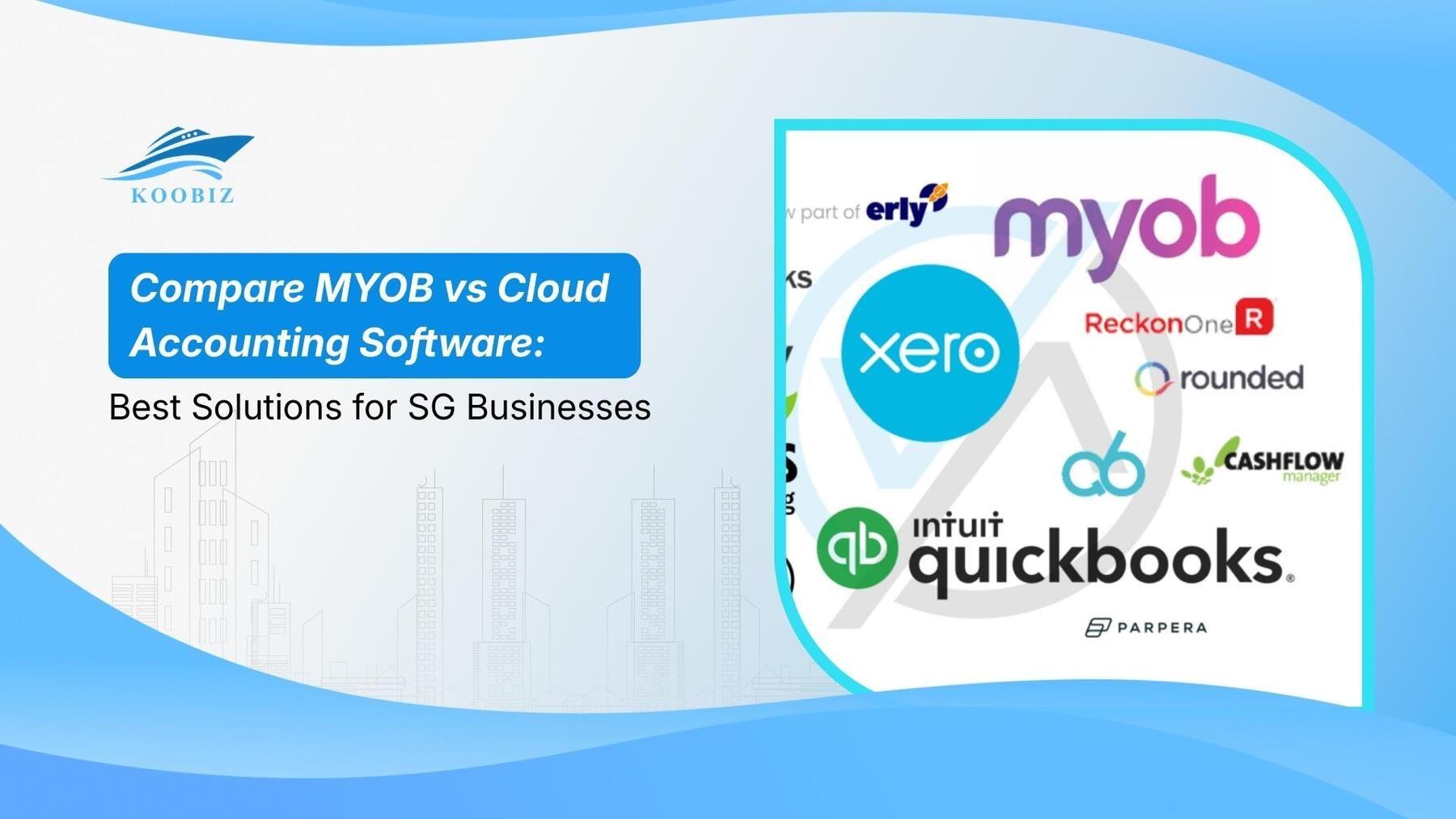
Choosing between the established reliability of MYOB (known as ABSS in Asia) and modern cloud accounting software is a crucial decision for Singapore SMEs seeking digital efficiency. While cloud platforms offer superior mobility and integration, MYOB is valued for its strong compliance features and direct data control. At Koobiz, we help many businesses with company setup and tax compliance, and we frequently see owners weighing this exact technology choice. This article explains the technical setup, grant options, and practical differences to help you select the best fit for your financial management.
Is MYOB a Cloud-Based Software? Understanding the Desktop vs. Cloud Distinction
No, MYOB (specifically the ABSS versions common in Singapore) is not a pure cloud platform. It is primarily desktop software with some cloud-sync functions, which is different from fully cloud-based services like Xero or QuickBooks.
To make this key difference clear, the table below outlines how their core design affects your finance team’s daily work:
| Feature | MYOB (ABSS) – “Cloud Enabled” | Cloud Software (Xero/QB) – “Cloud Native” |
|---|---|---|
| Installation | Required. Must be installed on a local PC or Office Server. | None. Accessed entirely via a Web Browser (Chrome, Edge). |
| Offline Access | Full Capability. Works perfectly without internet; data is local. | Zero. Requires active internet connection to function. |
| Data Location | Your Hard Drive. You own and manage the database file (.myo). | Vendor’s Cloud Server. Data sits on AWS/Azure; you don’t “hold” the file. |
| Backups | Manual/Local. You are responsible for scheduling backups. | Automated. Vendor handles redundancy and security patches. |
Case Study: The “Office-Bound” Logistics Firm vs. The “Remote-First” Agency
To see the architectural difference in action, consider two typical Singaporean businesses: LogiTrans Pte Ltd and CreativeSpark SG.
LogiTrans Pte Ltd (The MYOB User):
Based in a Tuas warehouse, LogiTrans handles many delivery orders daily using ABSS (MYOB) on a local office server.
- The Workflow: Their accounts clerk processes invoices quickly using keyboard shortcuts, unaffected by slow or unstable internet since data is stored locally.
- The Limitation: The Finance Director cannot easily check reports from home without a complex connection to the office server.
CreativeSpark SG (The Cloud User):
This digital marketing agency in Bugis uses a cloud accounting platform. Their team works flexibly from various locations.
- The Workflow: Consultants use a mobile app to snap receipt photos, which sync instantly. The founder can approve invoices from anywhere using a tablet.
- The Limitation: All access stops without an internet connection.
Koobiz Insight: This shows that “cloud-enabled” (MYOB) allows for occasional data syncing, while “cloud-native” means operating entirely online. We often recommend MYOB for operation-heavy businesses like LogiTrans that need unwavering stability. Cloud solutions suit service-based firms like CreativeSpark that prioritize mobility.
Key Comparisons: MYOB (ABSS) vs. Leading Cloud Competitors in Singapore
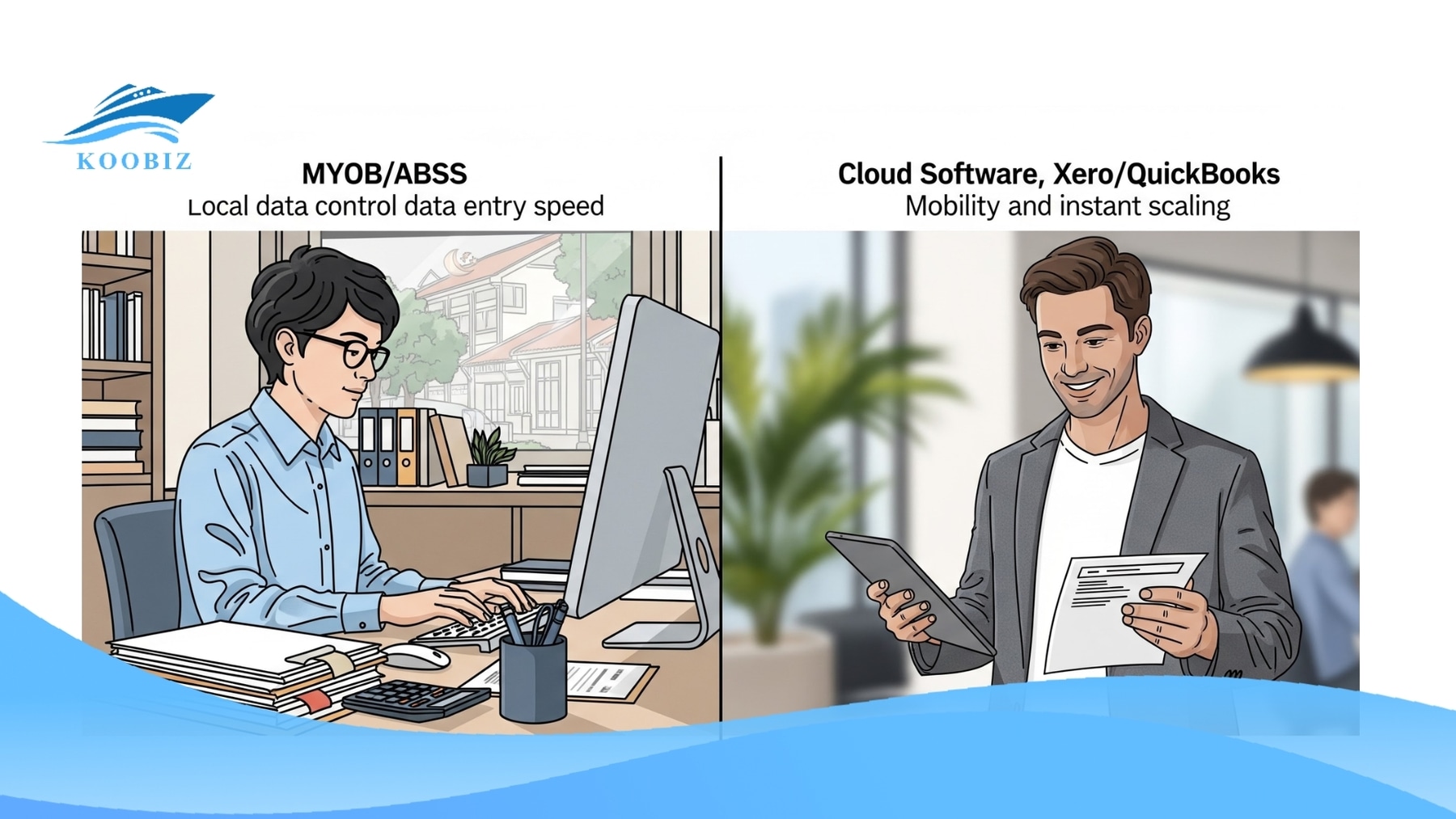
MYOB stands out for offline reliability and data sovereignty. Cloud competitors like Xero lead in real-time collaboration and connecting with other business apps.
A simple feature list isn’t always helpful. At Koobiz, we base our recommendations on your business’s specific operational style. Here’s which software excels in areas important to Singapore SMEs:
Best for Speed & High-Volume Data Entry: MYOB (ABSS)
- Why: The familiar interface lets experienced staff enter data rapidly with keyboard shortcuts, without browser delays.
- Verdict: Ideal for trading, manufacturing, or logistics companies processing high volumes of transactions.
Best for Mobility & Modern UX: Cloud Software (Xero/QuickBooks)
- Why: Clean, intuitive dashboards are accessible from any internet-connected device, supporting remote work and quick approvals.
- Verdict: Perfect for digital agencies, consultants, and startups with distributed teams.
Best for Complex Compliance (GST F5): Draw (Context Dependent)
- Why: Both generate compliant GST reports. MYOB allows for manual tweaks before filing (preferred by some auditors), while cloud software often automates direct submission to IRAS (preferred for efficiency).
Scalability and Multi-user Access for Growing SG Firms
For growing companies, the difference is about the ease of expansion.
- Scaling with MYOB (The “Logistical” Path): Adding users can involve buying new license packs and configuring your office network. It’s stable but less flexible.
- Scaling with Cloud (The “Instant” Path): Growth is instantaneous. Whether you hire one accountant or five, you simply click “Invite User” and the subscription adjusts automatically. For a Koobiz client expanding from Singapore to Vietnam, this friction-less scaling is often the deciding factor.
Data Security and Offline Accessibility: Where MYOB Excels
Each platform has a different approach to security: “Physical Control” vs. “Digital Protection”.
- Security with MYOB (The “Physical Vault” Model): You hold your data locally. You’re safe from cloud outages or vendor issues, but you are responsible for protecting against local disasters like hardware failure.
- Security with Cloud (The “Bank Vault” Model): The vendor stores your data on enterprise servers (like AWS), protecting it from local crashes. However, you rely on their security and need internet access to work.
Which Software Offers the Best ROI through Singapore Government Grants?
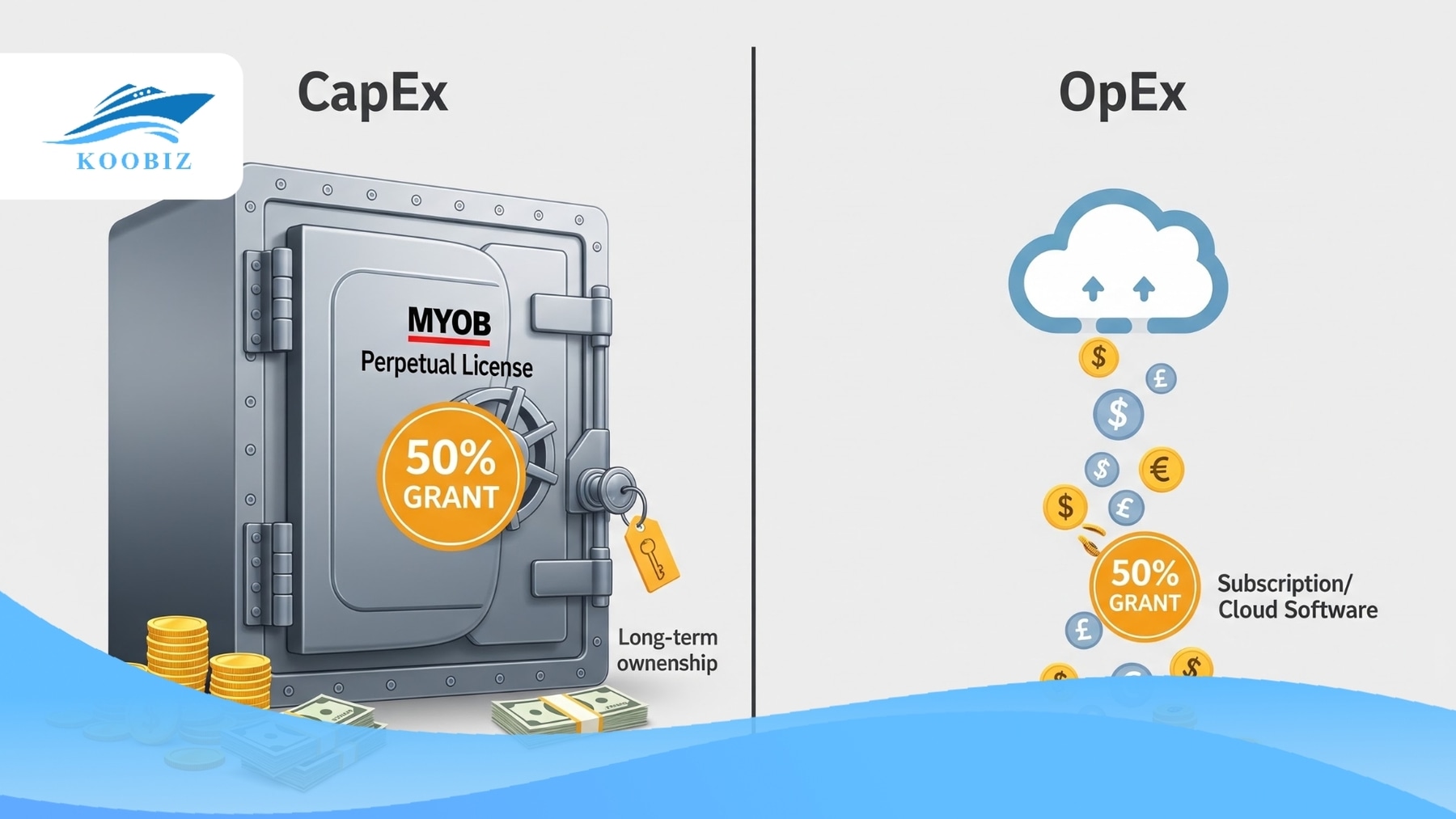
Both ABSS (MYOB) and major cloud platforms qualify for the Productivity Solutions Grant (PSG), offering up to 50% funding for eligible Singapore SMEs. The financial impact differs between buying a license (MYOB) and subscribing to a service (Cloud).
At Koobiz, we advise clients to look at the “Long-Term Cost of Ownership” rather than just the initial price tag.
CapEx vs. OpEx: A Strategic ROI Analysis
The grant supports both capital expenditure (CapEx) and operating expenditure (OpEx) differently.
The Asset Play (MYOB – CapEx):
- Strategy: You use the 50% PSG grant to purchase a perpetual license.
- ROI Verdict: High Upfront Value. You pay once, get the subsidy, and own the software forever. There are no mandatory monthly fees, making it excellent for long-term cost control.
The Cashflow Play (Cloud – OpEx):
- Strategy: You use the grant to subsidize the first 12 months of your subscription.
- ROI Verdict: Low Barrier to Entry. The grant protects your cash flow in Year 1. However, once the grant period ends, you must pay the full subscription price indefinitely.
Checklist: Am I Eligible for the PSG Grant?
Before signing any invoice, ensure your business meets these core criteria set by Enterprise Singapore:
- Registered & Operating in Singapore: Your company must be incorporated (ACRA registered) and active.
- Local Shareholding: You must have at least 30% local shareholding (for specific tiers) or be a valid SME.
- Usage Location: The software must be used in Singapore.
- Koobiz Tip: Apply for the grant BEFORE you sign the purchase order. Retrospective applications are almost always rejected.
Beyond the Basics: Navigating the Trade-offs of Digital Transformation
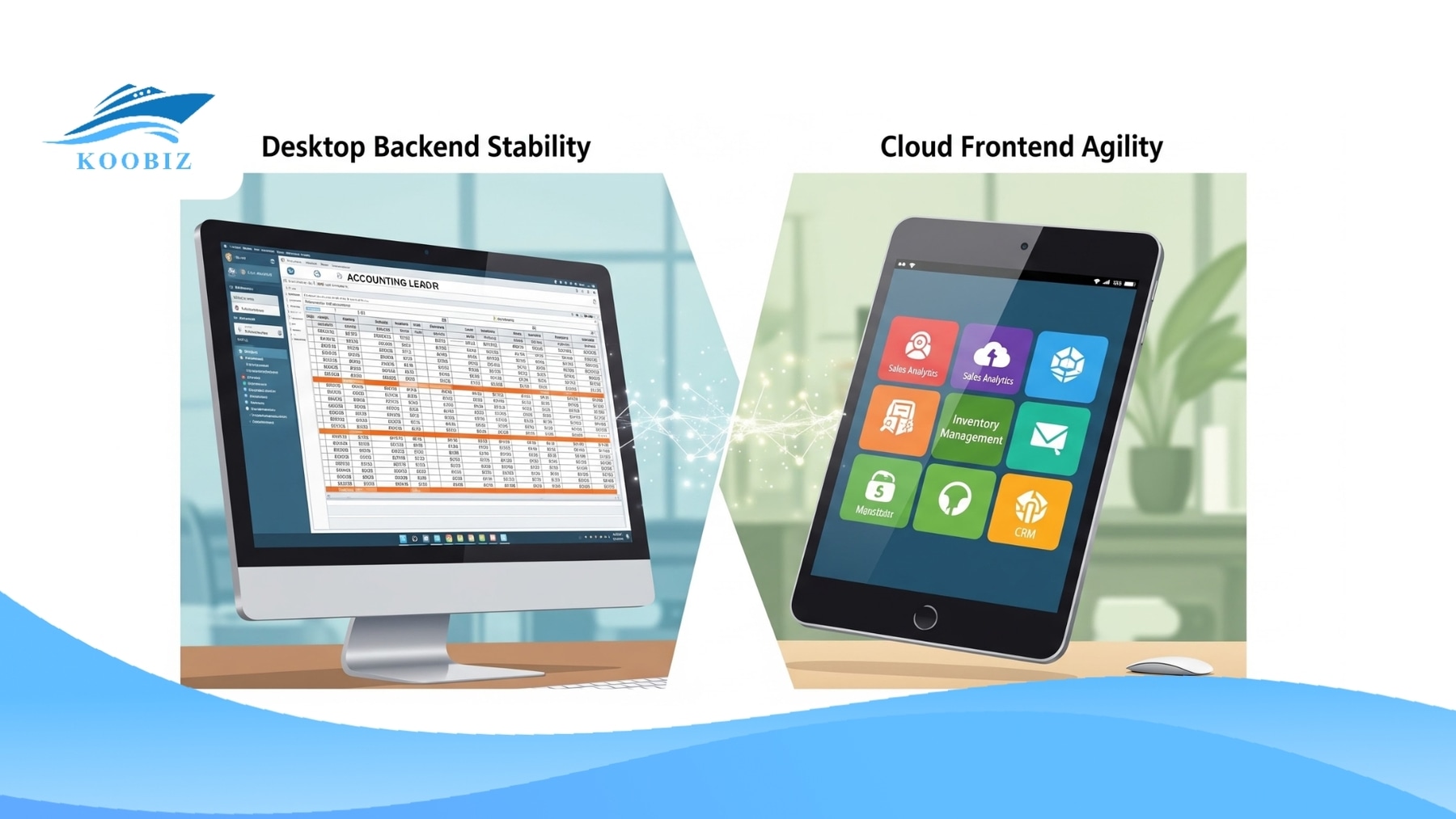
Moving to digital tools involves balancing trusted workflows with new automation. It’s important to consider specific operational needs that broad comparisons might miss.
The Koobiz Reality Check:
“In our work incorporating hundreds of Singapore companies, we see businesses sometimes adopt new software too quickly, only to find it disrupts their efficient routines. Digital transformation is about matching technology to your team’s real workflow. ‘Newer’ isn’t automatically ‘better’ if it hinders your core productivity.”
The “Desktop-Cloud Hybrid” Model: A Unique Middle Ground for SG SMEs
This model uses ABSS for reliable backend accounting and compliance, while adding cloud-based tools for frontend tasks like sales and inventory.
It allows businesses to separate “Agility” from “Stability” by using different software for different needs:
The Frontend Layer (Agility): Handles customer-facing tasks using cloud add-ons.
- Examples: Shopify (E-commerce), Salesforce (CRM), TradeGecko (Inventory).
- Benefit: Sales teams get modern tools on their phones.
The Backend Layer (Stability): Handles the “heavy lifting” using the ABSS engine.
- Examples: General Ledger, IRAS GST F5 Reporting, Audit Trails.
- Benefit: Finance teams keep the rigid compliance structure they need.
Why Traditional Bookkeepers in Singapore Still Prefer MYOB Over Pure Cloud
Many traditional bookkeepers favor MYOB because its keyboard-driven data entry is much faster for high-volume work than the click-heavy navigation of browser-based cloud software.
MYOB Speed (The Keyboard Warrior):
- Method: Alt + I + Enter. (Rapid-fire entry).
- Load Time: Zero. The interface is instant because it runs locally.
Cloud Speed (The Mouse Clicker):
- Method: Click ‘New Invoice’ > Wait for browser load > Click field.
- Load Time: Depends on internet speed and server response (often 1-3 seconds per page).
Data Migration Risks: Moving from Legacy MYOB to Cloud-Native Platforms
Switching from MYOB to a cloud platform is not a simple transfer. It can risk losing detailed historical data and disrupting established audit trails needed for compliance.
What Transfers Successfully:
- Opening Balances (Asset/Liability values).
- Active Contact Lists (Customers/Suppliers).
- Chart of Accounts structure.
What is Often Lost:
- Closed Invoices from previous years (Granular history).
- Detailed Audit Trails (Who edited what before the migration).
- Attached Receipts and older operational notes.
About Koobiz
Koobiz is your trusted partner for business expansion in Singapore. We specialize in Singapore company incorporation, corporate bank account opening, and comprehensive tax, accounting, and audit services. Whether you choose MYOB or a Cloud solution, our team of experts is ready to manage your financial compliance, ensuring your business meets all ACRA and IRAS requirements efficiently.
Visit us at: koobiz.com to start your business journey today.