

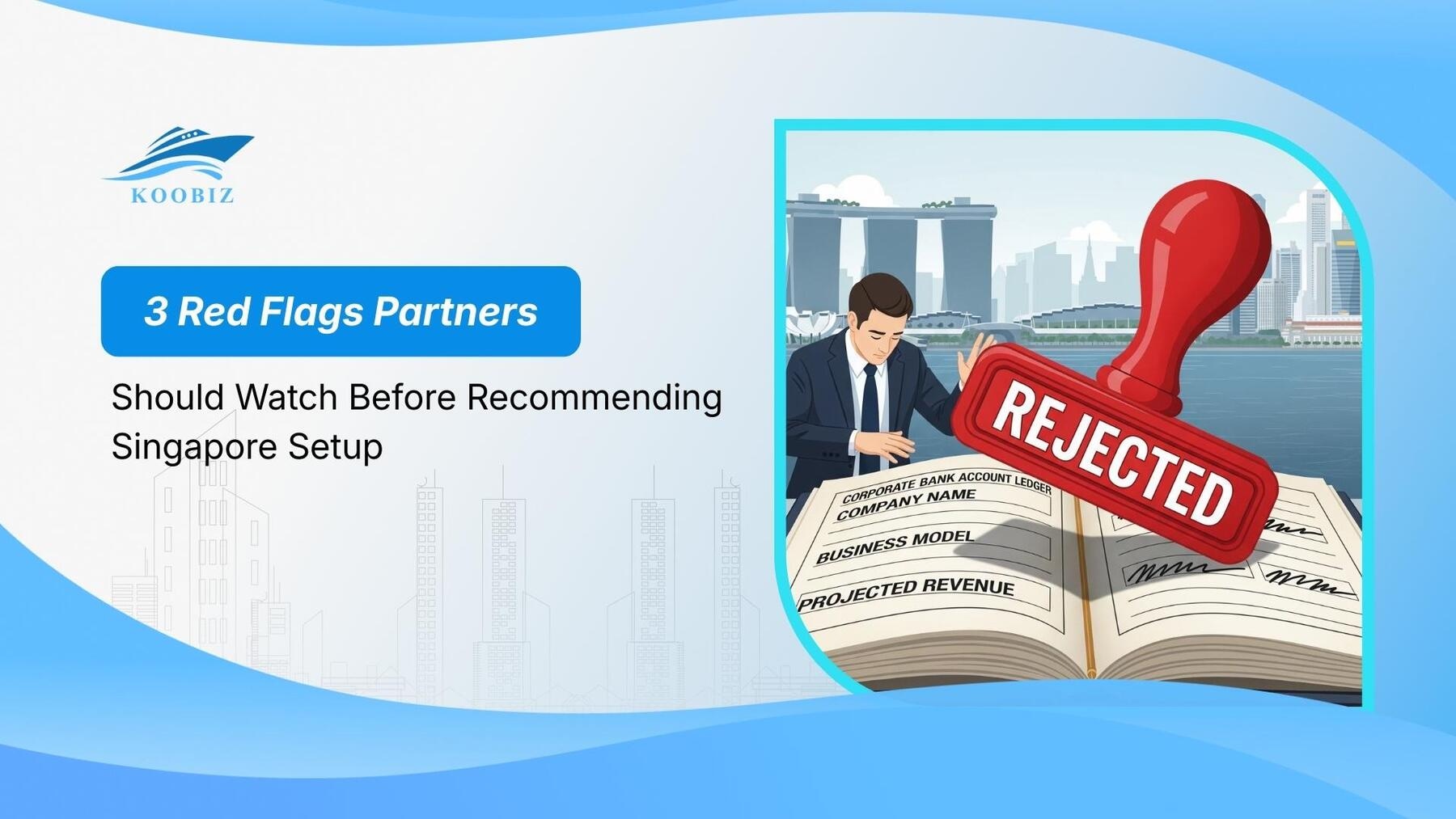
Singapore is widely recognised as a top-tier global financial centre, prized for its political stability, dependable legal framework and attractive tax landscape. That said, recommending a Singapore setup to international partners, intermediaries or consultants is never a blanket solution: it requires careful evaluation of compliance and real-world operational viability. The advantages are clear, but the regulatory bar is high, especially around AML and CFT. If a referred client is later turned away by banks or flagged by ACRA, the fallout can seriously harm the referrer’s reputation. To reduce that risk, partners must screen for three critical red flags: business models likely to be deemed “unbankable,” arrangements that resemble shell companies, and clients who resist director-level compliance. At Koobiz we specialise in navigating these issues so your referrals become compliant, workable and trusted Singapore entities.
Introduction: Why Partners Must Conduct Pre-Incorporation Due Diligence

Pre-incorporation due diligence means proactively confirming a client’s eligibility and genuine operational intent before any ACRA filings. It’s a vital filter that separates legitimate business expansion from high-risk arrangements that could run afoul of Singapore’s strict regulatory regime.
For partners and intermediaries, skipping this screening isn’t just an operational lapse — it brings real consequences:
- Wasted resources: time and effort spent on clients who are likely to be rejected by banks or regulators.
- Strained relationships: passing unvetted leads damages credibility with local Corporate Service Providers (CSPs) who depend on partners to pre-screen applicants.
- Legal exposure: facilitating high-risk structures can create potential liability under the Corruption, Drug Trafficking and Other Serious Crimes (Confiscation of Benefits) Act.
Unlike jurisdictions where incorporation is largely a formality, Singapore requires transparency. The emphasis has moved from “ease of doing business” to “responsible doing business”, so a client’s inability to meet compliance standards is often a deal-breaker rather than a minor hurdle. Identifying warning signs early is therefore essential to maintaining a high-quality, compliant client portfolio.
Red Flag #1: The “Unbankable” Business Model

From the perspective of Singaporean financial institutions, business models generally fall into two camps: those that fit within the country’s risk appetite, and those that are effectively “unbankable”. Spotting this red flag early requires partners to look for a few clear indicators.
- The symptom: the client operates in inherently high-risk industries (such as crypto or gambling), or relies on overly complex, multi-layered ownership structures with no clear commercial justification often designed to obscure the Ultimate Beneficial Owner (UBO).
- The consequence: the company turns into a “zombie entity” – legally incorporated, yet functionally paralysed because it cannot secure a corporate bank account to transact, meet tax obligations, or repatriate profits.
This distinction matters because a Singapore company without a bank account has little practical value. The red flag is not necessarily illegality, but a risk profile that exceeds what local banks are willing to accept. Partners need to recognise that Singapore banks apply some of the world’s most stringent KYC standards. Where a client operates in a volatile sector or cannot clearly explain the source and flow of funds, recommending a Singapore setup is likely to lead nowhere.
High-Risk Industries and Complex Structures
Some industries and ownership structures automatically attract heightened scrutiny. Partners can spot these risks early by identifying specific “triggers” within a client’s profile.
- The Trigger (Industry): The business deals in unregulated cryptocurrencies, ICOs, adult entertainment, or online gambling.
- The Evidence: Traditional Singapore banks will automatically reject applications from these sectors unless the client already holds a specific license from the Monetary Authority of Singapore (MAS).
- The Trigger (Structure): The proposed shareholder structure involves multiple layers of offshore holding companies (e.g., BVI, Seychelles) with no clear operational reason.
- The Evidence: Banks view this as an attempt to obscure the Ultimate Beneficial Owner (UBO). If the UBO cannot be immediately and clearly identified with a passport and proof of address, the KYC process will fail.
Lack of Proof of Business/Transactions
A client who is unable to produce concrete proof of their business operations poses a serious compliance risk. Partners should carefully review the client’s supporting documents to identify any gaps or inconsistencies.
- The Trigger: The client has no professional website, no corporate email domain (uses Gmail/Yahoo), and cannot produce a single invoice from previous business dealings.
- The Evidence: Banks mandate “proof of antecedent transactions”—typically 3 to 6 months of invoices or contracts—to verify the source of wealth. A “business plan” alone is often insufficient for foreign-owned startups without a local track record.
- The Trigger: The business description is vague (e.g., “General Consulting” or “Marketing Services”) without specific deliverables.
- The Evidence: Generic service descriptions are high-risk categories for shell companies. Koobiz data shows that 40% of rejections occur because the client cannot substantiate specific business activities with contracts.
Red Flag #2: The “Shell Company” Mindset

The “Shell Company” mindset refers to a client’s expectation of establishing a legal entity in Singapore solely for tax benefits, without intending to establish any real economic presence.
- The Symptom: The client focuses exclusively on “minimum cost” setup (e.g., SGD 1 capital), resides overseas, and has no intention of hiring local staff or holding board meetings in Singapore.
- The Consequence: Singapore authorities (IRAS) will deny the Certificate of Residence (COR), blocking access to tax treaties, and may trigger audits under the Base Erosion and Profit Shifting (BEPS) framework.
This mindset runs directly counter to modern international tax standards. Clients who think this way tend to ask, “What’s the cheapest way to incorporate?” instead of “How should I structure my operations?” That attitude is a major red flag, as Singapore authorities (IRAS and ACRA) actively scrutinise and penalise entities that lack genuine economic substance. By recommending such a setup, a partner is effectively steering the client straight into the path of a tax audit.
Misunderstanding Tax Residency vs. Incorporation
Incorporation simply establishes a legal entity, while tax residency depends on where the business is actually “controlled and managed.” Partners therefore need to assess the client’s true intentions when it comes to governance and decision-making.
- The Trigger: The client plans to hold all Board of Directors meetings via Zoom or in their home country, with no local executive director appointed.
- The Evidence: IRAS explicitly states that if “Control and Management” is not exercised in Singapore, the company is a non-resident for tax purposes.
- The Trigger: The client expects to use a standard Nominee Director to satisfy the “local director” requirement while retaining all decision-making power abroad.
- The Evidence: A standard nominee is a compliance officer, not an executive. Using a nominee does not create economic substance, and thus, the company will be denied the Certificate of Residence (COR) required for tax treaty benefits.
Inadequate Operational Budget (The $1 Setup Myth)
While it is legally possible to incorporate a Singapore company with a paid-up capital of SGD 1, relying on this minimum for a functioning business is a practical fallacy.
- The Trigger: The client insists on a paid-up capital of only SGD 1 and has no budget allocated for a registered office address, company secretary, or accounting fees.
- The Evidence: This signals a “dormant” or “shell” intent. Banks view SGD 1 setups as high-risk and will often refuse to open a corporate account until the capital is increased to a respectable amount (typically SGD 5,000 – SGD 10,000).
- The Trigger: The client views essential compliance costs (audit, tax filing) as “unnecessary expenses” rather than statutory obligations.
- The Evidence: This mindset leads to non-compliance with ACRA’s filing requirements, resulting in fines and eventual striking off of the company.
Red Flag #3: Refusal to Appoint a Qualified Local Director
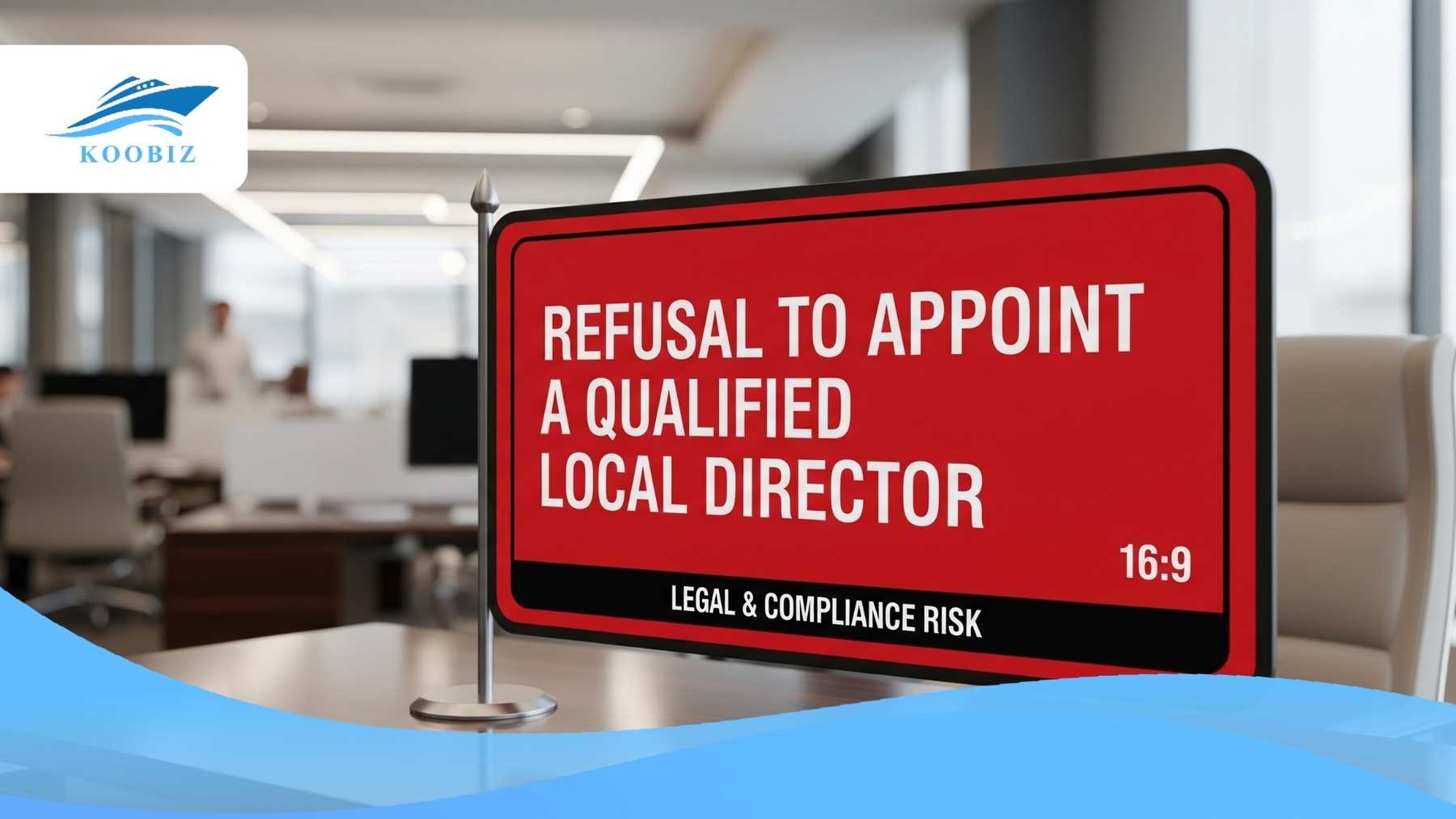
Refusal to appoint a qualified local director—or the attempt to use a “dummy” director without proper indemnification—is a critical indicator that the client may be trying to evade legal accountability.
- The Symptom: The client refuses to pay for a professional Nominee Director service, asks to use an unqualified individual, or attempts to bypass standard KYC/AML screening protocols.
- The Consequence: This triggers immediate legal liability for the partner/CSP under the Companies Act and can lead to the disqualification of the Ultimate Beneficial Owner (UBO) for failing to exercise reasonable diligence.
Under the Companies Act, every Singapore company is required to appoint at least one director who is “ordinarily resident” in Singapore, a role that comes with substantial fiduciary duties and legal exposure. A client who refuses to pay for a professional Nominee Director service, or expects a nominee to sign documents without proper oversight, represents a serious risk to both the partner and the service provider. Such conduct often signals an attempt by the UBO to distance themselves from the company’s activities – potentially to avoid accountability for questionable or illicit operations.
The Risks of “Cheap” Nominee Arrangements
There are legitimate Nominee Director services, and then there are high-risk, unregulated arrangements. Partners can spot dangerous clients by their approach to the nominee relationship.
- The Trigger: The client refuses to pay a security deposit for the Nominee Director service.
- The Evidence: Professional nominees require a deposit (refundable upon exit) to cover potential liquidation costs. Refusal usually indicates the client plans to abandon the company, leaving the nominee liable for penalties.
- The Trigger: The client asks if the nominee will “sign whatever we send them” (blind signing).
- The Evidence: This is a request for the nominee to breach their fiduciary duties. Koobiz nominees are strictly prohibited from signing contracts they have not vetted, as this creates immense legal liability for the firm.
Failure to Pass the CSP’s Internal AML Checks
Corporate Service Providers (CSPs) in Singapore are the first line of defense against money laundering. A client’s reaction to standard screening is a massive tell.
- The Trigger: The client is hesitant or refuses to provide notarized passport copies and proof of residential address for all shareholders.
- The Evidence: CSPs are legally required to maintain a Register of Registrable Controllers. Missing data forces the CSP to file a Suspicious Transaction Report (STR) with the police.
- The Trigger: Screening reveals the client is a Politically Exposed Person (PEP) or has Adverse Media (negative news) regarding fraud, but the client did not declare this.
- The Evidence: Non-disclosure of PEP status or financial crimes is a deliberate attempt to deceive the CSP. This results in immediate termination of services to protect the CSP’s license.
Beyond the Red Flags: Ensuring Economic Substance
Clearing the “Red Flags” is only the first step—it ensures your client avoids immediate rejection. However, to truly succeed in Singapore, partners must help clients pivot their mindset from “Surviving Compliance” to “Thriving through Substance.”
In the past, offshore setups were often about how little a company could exist physically while still claiming tax benefits. Today, that approach is obsolete. The new global standard is clear: value creation must align with profit taxation.
Partners play a crucial role in this transition. Instead of viewing Economic Substance as a regulatory hurdle, position it as a strategic asset. A company with real substance—staff, decision-making, and expenditure is not only audit-proof but also attractive to premium banking partners and investors. By focusing on substance, Koobiz ensures that your client’s Singapore entity transforms from a potential liability into a legitimate, high-value component of their global group.
What Constitutes “Control and Management” in Singapore?
Control and management is not merely about where the company is registered, but where the strategic decision-making actually takes place.
- The Rule: To qualify for tax residency and access Double Taxation Agreements (DTAs), strategic control must be exercised in Singapore.
- The Checklist:
- Are Board of Directors meetings physically held in Singapore?
- Is there a qualified local Executive Director with real decision-making authority?
- Do foreign directors travel to Singapore for key strategic votes?
- The Proof: IRAS requires detailed Board Minutes stating the venue as Singapore and travel records (flight tickets/immigration stamps) proving directors were physically present.
The Hidden Trap: Section 33 of the Income Tax Act
Section 33 is a potent anti-avoidance provision that allows the Comptroller of Income Tax to disregard arrangements made principally to avoid tax.
- The Rule: Even if a structure is technically legal, if it has no commercial justification other than tax reduction, IRAS can declare it void.
- The Checklist:
- Does the Singapore entity perform real functions (e.g., logistics coordination, quality control)?
- Does the entity assume real commercial risks (e.g., inventory risk, credit risk)?
- Are there local employees handling daily operations?
- The Proof: Employment contracts for local staff, office lease agreements, and transfer pricing documentation showing that transactions are conducted at arm’s length.
Comparison: Singapore vs. Traditional Tax Havens (BVI/Cayman)
Singapore sets itself apart from traditional tax havens such as the BVI or Cayman Islands by insisting on real business substance. While those jurisdictions may offer secrecy and zero-tax regimes, they come with reputational drawbacks and increasingly restricted access to banking.
For partners advising clients, the decision is ultimately between building sustainable, long-term operations and pursuing short-term opacity. The table below illustrates why Singapore remains the stronger option for businesses engaged in genuine trading activities.
| Feature | Singapore (Onshore Hub) | Traditional Havens (BVI/Cayman) |
|---|---|---|
| Banking Access | High: Access to top-tier global & local banks (DBS, OCBC, UOB). | Restricted: Extremely difficult to open accounts for trading companies; often forced to use EMIs. |
| Global Reputation | Excellent: “White-listed” jurisdiction; invoices are respected globally. | Scrutinized: Often flagged as high-risk; invoices may trigger withholding taxes abroad. |
| Tax Treaties (DTAs) | Extensive: Access to >90 Double Taxation Agreements. | None/Limited: Generally no access to tax treaty benefits. |
| Corporate Tax | 17%: (Effective rate often lower due to startups/industry incentives). | 0%: (But subject to economic substance rules without the treaty benefits). |
| Transparency | High: Strict AML/KYC; compliance with FATCA/CRS. | Privacy-Focused: Historically secretive, but facing immense global pressure to open up. |
The Verdict: While BVI and Cayman remain useful for specific holding structures or investment funds, they are increasingly viable only for institutional players. For a typical trading business or startup, a Singapore setup provides the operational legitimacy required to scale.
How Partners Can Pre-screen Clients Efficiently
Partners can streamline the referral process by implementing a standardized pre-screening checklist that filters out high-risk applicants before engaging a CSP.
To maximize the success rate and protect your credibility, consider requiring the following before recommending a setup:
- Comprehensive CV: Does the UBO have experience in the proposed industry?
- Source of Wealth Declaration: Can they prove how the startup capital was generated?
- Proof of Business: Do they have a website, brochures, or contracts?
- Business Plan: Is there a realistic forecast of revenue and local expenditure?
- Capital Commitment: Are they willing to deposit adequate paid-up capital?
By enforcing this checklist, you filter out the “Red Flags” early. At Koobiz, we work closely with our partners to review these documents, providing a preliminary assessment of “bankability” and compliance before any fees are exchanged.
About Koobiz
Navigating the complexities of Singapore’s regulatory environment requires more than just filling out forms; it demands a strategic partner who understands the nuances of compliance, banking, and tax planning. Koobiz (koobiz.com) is your trusted gateway to doing business in Singapore. We specialize in comprehensive corporate services, including Singapore company incorporation, corporate bank account opening consulting, tax optimization, accounting, and auditing services.
Whether you are a partner looking to refer clients or a business owner ready to expand, Koobiz ensures that your setup is robust, compliant, and primed for growth. Don’t let red flags derail your expansion—contact Koobiz today for a professional assessment.