


For global investors entering the Asian market, establishing a Singapore Private Limited Company (Pte Ltd), also known as LLC is a critical first step. As a separate legal entity, in Singapore, LLC creates a protective corporate veil, ensuring clear separation between personal assets and business liabilities—unlike a sole proprietorship or partnership. This guide explores the definitive structure, foreign ownership rights, and tax attributes that make the Singapore LLC the gold standard for entrepreneurs.
What Is the Definition of a Limited Liability Company (LLC) in Singapore?
A Singapore Limited Liability Company (LLC), formally registered as a Private Limited Company (Pte Ltd), is recognized by law as a legal entity separate from its owners. This structure means the company itself is responsible for its own debts and legal obligations, shielding the personal assets of its members from business liabilities. Thanks to this separation, the company operates in its own name: it can acquire property, enter into contracts, and initiate or be subject to legal action independently of the individuals who manage it.
To understand this core principle, imagine the LLC as a distinct legal “person,” much like an adult individual. This separate legal identity is crucial. It ensures the company’s survival is not tied to its founders—it enjoys “perpetual succession” and continues to operate independently until formally dissolved.This characteristic makes the LLC an excellent vehicle for attracting investment. Shareholders can confidently buy in, knowing their personal assets remain protected from the company’s operational risks and liabilities.
How Does Limited Liability Protection Work for Shareholders?
The “corporate veil” created by a Private Limited Company establishes a crucial legal boundary. It limits a shareholder’s financial risk strictly to the amount they have invested in the company’s shares. Consequently, in situations such as business debt, legal action, or insolvency, creditors’ claims are confined to the company’s assets. The personal assets, savings, and property of the individual shareholders remain protected behind this veil.
Your liability is strictly limited to your share capital. If you have fully paid SGD $10,000 for your shares, you have no further obligation—even if the company fails with substantial debt. For unpaid shares, liability is capped at the outstanding amount. This protection encourages entrepreneurship by allowing calculated risks without jeopardizing personal assets like your home or savings.
Can Foreigners Hold 100% Ownership of a Singapore LLC?
Yes, Foreign individuals and corporations are permitted to own 100% of a Singapore Private Limited Company (LLC). There is no legal requirement for a local Singaporean partner or sponsor, a policy that underscores Singapore’s commitment to an open economy and its strategy to attract global entrepreneurs and foreign investment by offering full equity control.
This places Singapore in a distinct position within Southeast Asia, where many countries restrict foreign ownership to a minority stake or mandate complex local partnership structures. In a Singapore LLC, a foreign entity or individual can be the sole shareholder. It’s important to note, however, that while you can own 100% of the company, you must still appoint at least one director who is ordinarily resident in Singapore to manage the company’s statutory obligations.
Key Tax Attributes and Benefits
Singapore’s Private Limited Company structure is bolstered by three key tax advantages: a competitive corporate tax rate, the Start-Up Tax Exemption (SUTE) scheme, and a policy of tax-exempt dividends.These fiscal policies are designed to incentivize profit reinvestment and enhance returns for shareholders.
Corporate Tax Rate
Singapore imposes a flat corporate income tax rate capped at 17% on chargeable income, which is significantly lower than the global average.Singapore maintains a competitive corporate tax system, with a flat rate capped at 17% on taxable income. This rate is considerably more favorable compared to the global average. Tax Exemptions (SUTE)
For new companies, the Start-Up Tax Exemption (SUTE) scheme significantly reduces your tax bill for the first three consecutive years. Eligible start-ups benefit from a 75% tax exemption on their first SGD 100,000 of taxable income, plus an additional 50% exemption on the next SGD 100,000. This structure effectively shelters a significant portion of early-stage profits, providing vital financial support during the critical growth phase.
0% Dividend Tax
Singapore’s single-tier tax system simplifies profit distribution: once a company has paid corporate tax on its profits, any dividends paid to shareholders are completely exempt from further taxation.
Types of LLCs in Singapore
Beyond the general “Private Limited” designation, Singapore structures LLCs into three specific categories, each defined by its shareholding model. Choosing the right one is a critical step, as it directly impacts your regulatory compliance and access to financing.
Private Limited Company (Pte Ltd)
This is the standard form of LLC. It has fewer than 50 shareholders and restricts the right to transfer shares. It offers an optimal balance of flexibility and scalability for small to medium-sized enterprises (SMEs).
Exempt Private Company (EPC)
An Exempt Private Company (EPC) is a specialized type of Private Limited Company designed for closely-held ownership. It is limited to 20 individual shareholders (with no corporate shareholders) and enjoys distinct advantages. These benefits include greater flexibility in providing loans to directors. Furthermore, most EPCs meet the “Small Company” criteria (with annual revenue below SGD 10 million), which grants them an exemption from mandatory statutory audits—a significant administrative and cost-saving advantage.
Public Company Limited by Guarantee
This entity type is primarily designed for non-profit and charitable activities, as it operates without share capital. Instead, its members provide a guarantee to cover a fixed amount of the company’s liabilities in the event of winding up. This structure is seldom the appropriate choice for commercial trading purposes.
Advantages and Disadvantages of a Singapore LLC
Opting for an LLC structure requires balancing its strong liability protection and favorable tax regime against the increased compliance obligations relative to simpler business forms.
Advantages
- Personal Asset Protection: The core “limited liability” feature legally shields shareholders’ personal assets from business debts.
- Tax Efficiency: Companies benefit from Singapore’s competitive 17% corporate tax rate and valuable incentives like the Start-Up Tax Exemption (SUTE).
- Enhanced Credibility: The “Pte Ltd” designation builds trust with financial institutions, partners, and investors by conveying a formal, established presence.
- Operational Continuity: The company enjoys perpetual succession, meaning it exists independently of its owners and continues despite changes in ownership or management.
Disadvantages
- Regulatory Requirements: Maintaining compliance involves ongoing costs, including a mandatory Corporate Secretary, annual filings, and in some cases, statutory audits.
- Public Transparency: Key company information—such as details on directors, shareholders, and capital—is part of the public record via the Accounting and Corporate Regulatory Authority (ACRA).
- Formal Winding-Up: Dissolving a company requires a formal legal procedure known as “Striking Off,” which can take several months to complete.
Comparison: LLC vs. Sole Proprietorship
When it comes to risk between two types of company, the distinction is critical.
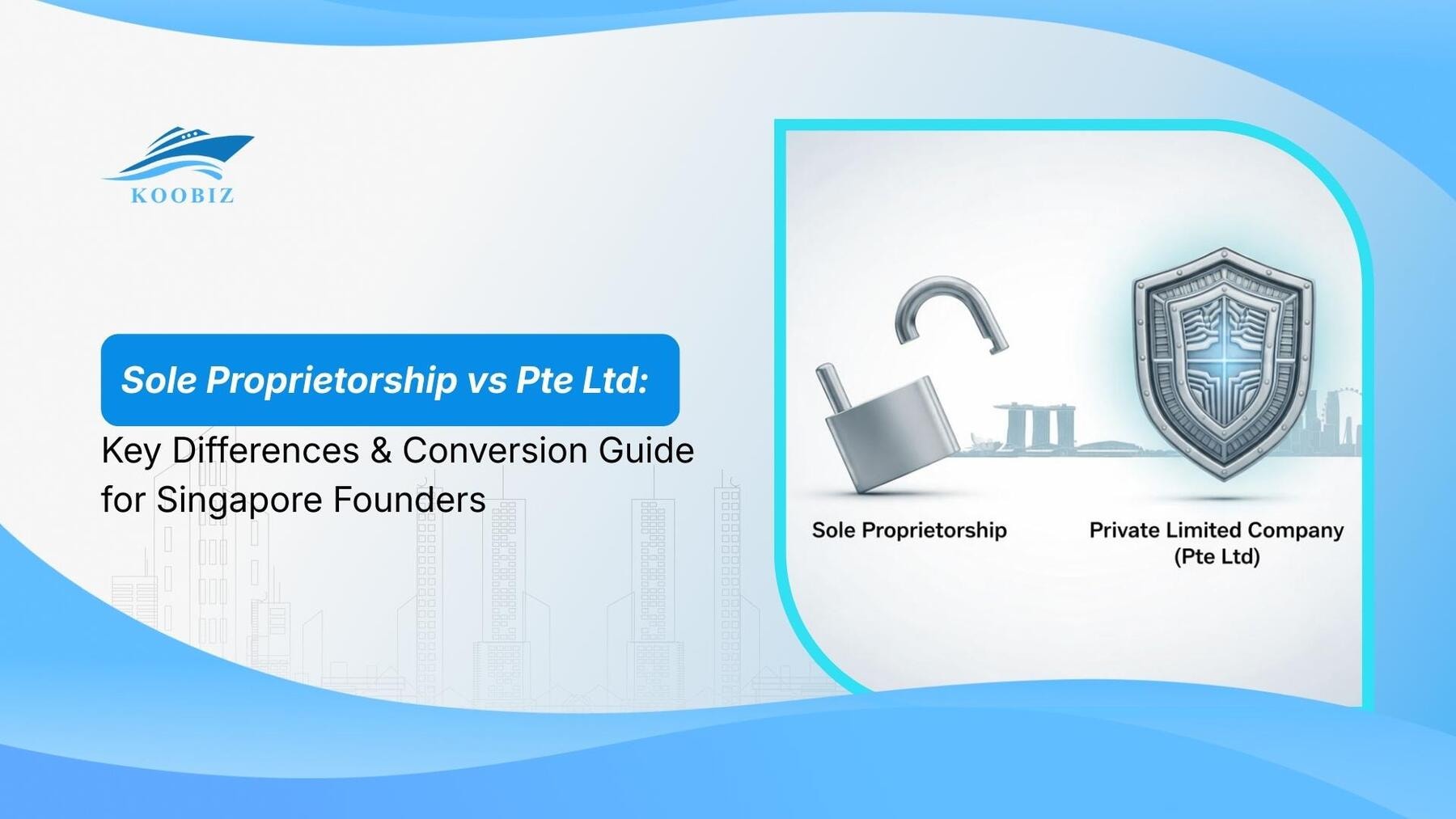
- A Private Limited Company (Pte Ltd) provides Limited Liability. If the company cannot meet its debts, your personal assets—such as your home or savings—are protected from creditors.
- A Sole Proprietorship, however, carries Unlimited Liability. You and the business are legally inseparable. Should the business fail, you are personally liable for all debts, risking personal bankruptcy.
This fundamental contrast is why a Private Limited Company is the essential structure for entrepreneurs who plan to grow and protect their personal wealth.
Mandatory Key Roles and Compliance Requirements
To establish a compliant Singapore Private Limited Company, specific roles must be filled as mandated by the Accounting and Corporate Regulatory Authority (ACRA).
Why Is a Local Resident Director Required?
Singapore law requires at least one director who is “ordinarily resident” in the country (e.g., a Citizen, Permanent Resident, or holder of an eligible pass). This ensures there is always an accountable person within Singapore’s legal jurisdiction.
For founders residing overseas, professional services like Koobiz offer Nominee Director solutions to fulfill this requirement while safeguarding your business’s operational control.
What Is the Function of a Corporate Secretary?
Every company must appoint a qualified Corporate Secretary within six months of incorporation. This specialist is responsible for ensuring compliance with the Singapore Companies Act, including arranging Annual General Meetings (AGMs) and filing annual returns. Professional agencies like Koobiz often provide this service to guarantee deadlines are met and obligations are managed accurately.
What Is the Minimum Paid-Up Capital Requirement?
The barrier to entry is low: a company can be incorporated with a minimum paid-up capital of just SGD $1. This provides flexibility to start lean, with the option to increase capital at any time as the business expands.
How Do You Register an LLC in Singapore? (Step-by-Step)
Incorporating an LLC in Singapore is conducted digitally through ACRA’s BizFile+ platform, and foreign founders typically engage a professional filing agent to navigate the process smoothly.
- Name Reservation: Propose a unique company name to ACRA for approval.
- Prepare Documents: Prepare the necessary paperwork, including the Company Constitution, signed Consent to Act forms, and KYC documents for all directors and shareholders.
- Registration: Once documents are ready, the application is submitted via BizFile+. With a qualified incorporation partner, such as Koobiz, this step can often be completed within hours.
- Post-Formation: Receive your UEN (Unique Entity Number). The next key steps include appointing a Corporate Secretary and opening a corporate bank account to commence operations.
Ready to Launch Your Singapore LLC?
Navigating the nuances of foreign ownership, tax exemptions, and statutory compliance can be complex, but you don’t have to do it alone.
Koobiz specializes in helping global entrepreneurs incorporate and manage their Singapore companies with ease. From fast incorporation filing to providing trusted Nominee Directors and Corporate Secretaries, we ensure your business is compliant from Day 1.
- Fast Incorporation: Get your Pte Ltd running in as little as 24 hours.
- Full Compliance: We handle the paperwork, AGMs, and ACRA filings.
- Global Support: 100% remote setup support for foreign owners.