

Choosing between a US-style Limited Liability Company (LLC) and a Singapore Private Limited Company (Pte Ltd) is the critical first step for expansion. While both offer limited liability, the Pte Ltd is generally the superior choice for scalable businesses in Singapore due to its tax efficiency and professional credibility.
At Koobiz (koobiz.com), we often advise clients that while a Pte Ltd requires stricter compliance, the trade-off – access to Singapore’s extensive tax treaties and a robust corporate image is invaluable for long-term growth.
Is a Singapore Pte Ltd the Same as a US LLC?
No, a Singapore Pte Ltd is not legally identical to a US LLC, although they share the fundamental characteristic of limiting the owner’s liability to their investment amount.
To elaborate on this distinction, an LLC (Limited Liability Company) in the United States is a hybrid entity that combines the operational flexibility of a partnership with the liability protection of a corporation. In contrast, a Pte Ltd (Private Limited Company) is a purely corporate entity governed by the Singapore Companies Act, possessing a distinct legal personality separate from its owners. This means a Pte Ltd can own property, sue, and be sued in its own name, independent of its shareholders. While an LLC is often treated as a “pass-through” entity for tax purposes, a Pte Ltd is a tax resident in its own right. Understanding this legal separation is the first step in recognizing why the Pte Ltd structure is preferred for serious business operations in Asia.
What Are the Key Differences Between LLC and Pte Ltd?
The key differences between an LLC and a Pte Ltd lie in their ownership structure, liability protection mechanisms, and capital raising capabilities, with the Pte Ltd offering a more formalized framework suitable for growth.
| Feature | US LLC | Singapore Pte Ltd |
|---|---|---|
| Legal Identity | Hybrid Entity (Partnership/Corp mix) | Separate Legal Entity |
| Ownership | Members (Flexible management via Operating Agreement) | Shareholders (Managed by Directors, governed by a Constitution) |
| Liability | Limited (Varies by state) | Limited (Strict Corporate Veil) |
| Taxation | Pass-through (Personal Income Tax) | Corporate Tax (Singapore’s headline CIT rate is 17%) |
| Capital Raising | Difficult (VCs dislike pass-through) | Easy (Preferred by VCs) |
| Governing Doc | Operating Agreement | Constitution |
While both structures shield personal assets, the method by which they manage control and attract funding varies drastically. An LLC is designed for flexibility and ease of management, often blurring the lines between ownership and operation, whereas a Pte Ltd establishes a clear hierarchy that institutional investors prefer. This structural rigidity, while seemingly complex, provides the certainty required for high-stakes business dealings.
How Do Ownership and Management Structures Differ?
Ownership in a US LLC is vested in “Members,” whereas a Singapore Pte Ltd is owned by “Shareholders”, leading to distinct management hierarchies.
In an LLC, the owners are referred to as members, and the management structure is defined by an Operating Agreement. This allows for a decentralized management style where members can manage the business directly (Member-Managed) or appoint managers (Manager-Managed). Conversely, a Pte Ltd is strictly governed by its Constitution (formerly Memorandum and Articles of Association). The shareholders own the company, but the management is delegated to a Board of Directors. For foreign entrepreneurs, this is crucial because Singapore law requires at least one director to be a local resident (Citizen, Permanent Resident, or Employment Pass holder), which often means using Koobiz’s nominee director service initially. This clear separation of ownership (Shareholders) and control (Directors) allows for a scalable governance structure that an LLC often lacks.
What Are the Liability Protections for Owners?
Both structures offer limited liability, but the Pte Ltd upholds a stricter “Corporate Veil” that is harder to pierce than that of a typical LLC.
In a Pte Ltd, the liability of shareholders is strictly limited to the amount of share capital they have subscribed to but not yet paid. Once their shares are fully paid up, they have no further financial obligation to the company’s creditors. Personal assets such as homes, cars, and personal savings are legally untouchable by business debts.
While US LLCs also offer this protection, the “piercing of the corporate veil” can occur more easily in LLCs if the court finds that the business and owner are not sufficiently separate (alter ego theory), especially if formalities like meetings are not observed. The Pte Ltd’s mandatory statutory compliance strengthens this legal barrier, providing superior asset protection for the entrepreneur.
Which Structure is Better for Capital Raising and VC Funding?
The Pte Ltd structure is significantly better for capital raising and Venture Capital (VC) funding compared to an LLC due to its ability to issue distinct classes of shares.
Startups aiming for rapid growth almost exclusively incorporate as Pte Ltd companies because VCs and institutional investors require a corporate structure that allows for the issuance of preference shares or convertible notes. Investors generally avoid LLCs because the “pass-through” tax nature of an LLC can create complex tax liabilities for the fund’s own investors (specifically unrelated business taxable income). A Pte Ltd acts as a tax blocker, meaning the investor only deals with taxes on dividends (which are tax-exempt in Singapore) or capital gains (also tax-exempt). Therefore, if your goal is to exit or raise Series A funding, a Pte Ltd is the industry standard.
Which Structure Offers Better Tax Benefits for Foreigners?
A Singapore Pte Ltd typically offers superior tax benefits for foreigners compared to a US LLC due to Singapore’s single-tier corporate tax system versus the US pass-through taxation model.
Taxation is often the deciding factor for incorporation. While an LLC might seem simpler because it avoids corporate tax at the entity level, it exposes the foreign owner to personal income tax rates which can be significantly higher. Singapore’s jurisdiction is territorially based, meaning foreign-sourced income not remitted to Singapore may not be taxed, whereas US LLCs often entangle owners in the global US tax net.
How Does Taxation Work for a US LLC?
A US LLC utilizes “pass-through taxation”, meaning the business itself pays no tax, but profits are funneled to the owners to be reported on their personal tax returns.
This can be advantageous for local US small business owners who want to avoid double taxation. However, for a foreign entrepreneur, this can be detrimental. If you are considered engaged in a US trade or business, you are subject to US progressive personal income tax rates (up to 37%) and potentially the Self-Employment Tax (Social Security and Medicare taxes). Furthermore, the “Check-the-box” regulation allows LLCs to choose how they are taxed, but navigating this as a non-resident alien is complex and often results in a heavier tax burden than anticipated.
How Does Singapore’s Single-Tier Tax System Work for Pte Ltd?
Singapore employs a single-tier tax system where the Pte Ltd pays a flat Corporate Tax rate of 17%, and dividends distributed to shareholders are completely tax-exempt.
This system effectively eliminates double taxation for shareholders. Moreover, the effective tax rate is often much lower than 17% due to the Start-Up Tax Exemption (SUTE) scheme. Under SUTE, new companies receive a 75% exemption on the first SGD 100,000 of chargeable income and a 50% exemption on the next SGD 100,000 for the first three consecutive years. Additionally, Singapore has 0% Capital Gains Tax, meaning if you sell your shares or the company creates profit from selling assets, that income is tax-free. For foreign entrepreneurs, this structure ensures that once corporate tax is paid, the remaining profit is yours to keep without further deductions.
Koobiz Insight: Utilizing Singapore’s network of over 90 Double Taxation Agreements (DTAs) can further reduce withholding taxes on international trade. At Koobiz, we help structure your Pte Ltd to maximize these treaty benefits.
Pros & cons of a Pte Ltd (summary)
The main advantages of a Pte Ltd include high credibility and tax efficiency, while the primary disadvantages are the higher compliance costs and stricter administrative requirements.
To summarize the decision-making process:
Pros:
- Credibility: A “Pte Ltd” suffix commands respect from banks, suppliers, and clients, signaling a commitment to longevity.
- Perpetual Succession: The company continues to exist even if shareholders die or resign.
- Tax Efficiency: corporate tax, start-up exemptions, and no capital gains tax in Singapore.
- Ease of Transfer: Ownership can be transferred simply by selling shares.
Cons:
- Higher compliance costs (secretarial, filings).
- More formalities for corporate governance.
- Deregistration / winding down takes longer than dissolving a sole proprietorship.
Having weighed these points, many foreign entrepreneurs find a Pte Ltd the optimal choice for regional growth. Koobiz supports founders from formation through compliance (nominee director solutions, company secretarial, tax advisory, and ongoing filings).
What Are the Registration and Compliance Requirements for a Pte Ltd?
The requirements for a Pte Ltd generally fall into two categories: Initial Registration requirements involving personnel and capital, and Annual Compliance requirements involving reporting to government authorities.
Unlike some jurisdictions where you can register a company with just an email, Singapore maintains its reputation as a trusted financial hub by enforcing strict Know-Your-Customer (KYC) and Anti-Money Laundering (AML) regulations. This means the barrier to entry is slightly higher, but it ensures the legitimacy of your business. Koobiz specializes in navigating these regulatory waters for foreign clients, ensuring a seamless setup process.
Initial Registration Requirements for Foreigners
To register a Pte Ltd, a foreigner must appoint at least one locally resident director, a company secretary, and provide a local registered address.
Specifically, the requirements include:
- Shareholding: Minimum of 1 and maximum of 50 shareholders (can be foreign individuals or entities).
- Share Capital: Minimum paid-up capital of SGD 1.
- Resident Director: You must have at least one director who is “ordinarily resident” in Singapore. Foreigners often use a Nominee Director Service provided by firms like Koobiz to satisfy this requirement until they can obtain an Employment Pass to act as the local director themselves.
- Company Secretary: Must be appointed within 6 months of incorporation.
- Address: A physical local address (P.O. Box is not allowed).
Annual Filing and Compliance Requirements
Every Pte Ltd must hold an Annual General Meeting (AGM) and file both Annual Returns with ACRA and Tax Returns with IRAS.
Compliance is non-negotiable in Singapore.
- Annual General Meeting (AGM): Must be held typically within 6 months after the Financial Year End (FYE).
- Annual Return (AR): Must be filed with the Accounting and Corporate Regulatory Authority (ACRA) within 7 months of the FYE.
- Tax Filing: Companies must file Estimated Chargeable Income (ECI) within 3 months of FYE and the Corporate Income Tax Return (Form C-S/C) by November 30th. Failure to meet these deadlines can result in penalties or court summons for the directors.
Need help with Compliance? Incorporating is just the start. Koobiz provides comprehensive Corporate Secretarial services to handle your AGMs, AR filings, and ensure you never miss a deadline. Get Started with Koobiz Incorporation Services Today
LLP vs Pte Ltd
An LLP offers limited liability but is taxed through partners (personal tax rates apply). LLPs suit professional partnerships (accountancy, law) where partner taxation at personal rates is acceptable. For scale and outside investor-friendliness, Pte Ltd is usually superior.
Other structures: Sole proprietorship
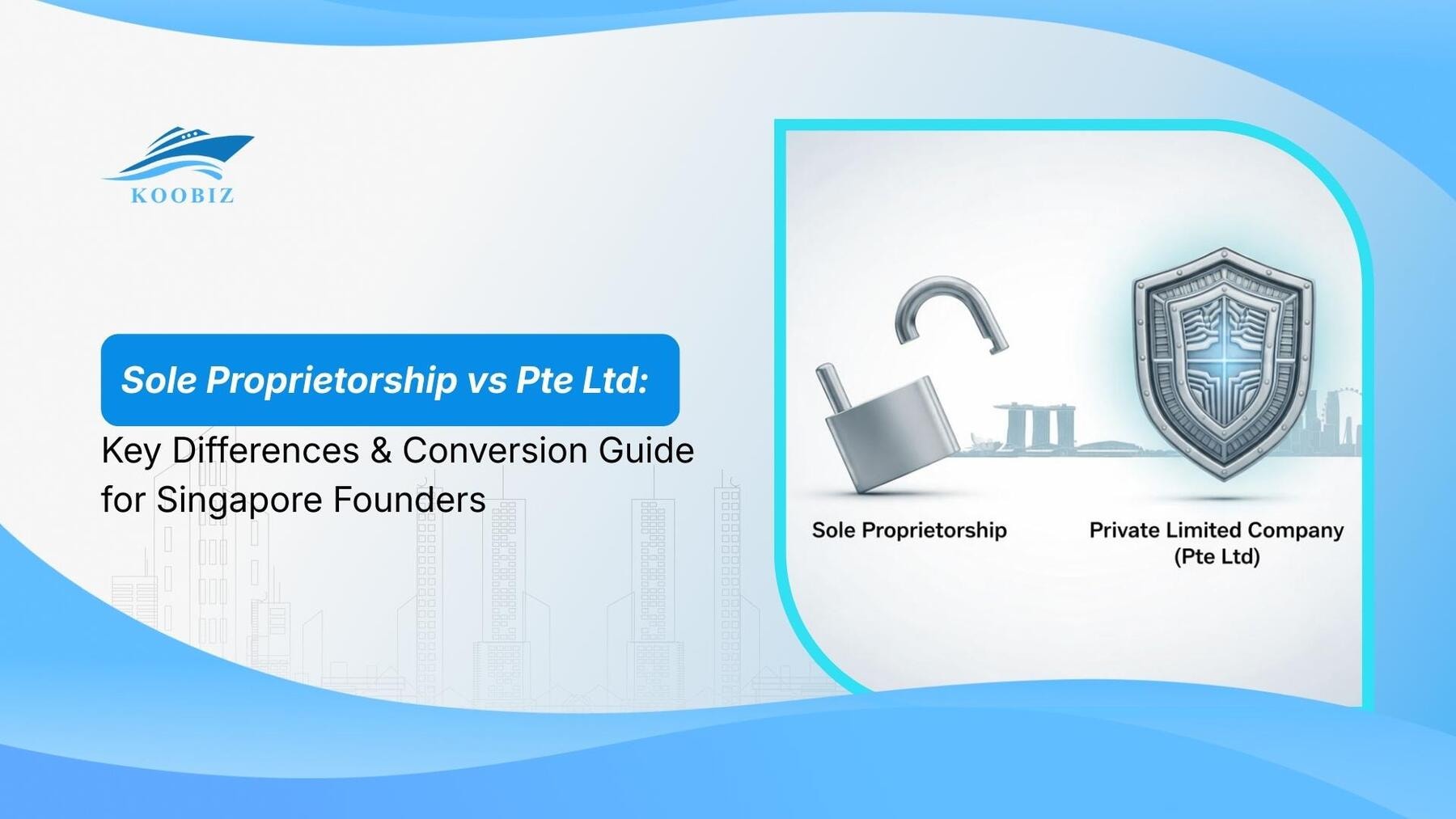
Sole proprietorships are easy to set up but offer no limited liability – personal assets are at risk. Foreigners must appoint a local manager, and there are limited tax incentives compared with Pte Ltd.
International tax & treaties
Singapore maintains an extensive DTA network (around 100 DTAs/limited DTAs/EOI arrangements), which helps reduce withholding taxes for cross-border trading and investment. Koobiz advises on structuring to maximize treaty benefits where applicable.
Ready to Incorporate Your Singapore Company?
Choosing between a Pte Ltd and other structures is just the first step. Navigating the incorporation process, securing a nominee director, and ensuring tax compliance requires a partner who understands the local landscape.
At Koobiz, we simplify market entry for foreign entrepreneurs. From same-day incorporation to ongoing corporate secretarial support, our team ensures your business is set up for success from day one.
Don’t let bureaucracy slow you down. Book a Free Consultation with Koobiz and let us handle the paperwork while you focus on building your business.
Frequently Asked Questions (FAQs)
Can I convert my existing US LLC into a Singapore Pte Ltd?
No, you cannot directly “convert” a US entity into a Singapore entity due to different legal jurisdictions. You would typically incorporate a new Pte Ltd in Singapore and transfer assets or set it up as a subsidiary.
Do I need to physically visit Singapore to set up a Pte Ltd?
No, the entire incorporation process can be done online. However, you will need to engage a registered filing agent (like Koobiz) to submit the application to ACRA on your behalf.
What is the minimum paid-up capital required?
The minimum paid-up capital is just SGD 1. You can increase this amount later as your business grows or if you need to apply for work passes.
How long does the incorporation process take?
With all documents prepared and no complex compliance issues, a Pte Ltd can often be incorporated within 24 hours.