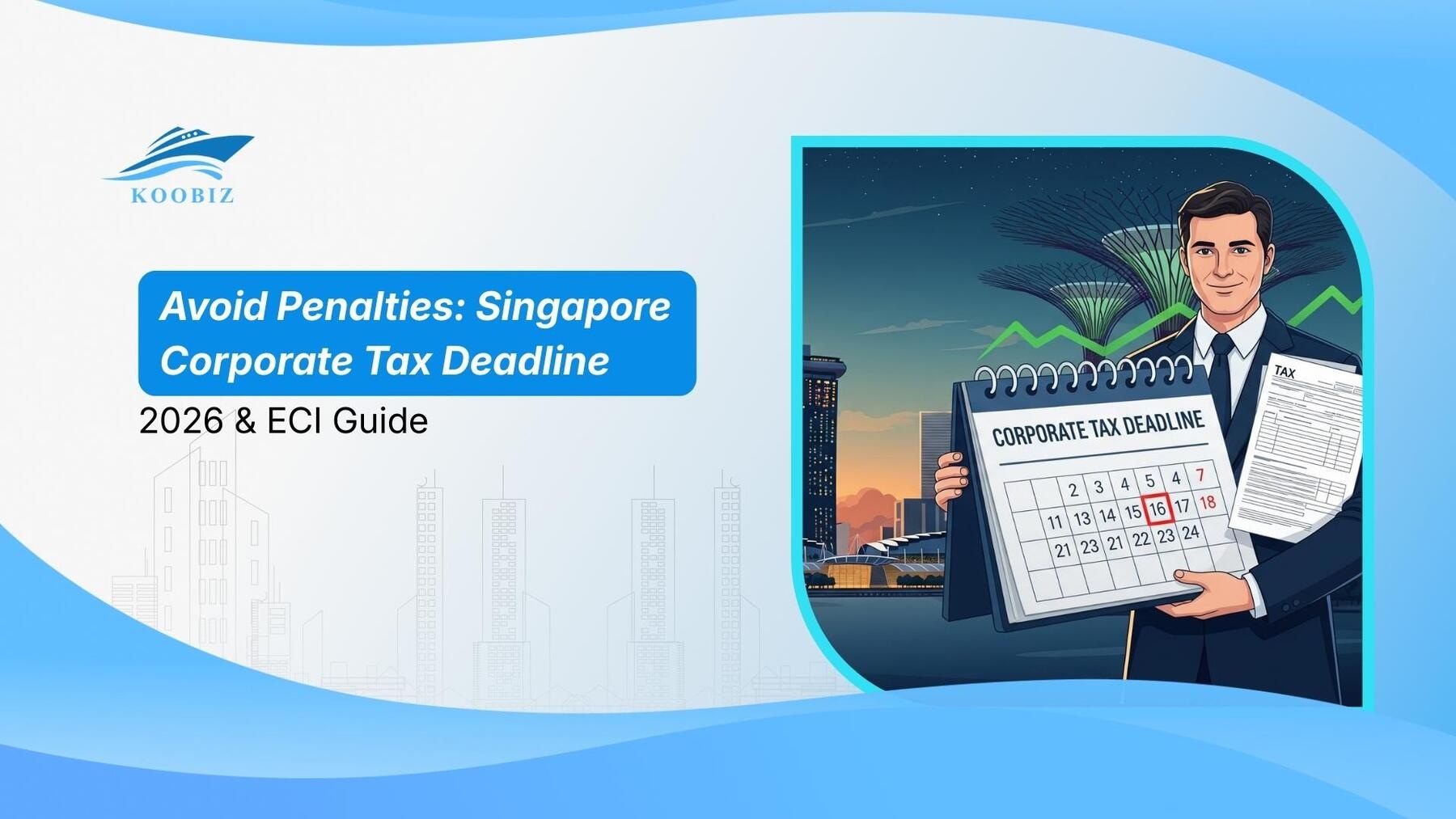


Stay on top of corporate tax filing deadlines in Singapore and ensure your business remains compliant. Learn the key deadlines for ECI and Corporate Tax Returns, and follow simple steps to avoid fines and stay on track with IRAS.
What Is the Corporate Tax Filing Deadline in Singapore?
The corporate tax filing deadline in Singapore refers to the statutory dates set by the Inland Revenue Authority of Singapore (IRAS) for companies to submit their corporate tax information each year. All companies, including dormant companies or loss-making entities, are required to comply to avoid penalties.
Corporate tax filing in Singapore involves two separate stages:
- Estimated Chargeable Income (ECI): Must be filed within three months after the company’s Financial Year End (FYE), unless the company qualifies for an ECI filing waiver.
- Corporate Income Tax Return (Form C-S, Form C-S Lite, or Form C): Must be filed by 30 November of the following Year of Assessment (YA).
Unlike in many other jurisdictions, Singapore’s corporate tax deadlines are not based on the calendar year. Instead, they depend on your company’s FYE. Understanding how these deadlines work is essential to stay compliant and avoid late filing penalties or composition fines imposed by IRAS.
The Two Corporate Tax Filing Deadlines Companies Must Meet
As mentioned, corporate tax filing in Singapore involves two critical deadlines. Each serves a distinct regulatory purpose and follows its own timeline. Let’s take a closer look at these requirements with Koobiz to help you stay ahead of your compliance obligations.
Estimated Chargeable Income (ECI) Filing Deadline
The ECI is a preliminary declaration of your company’s estimated taxable income for the financial year.
- Deadline: Within 3 months after the company’s Financial Year End (FYE).
- Who must file: Most companies, regardless of their profitability.
- Possible Waiver: Your company is exempt from filing ECI if it meets both IRAS conditions: Annual revenue does not exceed SGD 5 million, and ECI is nil.
Why it matters: Filing the ECI allows IRAS to assess your tax payable early and, where applicable, grant interest-free installment payment plans. Even if your tax liability is zero, missing this deadline without a waiver can still trigger IRAS penalties.
Corporate Income Tax Return (Form C-S / Form C) Filing Deadline
The final stage is filing the Corporate Income Tax Return, which reports your company’s actual taxable income.
- Deadline: 30 November of the following Year of Assessment (YA).
- Submission Forms:
- Form C-S / Form C-S Lite: Simplified filing for qualifying small and medium-sized enterprises (SMEs).
- Form C: For companies that do not meet the simplified filing criteria.
Note: This filing is mandatory even for dormant or loss-making entities. Unlike the ECI, there is no automatic waiver for the Income Tax Return, making this deadline the most critical date for corporate compliance.
How Financial Year End Affects Corporate Tax Filing Deadlines
Many companies in Singapore miss tax deadlines simply because they do not clearly understand the relationship between Financial Year End (FYE) and Year of Assessment (YA). These two concepts are closely linked and together determine when your corporate tax filings are due.
Distinguishing Financial Year End (FYE) vs. Year of Assessment (YA)
Financial Year End (FYE) and Year of Assessment (YA) play different but closely related roles in Singapore’s corporate tax system. Importantly, tax filing deadlines are based on FYE and YA — not the calendar year.
| Feature | Financial Year End (FYE) | Year of Assessment (YA) |
|---|---|---|
| Definition | End of your company’s accounting period | Year IRAS assesses and taxes the income |
| Purpose | Determines when income is earned | Determines when tax is reported and paid |
| Flexibility | Chosen by the company | Fixed by IRAS (year after FYE) |
| Rule of Thumb | Earning period | Taxing period |
In simple terms:
- FYE = when income is earned
- YA = when income is taxed
How Financial Year End Influences Your Corporate Tax Deadlines
Your FYE sets the timeline for both corporate tax filings:
- ECI: Due within 3 months after FYE
- Form C-S / Form C: Due 30 November of the following YA
Example: Filing Timeline by FYE
| FYE | ECI Deadline | YA | Form C-S / C Deadline |
|---|---|---|---|
| 31 March 2024 | 30 June 2024 | YA 2025 | 30 November 2025 |
| 30 June 2024 | 30 September 2024 | YA 2025 | 30 November 2025 |
| 31 December 2024 | 31 March 2025 | YA 2025 | 30 November 2025 |
Because companies can choose different FYEs, ECI deadlines vary, while the corporate tax return deadline remains fixed. Understanding this helps companies plan ahead and avoid late filing penalties from IRAS.
Who Is Required to File Corporate Tax in Singapore?
In Singapore, all companies incorporated with ACRA or registered in Singapore are generally required to file corporate tax returns with IRAS, regardless of business activity or financial performance. This mandatory filing obligation applies to:
- Active companies, whether profitable or loss-making
- Dormant companies, unless IRAS has explicitly granted a Waiver to Submit Tax Return
- Newly incorporated companies, after closing their first financial year
- Foreign-owned companies, including foreign branches and subsidiaries registered in Singapore
Having zero income or incurring losses does not remove the filing obligation. Companies must still submit the required tax returns unless IRAS has formally approved an exemption.
Exceptions and Administrative Concessions:
While filing is the default rule, IRAS provides administrative concessions for certain companies, including:
- ECI filing waivers for companies that meet specific revenue and income thresholds
- Simplified tax filings (Form C-S / Form C-S Lite) for qualifying small businesses
- Dormant company waivers, subject to strict conditions and usually requiring a formal application
These concessions are not automatic. Companies must ensure they meet IRAS requirements before skipping any filing step.
Understanding which filings apply to your company and whether you qualify for any exemptions is essential to avoid unintentional non-compliance and strict late filing penalties imposed by IRAS.
Consequences of Missing Corporate Tax Filing Deadlines
Missing corporate tax deadlines in Singapore can lead to fines and compliance issues, even if your company has no tax to pay. According to IRAS, late or non-filing of Form C-S, C-S Lite, or Form C may result in:
- Estimated Assessment: IRAS may issue an estimate of your tax. Payment is due within 1 month, even if you dispute it.
- Composition Fine: To avoid prosecution, IRAS may charge a fine up to SGD 5,000 per offence, payable along with the overdue return.
- Director Information Notice: Directors may be required to provide information. Non-compliance can lead to further action.
- Court Action: Persistent late filing can lead to summons or prosecution.
- Company Standing: Repeated delays may affect your compliance record and dealings with banks or regulators.
Note: Dormant companies must still file returns unless IRAS grants a formal waiver.
Do Companies Need to File ECI and Corporate Tax Returns Every Year?
Yes. In Singapore, most companies must file both ECI and Corporate Tax Returns annually, even if dormant or making losses.
- ECI: Submit an estimate of taxable income within 3 months after your Financial Year End (FYE). Small or dormant companies may qualify for a waiver.
- Corporate Tax Return (Form C-S / C-S Lite / C): File the actual tax return by 30 November of the following Year of Assessment (YA).
Filing each year is mandatory unless IRAS grants a formal waiver. Timely submission helps avoid fines, estimated assessments, and compliance risks.
How Koobiz Simplifies Corporate Tax Filing in Singapore
Filing corporate tax in Singapore can be complex, but Koobiz makes it simple and stress-free. Our professional advisory and compliance services help companies:
- Submit ECI and Corporate Tax Returns (Form C-S / C) accurately and on time
- Identify eligible waivers or tax exemptions to reduce your administrative burden
- Ensure full compliance with IRAS deadlines to avoid fines and estimated assessments
- Minimize compliance risks, allowing your team to focus on scaling the business
With Koobiz, your company can confidently manage corporate tax filing in Singapore without the stress of missing deadlines or facing financial penalties.