

Prime Location: Singapore remains a top global hub for startups due to its pro-business policies, 100% foreign ownership allowance, and attractive tax exemptions.
Top Profitable Sectors: High-yield industries include FinTech, E-commerce, Health & Wellness, F&B (Cloud Kitchens), and specialized B2B Consulting.
Seamless Setup Process: Legally starting a business requires choosing an entity, ACRA registration, opening a bank account, and appointing a corporate secretary.
Koobiz Support: Koobiz provides end-to-end solutions, from company incorporation and nominee director services to corporate bank account advisory, tax, and accounting.
[/SUMMARIES]Choosing the right business to start in Singapore is not just about having a good idea. Long-term profitability depends on selecting a scalable model, complying with local regulations, and having reliable corporate support such as Koobiz to handle incorporation and compliance. This guide outlines the 10 most profitable business ideas in Singapore for 2026, along with practical incorporation steps and key considerations for both foreign and local founders.
Is Singapore Still a Good Place to Start a Business?

Yes, Singapore remains one of the most attractive jurisdictions to start a business, supported by competitive tax rates, a strategic geographic location, and strong government-backed startup initiatives.
The following factors explain why Singapore continues to rank as a leading global business hub:
- Highly Favorable Tax System: Singapore applies a flat corporate tax rate of 17%, with no capital gains tax and no tax on dividends. The Start-Up Tax Exemption (SUTE) scheme further reduces taxable income during the first three years of assessment for qualifying companies. Additionally, companies can take advantage of the new 40% Corporate Income Tax (CIT) Rebate for YA 2026 (capped at S$30,000, with a possible cash grant), making it incredibly cost-effective to scale right now.
- 100% Foreign Ownership: Foreign investors may own 100% of a Singapore company’s shares without a local equity partner, provided they appoint at least one locally resident director, as required by Singapore law.
- Strategic Global Location: Located in the heart of Southeast Asia, Singapore offers direct access to fast-growing regional markets like Malaysia, Indonesia, Vietnam, and Thailand.
- World-Class Infrastructure & IP Protection: Singapore also benefits from strong intellectual property protection, political stability, and a highly skilled workforce. The ecosystem allows innovative tech and creative ideas to scale rapidly and safely.
Singapore ranks #1 globally in the World Bank’s Business Ready (B-READY) 2025 report for overall business readiness and operational efficiency, proving its unparalleled regulatory environment.
What Are the Top 10 Profitable Business Ideas in Singapore?
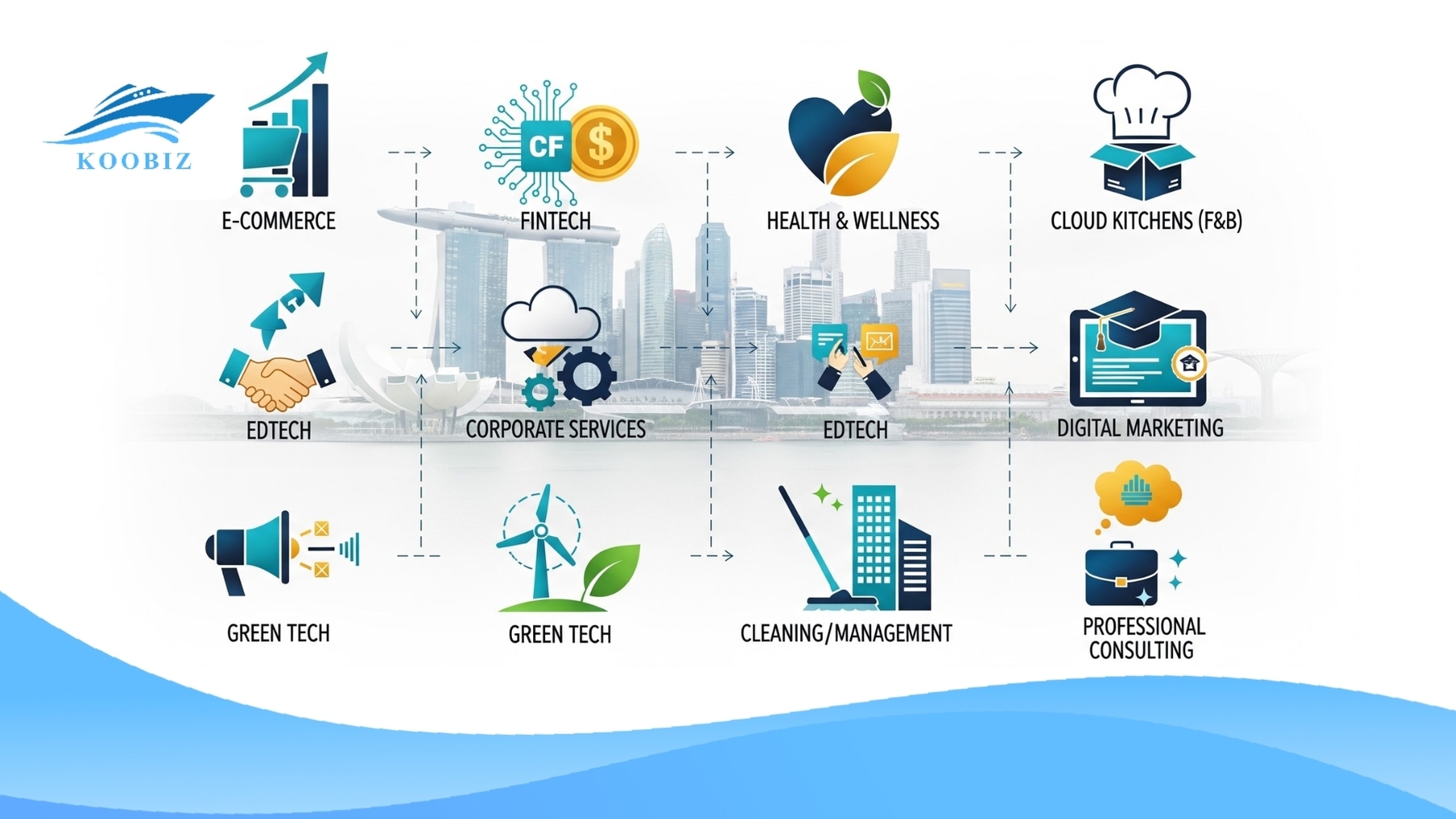
Based on current market demand, the 10 most profitable business ideas in Singapore include E-commerce, FinTech, Health and Wellness, F&B, Corporate Services, EdTech, Digital Marketing, Green Tech, Cleaning Services, and Professional Consulting.
These sectors deliver strong return on investment (ROI) driven by changing consumer behaviour, targeted government initiatives, and rapid technological adoption. Below is a practical breakdown of each business idea to help you assess alignment with your capital structure and operational expertise.
1. E-commerce and Cross-Border Retail
Singapore’s digital retail sector continues to expand, positioning e-commerce as one of the most accessible and scalable business models. Singapore’s excellent logistics infrastructure, anchored by Changi Airport and the Port of Singapore, makes it the perfect base to sell to the broader ASEAN market.
- Pros: Lower upfront capital requirements, reduced inventory risk through dropshipping models, and strong regional logistics connectivity.
- Cons/Challenges: High market competition and compliance with cross-border tax and customs regulations.
- The Koobiz Advantage: We support e-commerce founders by structuring entities for tax efficiency and managing ongoing corporate tax compliance to ensure you remain compliant while scaling globally.
2. FinTech and Web3 Solutions
Singapore is recognised as one of Asia’s leading FinTech hubs. With active regulatory oversight and innovation support from the Monetary Authority of Singapore (MAS), starting a business in blockchain tech, digital payments, or WealthTech offers strong long-term commercial potential.
- Pros: High scalability, access to institutional funding, and government-backed innovation programmes.
- Cons/Challenges: Strict regulatory compliance and complex initial entity setups.
- The Koobiz Advantage: We manage the complex incorporation requirements and provide expert corporate secretarial services, ensuring your FinTech startup meets all rigorous local governance standards from day one.
3. Health and Wellness Services
Singapore has a rapidly aging population and a highly stressed corporate workforce, driving sustained demand for health and wellness services like boutique fitness studios, mental health apps, and specialized nutrition consulting.
- Pros: Year-over-year revenue growth, diverse profitable niches, and high consumer willingness to spend on self-care.
- Cons/Challenges: Stringent licensing requirements for health products and high physical space rental costs.
- The Koobiz Advantage: We streamline your business registration and provide accurate financial reporting to help you keep your operational overheads and rental costs strictly in check.
4. F&B (Food and Beverage) and Cloud Kitchens
The modern “Cloud Kitchen” (or ghost kitchen) model has significantly improved cost efficiency within the traditional F&B sector by operating as a delivery-only food business tailored to health-conscious demographics.
- Pros: Reduces fixed overheads such as prime retail rental and front-of-house staffing.
- Cons/Challenges: Managing tight profit margins on delivery apps and complying with the National Environment Agency (NEA) licensing.
- The Koobiz Advantage: Our precise accounting services help you track your food costs and platform margins meticulously, ensuring your cloud kitchen remains consistently cash-flow positive.
5. Corporate and Accounting Services
With thousands of new companies registering in Singapore every month, B2B services (like corporate secretaries, tax consultants, and HR recruiters) highlight the sustained and recurring demand for corporate compliance and advisory services.
- Pros: High-margin, low-overhead business model with recurring revenue streams.
- Cons/Challenges: Requires deep local legal and financial expertise.
- The Koobiz Advantage: While this is our core area of expertise, we also support independent consultants and professional service agencies. We can serve as your reliable backend corporate secretary, allowing you to deliver incorporation and compliance services to your own clients without maintaining an in-house corporate team.
6. Education and EdTech
Education is a top priority for both individuals and employers in Singapore. Starting an enrichment center, offering specialized tutoring, or developing an EdTech platform can generate strong and predictable returns, especially with the modern shift toward lifelong learning.
- Pros: Stable recurring revenue and access to government-supported adult upskilling initiatives.
- Cons/Challenges: High customer acquisition costs and the need to hire accredited professionals.
- The Koobiz Advantage: We help EdTech startups structure their companies to be attractive to venture capital, and we manage the well-maintained financial records required for government grant applications.
7. Digital Marketing and Creative Agencies
As more businesses migrate online, specialized digital marketing agencies focusing on specific niches—such as TikTok marketing for F&B or SEO for corporate services—can command premium monthly retainers.
- Pros: High profit margins, minimal physical infrastructure requirements, and strong scalability.
- Cons/Challenges: Managing erratic cash flows from clients and scaling talent.
- The Koobiz Advantage: Our dedicated tax and accounting experts ensure your agency’s cash flow is properly tracked, invoiced, and tax-optimized, supporting long-term profitability and tax efficiency.
8. Green Tech and Sustainability Solutions
The Singapore Green Plan 2030 has created significant commercial opportunities for sustainability-focused businesses. Ideas include renewable energy consulting, sustainable packaging, and carbon footprint tracking software.
- Pros: Government incentives, access to sustainability-focused funding, and rising corporate ESG requirements.
- Cons/Challenges: High initial R&D costs and long sales cycles for B2B enterprise contracts.
- The Koobiz Advantage: We maintain the impeccable financial records and compliance standards you absolutely need to qualify for funding programmes administered by Enterprise Singapore and other green technology grant bodies.
9. Cleaning and Facility Management
Commercial cleaning and facility management is a stable business model with predictable cash flow. Corporate offices, retail malls, and high-end residential condos require constant, reliable maintenance.
- Pros: High-value, long-term corporate contracts and the ability to differentiate your brand using smart/IoT cleaning tech.
- Cons/Challenges: Highly labour-intensive and requires managing complex payrolls for hourly workers.
- The Koobiz Advantage: Outsourcing administrative and accounting functions helps operators focus on operational scaling. Our accounting services ensure your finances are organized, allowing you to scale your workforce without operational bottlenecks.
10. Specialized Consulting (HR, IT, Legal)
If you have years of corporate experience, monetizing your knowledge through a specialized consulting firm (such as cybersecurity advisory or D&I HR training) can be a highly profitable and scalable business model.
- Pros: High margins, low overhead costs, and flexibility to operate as a solo or boutique consultancy.
- Cons/Challenges: Personal liability risks if operating as a sole proprietor instead of a properly incorporated entity.
- The Koobiz Advantage: We assist with incorporating your consulting firm as a Private Limited (Pte Ltd) company, protecting your personal assets, maximizing your tax benefits, and boosting your professional credibility.
How to Setup Your New Business in Singapore?
Setting up a business in Singapore typically involves four essential legal and operational steps: choosing your entity, registering with ACRA, opening a corporate bank account, and appointing a qualified corporate secretary for compliance.
Following these steps ensures your business operates legally, efficiently, and benefits from Singapore’s tax framework from the outset. Below is a practical step-by-step overview of how to convert your business idea into a legally incorporated Singapore company.
Step 1: Choose Your Business Entity
Before registering, you must decide on the legal structure, with the Private Limited Company (Pte Ltd) as it is the most commonly adopted structure for growth-oriented businesses.
- The Standard Process: Requires deep research into liability, tax implications, and corporate structures to ensure you don’t accidentally choose an entity (like a Sole Proprietorship) that puts your personal assets at risk if the business fails.
- The Koobiz Solution: Our consultants evaluate your specific business model and expertly structure your Pte Ltd to maximize liability protection and ensure you qualify for the 17% corporate tax cap and startup exemptions.
Step 2: Register with ACRA
Accounting and Corporate Regulatory Authority (ACRA) is Singapore’s national company registrar and regulator. You must submit your official incorporation application via the BizFile+ portal.
- The Standard Process: Involves preparing the company constitution, drafting shareholder agreements, and requires a local Singpass. Foreign entrepreneurs cannot legally self-register without a resident partner.
- The Koobiz Solution: As a registered filing agent, we manage the entire incorporation process on your behalf. We prepare all necessary legal documents and handle the entire ACRA submission on your behalf, often incorporating your company in just 1-2 days.
Step 3: Open a Corporate Bank Account
Once incorporated, opening a corporate bank account is crucial for managing your capital, receiving client payments, and paying employees.
- The Standard Process: Involves navigating strict Anti-Money Laundering (AML) laws, preparing extensive KYC (Know Your Customer) documentation, and frequently encountering delays or rejections
- The Koobiz Solution: We work closely with major Singapore banks (including DBS Bank, OCBC Bank, and UOB) to provide expert advisory. We prepare your exact documents and liaise directly with bankers to to improve approval efficiency and success rates.
Step 4: Appoint a Corporate Secretary
Under the Singapore Companies Act, every company must legally appoint a qualified Company Secretary within six months of incorporation.
- The Standard Process: Hiring an in-house secretary is an expensive overhead. Trying to manage ACRA and IRAS statutory filings yourself often results in missed statutory deadlines, financial penalties, or director disqualification risks.
- The Koobiz Solution: We provide professional, outsourced Corporate Secretary services. We ensure your business remains 100% compliant year-round, allowing you to focus entirely on growing your profits without the administrative stress.
Professional secretarial support significantly improves compliance rates and makes companies much more attractive to investors (per industry benchmarks), compared to self-managed entities.
Advanced Considerations for Entrepreneurs in Singapore
Beyond incorporation, entrepreneurs should assess four additional strategic considerations: foreign ownership viability, entity structure comparison, common failure risks, and access to government startup grants based on compliance.
Beyond the basics, addressing these complex queries will safeguard your investment, mitigate legal risks, and unlock additional financial resources from the government.

Can a Foreigner Start a Business Without Relocating to Singapore?
The Short Answer: Yes, absolutely. You can own 100% of a Singapore company without ever physically relocating to the country.
The Details: However, the law mandates that every company must have at least one ordinarily resident Director (a Singapore Citizen, Permanent Resident, or EntrePass holder). If you wish to remain overseas, you must utilize a Nominee Director service. Koobiz provides Nominee Director services to meet this statutory requirement while preserving full operational control for foreign owners.
Private Limited vs. Sole Proprietorship: Which Entity is Best?
The Short Answer: The Private Limited (Pte Ltd) definitely wins on liability protection and tax efficiency, while the Sole Proprietorship is only optimal for extremely simple, low-risk setups.
The Details: In a Sole Proprietorship, the owner and the business are the same legal entity, meaning personal assets are at risk if the business is sued or goes bankrupt. Conversely, a Pte Ltd limits your liability to your share capital. Furthermore, Sole Proprietors are taxed at personal income tax rates (which can go up to 24%), whereas Pte Ltd companies benefit from corporate tax rates (capped at 17%) and generous startup exemptions. For any serious entrepreneur, a Pte Ltd is the definitive choice.
What Are the Most Common Reasons Businesses Fail in Singapore?
The Short Answer: The most common reasons businesses fail in Singapore are poor cash flow management, lack of market differentiation, and failure to comply with statutory tax regulations.
The Details: Cash flow management is a critical factor for startup survival. Additionally, ignoring tax filings with the Inland Revenue Authority of Singapore (IRAS) leads to compounding penalties that can cripple a new venture. By utilizing Koobiz’s professional accounting, auditing, and tax services, founders can maintain clear financial visibility and significantly reduce compliance-related risks.
Are There Government Grants Available for New Startups?
The Short Answer: Yes, the Singapore government offers a wealth of financial grants and incentives to foster innovation and business growth.
The Details: Programs such as the Startup SG Founder grant provide capital matching for first-time entrepreneurs, while the Enterprise Development Grant (EDG) supports businesses upgrading their technology or expanding overseas. However, to qualify for these grants, companies must maintain impeccable financial records and demonstrate strong corporate governance. Having a professional accounting firm like Koobiz manage your books drastically increases your chances of successful grant applications.
Ready to Launch Your Profitable Business in Singapore?
Knowing what business to start in Singapore is only the beginning of your entrepreneurial journey. Executing that idea flawlessly requires a solid legal foundation, meticulous financial management, and a trusted corporate partner.
At Koobiz, we specialize in turning your profitable ideas into fully compliant, operational businesses. From seamless Company Incorporation and Nominee Director Services to expert Corporate Bank Account Advisory, Tax, Accounting, and Auditing, we handle the bureaucratic heavy lifting so you can focus on what you do best: growing your business.
Avoid regulatory and compliance delays that can impact early-stage growth. Visit Koobiz.com today and consult with our experts to kickstart your Singapore business journey with confidence.