

Disclaimer: This guide is based on IRAS regulations as of 2025/2026. Always verify the latest specific instructions on the IRAS website.
Navigating the Singapore tax regime is crucial for business continuity, yet many company directors confuse the Estimated Chargeable Income (ECI) window with the final corporate tax filing date. For the Year of Assessment (YA) 2026, missing the Singapore Corporate Tax Deadline can lead to unnecessary financial setbacks, ranging from escalating fines to strict enforcement actions.
At Koobiz, we understand that compliance is the foundation of a successful business. This guide details exactly when to file, distinguishes between the various tax forms, and explains how to avoid penalties while optimizing your cash flow.
When are the Corporate Tax Filing Deadlines for Year of Assessment 2026?
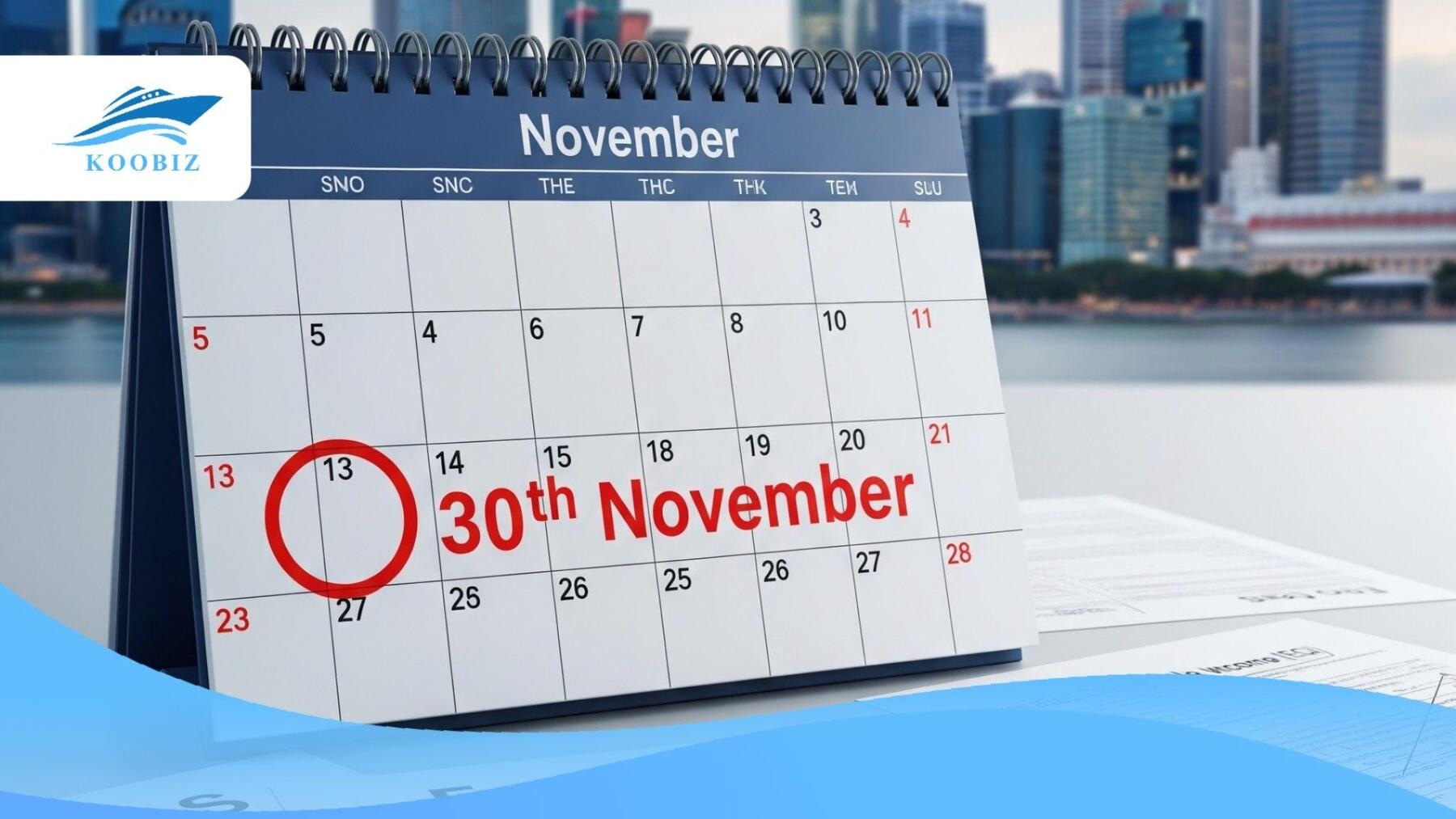
There are two distinct filing deadlines for Singapore companies in YA 2026: the ECI filing (3 months after Financial Year End) and the Form C-S/C filing (30 November). It is vital to understand that the Year of Assessment (YA) 2026 refers to the income earned in the financial year ending in 2025.
To simplify the process, use the lookup table below to find your specific deadlines based on your Financial Year End (FYE):
| Financial Year End (FYE) | ECI Deadline (3 Months Rule) | Form C-S Deadline (Fixed) |
|---|---|---|
| 31 January 2025 | 30 April 2025 | 30 November 2026 |
| 31 March 2025 | 30 June 2025 | 30 November 2026 |
| 30 June 2025 | 30 September 2025 | 30 November 2026 |
| 30 September 2025 | 31 December 2025 | 30 November 2026 |
| 31 December 2025 | 31 March 2026 | 30 November 2026 |
General Rule: Your ECI deadline is the last day of the third month following your FYE. The Form C-S deadline is fixed at 30 November for all companies filing electronically.
The ECI Filing Deadline (3 Months Rule)
The Estimated Chargeable Income (ECI) must be filed within three months from the end of your company’s financial year. This provides IRAS with an early snapshot of the company’s performance. Failing to meet this “3-month rule” triggers the first layer of non-compliance flags.
The Form C-S/Form C Deadline (30 November)
The final deadline for filing the Corporate Income Tax Return (Form C-S, Form C-S (Lite), or Form C) is strictly 30 November 2026. All business entities are required to declare the actual income with a view to identifying all deductible expenses and/or claiming any relevant tax exemptions.
What is the Difference Between ECI and Form C-S?
Form C-S and ECI differ fundamentally in purpose: ECI is a preliminary estimate, whereas Form C-S is the final declaration. Many new business owners mistakenly believe that filing one negates the need for the other.
| Feature | ECI (Estimated Chargeable Income) | Form C-S (Corporate Income Tax Return) |
|---|---|---|
| Purpose | Quick forecast of tax revenue for IRAS | Final declaration of actual accounts & tax adjustments |
| Filing Window | Within 3 months of Financial Year End (FYE) | Fixed deadline: 30 November annually |
| Basis | Unaudited / Management Accounts | Final / Audited Accounts |
| Complexity | Simple estimate (Revenue + Taxable Income) | Detailed (Expenses, Claims, Capital Allowances) |
What are the Penalties for Late Tax Filing in Singapore?
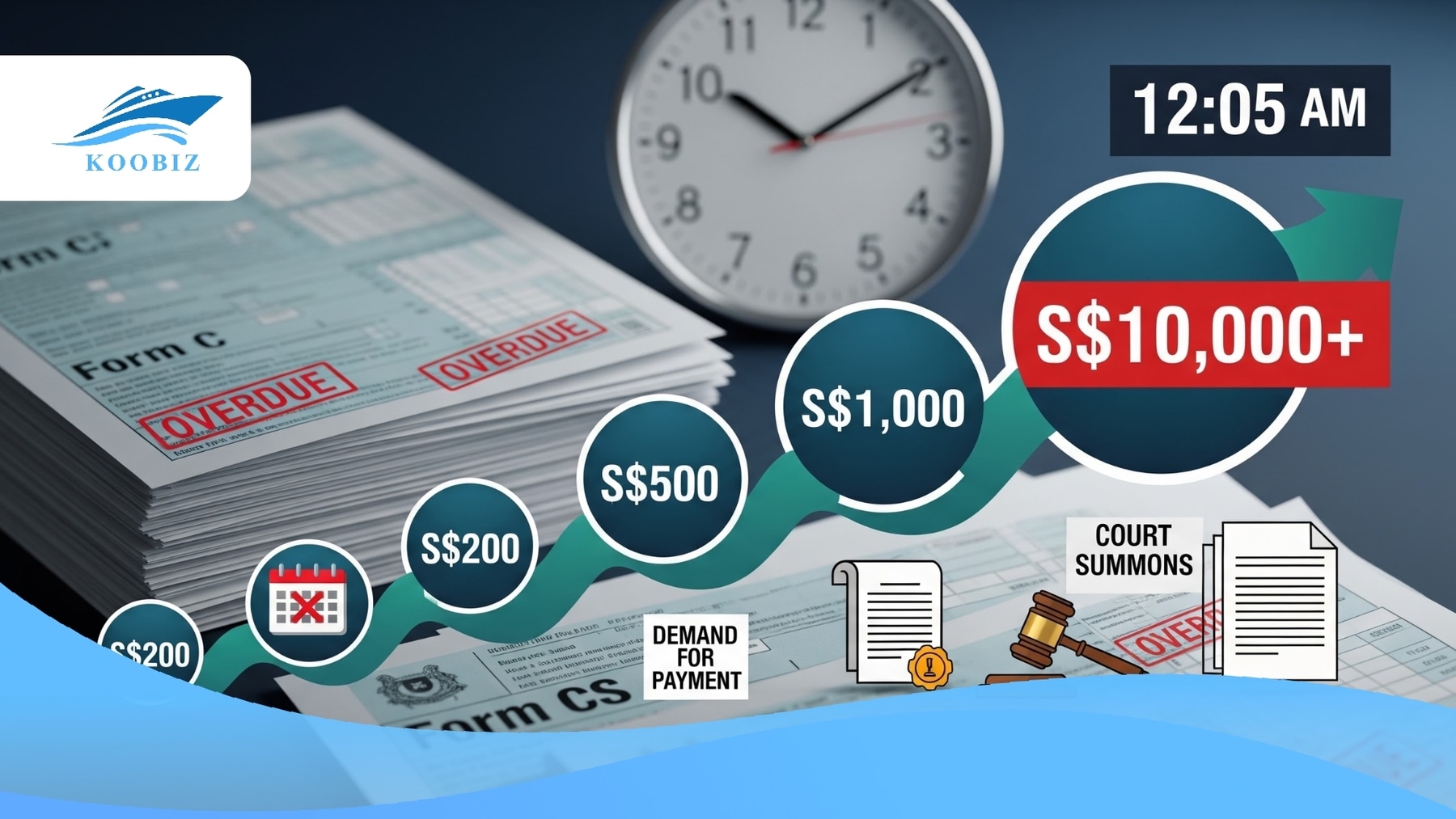
Failing to file tax returns on time results in immediate financial penalties which escalate to court summons. The penalty structure follows a clear escalation ladder:
Stage 1: The Composition Fee (Discretionary)
After missing the deadline, IRAS issued a Notice of Composition.
- Penalty Amount: Typically 200 SGD to 1,000 SGD for first-time offenses, but this is discretionary and can be higher depending on your compliance history.
- Action: You must pay the fine AND file the overdue return immediately.
Stage 2: Late Payment Penalties
If tax is assessed but remains unpaid by the due date:
- 5% Penalty: Imposed immediately on the unpaid tax.
- 1% Additional Penalty: Imposed for each completed month the tax remains unpaid (up to a maximum of 12% total, resulting in a significantly higher debt).
Stage 3: Court Summons (Severe Escalation)
If notices are ignored, IRAS will issue a Court Summons.
- Director Liability: Directors can be fined up to S$10,000 or face imprisonment in extreme cases (e.g., failure to comply with Section 65B).
- Tax Penalty: Up to double the amount of tax undercharged.
- Permanent Record: A “Non-Compliance” mark is lodged, potentially affecting future work pass applications (EP/S Pass).
Who is Eligible for the ECI Filing Waiver?
Not every company needs to file ECI. If you meet the administrative concession criteria, you can skip this step.
Correction Note: The revenue threshold is S$5 Million. You must meet both conditions below:
| Annual Revenue (FY) | ECI Status (Chargeable Income) | Eligibility Result |
|---|---|---|
| Below S$5 Million | NIL (Zero or Loss) | WAIVER GRANTED (No need to file ECI) |
| Below S$5 Million | Positive (Profit > $0) | MUST FILE ECI |
| Above S$5 Million | Any (Nil or Positive) | MUST FILE ECI |
Tip: “Nil ECI” generally means your company is in a loss position or has zero chargeable income after exemptions.
How Do Dormant Companies Handle Tax Filing?
Dormant companies (those with no revenue or income) must still file a tax return unless granted a specific waiver.
The “One-and-Done” Workflow for Waiver Application
Note: This applies to Singapore-incorporated companies.
- Step 1: Log in to myTax Portal and select “File Form C-S/C”.
- Step 2: Select the option for “Dormant Company”.
- Step 3: Tick the box: “Apply for Waiver of Income Tax Return Submission.”
- Result: Once approved, you are exempt from filing future returns until you recommence business.
Can Companies Pay Corporate Tax via Installments?
Yes, companies can pay their corporate tax via interest-free monthly installments, provided they sign up for GIRO and file their ECI on time.
The “26th of the Month” Rule
To maximize your installment plan, you should generally file by the 26th of the month. This allows IRAS sufficient time to process the GIRO deduction for the following month.
| ECI Filing Timeline | Installment Plan Granted |
|---|---|
| By 26th of 1st Month after FYE | 10 Months (Maximum) |
| By 26th of 2nd Month after FYE | 8 Months |
| By 26th of 3rd Month after FYE | 6 Months |
| Late Filing (After 3 Months) | No Installments (Lump sum payment required) |
Important: You must set up your GIRO arrangement with IRAS at least 3 weeks before your payment is due to ensure it is active.
Common Mistakes to Avoid During Tax Season
As an initial indicator of your compliance health, assess whether you are exposed to any of the following critical errors:
| Common Mistake | Audit Risk | Koobiz Solution |
|---|---|---|
| Confusing YA with FYE | Filing for the wrong basis period leads to re-filing and penalties. | Remember: YA 2026 = Income earned in FYE 2025. |
| Discarding Records Early | Expenses disallowed during IRAS audit; fines imposed. | Rule: Maintain all receipts, invoices, and bank statements for 5 years digitally. |
| Under-declaring Income | Severe penalties (up to 400%) for tax evasion. | Rule: Reconcile bank statements with sales invoices monthly. |
| Ignoring “Nil” Returns | Penalties for non-filing even if the company is dormant. | Rule: Apply for the Dormant Company Waiver immediately. |
In conclusion, mastering the Singapore Corporate Tax Deadline 2026 is about maintaining a pristine reputation for your business. From the preliminary ECI filing to the final Form C-S, every step requires attention to detail.
At Koobiz, we specialize in guiding businesses through the complexities of the Singapore regulatory environment, from incorporation to tax compliance. Don’t let tax season become a burden—contact us today to ensure your filing is seamless and timely.