

Choosing the right business structure is the first critical strategic decision a founder makes in Singapore, as it dictates your tax obligations, personal liability, and ability to raise capital. While a Limited Liability Partnership (LLP) provides a flexible, lower-cost alternative for professional service providers, a Private Limited (Pte Ltd) company is the gold standard for scalable startups offering limited liability and tax incentives.
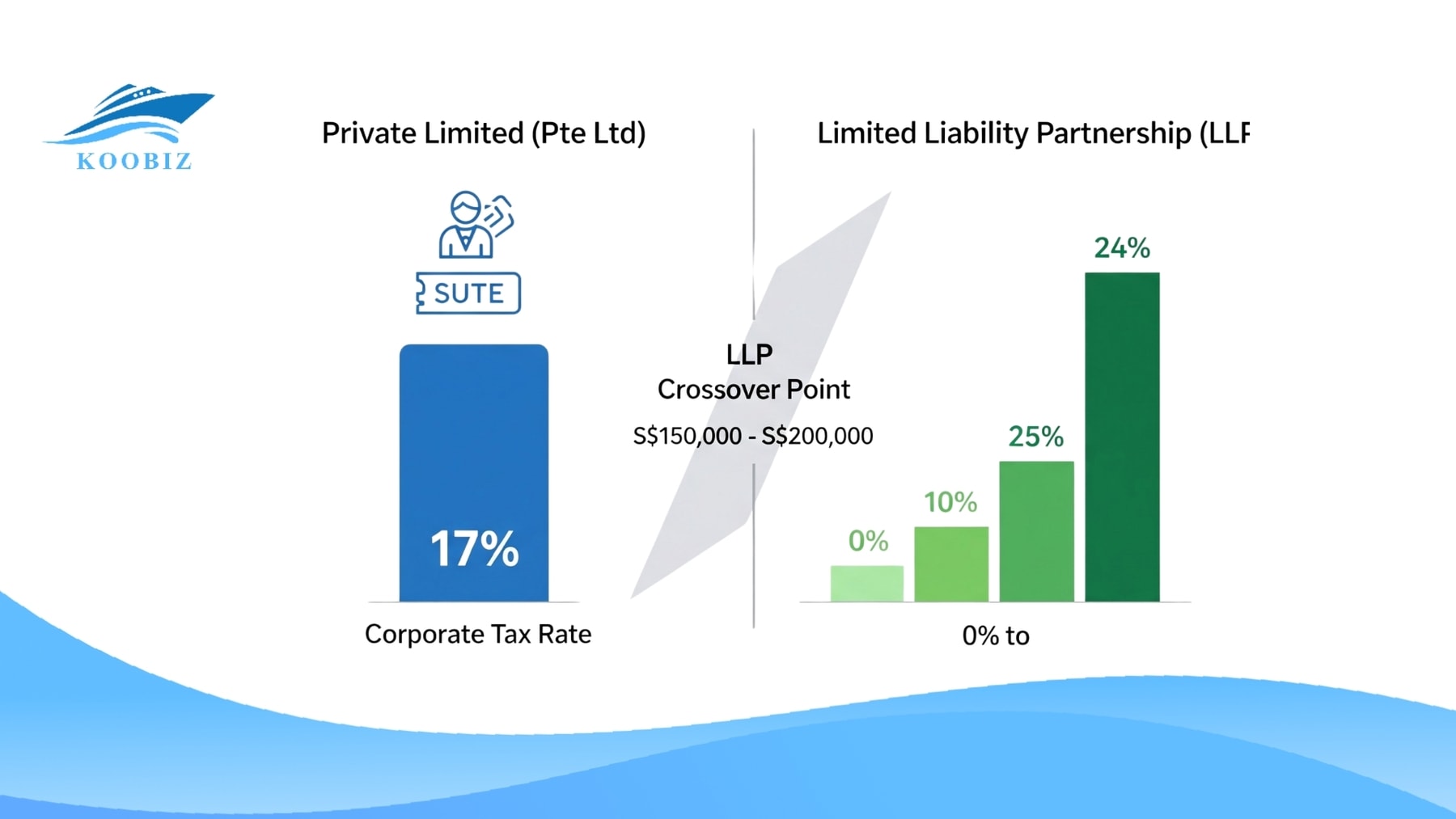
Specifically, the decision between these two entities often hinges on the “Tax Efficiency vs. Compliance Cost” trade-off. A Pte Ltd benefits from a flat 17% corporate tax rate and the Start-Up Tax Exemption (SUTE) scheme, whereas LLP partners are taxed at personal progressive rates ranging from 0% to 24%. For high-earning businesses, the Pte Ltd structure usually offers significant tax savings despite higher maintenance costs.
Regarding liability, both structures offer protection, but with nuances. In a Pte Ltd, shareholders are only liable up to their paid-up capital. In contrast, an LLP protects innocent partners from the negligence of others, the partner at fault remains personally liable for their own malpractice. This distinction is crucial for founders in high-risk industries.
To help you navigate this complex landscape, the experts at Koobiz will dissect the definitions, compare key differences, analyze tax scenarios, and evaluate which structure aligns with your future wishes. Let’s explore the fundamental definitions to establish a clear baseline.
The Definition of LLP and Pte Ltd
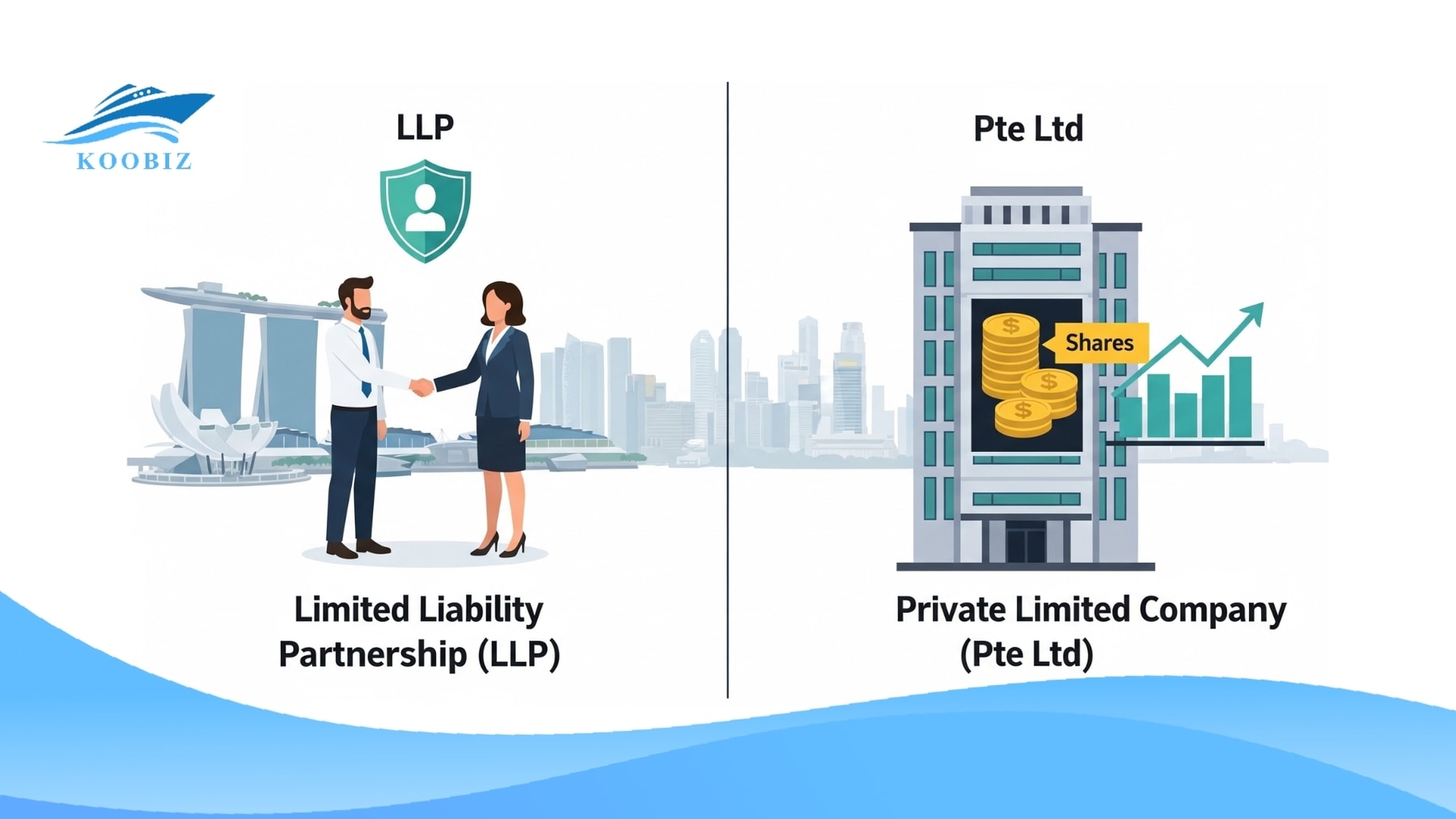
An LLP is a partnership with a separate legal personality suitable for professionals, while a Pte Ltd is a distinct legal entity limited by shares, designed for scalable businesses.
An LLP and a Pte Ltd are the two most common business entities in Singapore registered with ACRA, distinguished primarily by their legal personality and ownership structure. To understand which vehicle drives your business goals, we must first look under the hood at their legal definitions.
What is a Private Limited Company (Pte Ltd)?
It is a separate legal entity that shields shareholders from personal liability beyond their share capital and allows for perpetual succession.
A Private Limited Company (Pte Ltd) is a separate legal entity distinct from its shareholders and directors, capable of owning property, suing, and being sued in its own name. It is limited by shares, meaning the liability of its members is restricted to the amount unpaid on their respective shares. This structure allows for a maximum of 50 shareholders and is the preferred entity for businesses intending to scale, owing to its perpetual succession, meaning the company survives even if shareholders resign.
What is a Limited Liability Partnership (LLP)?
It is a hybrid structure requiring two partners to avoid potential negligence without issuing shares.
An LLP is a hybrid business vehicle that combines the flexibility of a partnership with the protection of a separate legal entity. It requires a minimum of two partners and limits each partner’s liability so they are not personally responsible for another partner’s misconduct.. Governed by the Limited Liability Partnerships Act, it is commonly used by professionals like lawyers, accountants, and architects to work together while reducing shared risk.According to ACRA (Accounting and Corporate Regulatory Authority), as of 2024, the Pte Ltd remains the most registered business entity type in Singapore due to its robust legal framework.
Comparison: What are the Key Differences between LLP and Pte Ltd?
The Pte Ltd structure wins on Legal Liability protection and Funding potential, while the LLP structure is superior regarding Setup Costs and Compliance simplicity.
| Feature | Limited Liability Partnership (LLP) | Private Limited (Pte Ltd) |
|---|---|---|
| Legal Status | Separate Legal Personality. | Separate Legal Entity. |
| Liability | Partners Protected (except the partner at fault, who faces unlimited liability for negligence). | Limited to the amount unpaid on shares. Personal assets are generally safe. |
| Tax Rates | Personal Progressive Rates (0% to 24%). | Flat Corporate Rate (17%) |
| Compliance & Cost | Minimal. No Company Secretary required. Audit exempt usually. | High (S$2,000 – S$5,000/yr). Requires qualified Company Secretary & strict filing. |
| Fundraising | Difficult. No shares to issue. Investors rarely fund LLPs. | High Potential. Can issue shares (Equity) to VCs and Angels. |
| Perception | Good for professionals, but banks may be hesitant to lend. | High Credibility. Preferred by suppliers and banks for loans. |
Koobiz Expert Note: While the LLP is cost-efficient, commercially, a Pte Ltd carries more weight. It signals to suppliers, banks, and clients that the business is committed to rigorous regulatory compliance. At Koobiz, we often advise clients that this perception is vital if you intend to secure corporate loans early on.
Does Pte Ltd Offer Better Tax Benefits than LLP?
Yes, a Pte Ltd generally offers better tax benefits for businesses with profits exceeding S$150,000 due to the flat corporate tax rate and exemption schemes, whereas LLPs are more tax-efficient for businesses with lower profit margins.
Understanding the tax implications is often the deciding factor for founders, so let’s break down the mechanics of how the Inland Revenue Authority of Singapore (IRAS) treats each entity.
How is Corporate Tax Applied to Pte Ltd?
Taxed at a flat 17%, with significant rebates available for the first three years under the SUTE scheme.
A Pte Ltd is taxed at a flat Corporate Income Tax (CIT) rate of 17% on its chargeable income. However, the effective tax rate is often much lower due to the Tax Exemption Scheme for New Start-Up Companies (SUTE). Under this scheme, for the first three consecutive years, a qualifying new company gets a 75% exemption on the first S$100,000 of normal chargeable income and a 50% exemption on the next S$100,000. This is a massive advantage for profitable startups looking to reinvest earnings.
How are LLP Partners Taxed?
Profits are distributed to partners and taxed at personal income tax rates (0% to 24%).
LLPs are not taxed at the entity level. Instead, they operate under a “pass-through” taxation system. The profits are distributed to the partners and taxed as part of their personal income. Residents are taxed at progressive rates ranging from 0% to 22% (increasing to 24% for YA 2024 onwards). If the business profit is low, the partner might pay little to no tax. However, once the partner’s income exceeds the corporate tax threshold, the LLP becomes less tax-efficient compared to a Pte Ltd.
According to IRAS guidelines, tax planning should focus on the projected net profit; the crossover point where a Pte Ltd becomes more tax-efficient is typically around the S$150,000 – S$200,000 profit mark.
Which Structure is Suitable for Fundraising and Scaling?
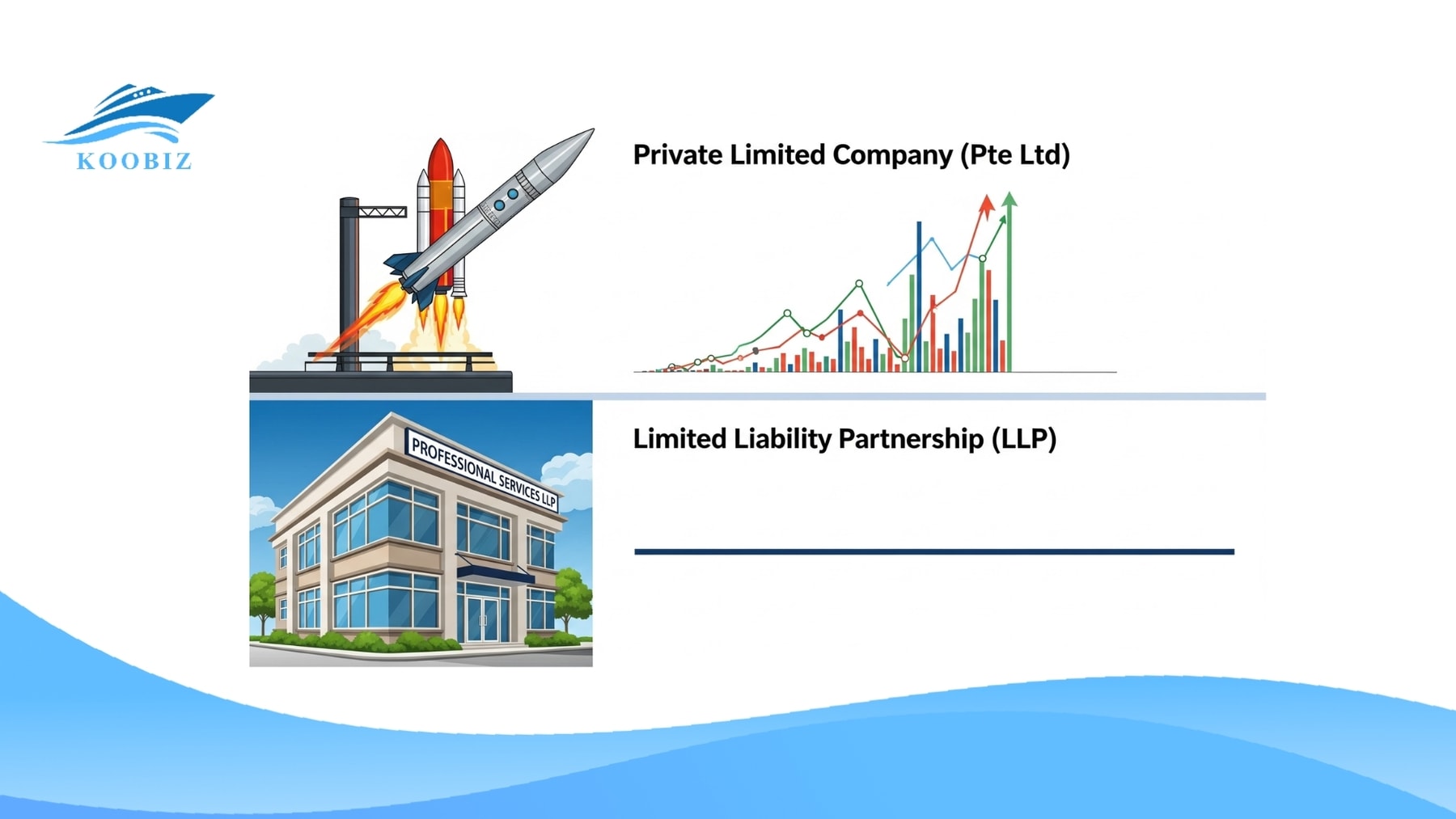
There are two distinct paths for growth: the Pte Ltd is the only viable option for startups seeking Venture Capital (VC) or Angel Investment, while the LLP is suitable for lifestyle businesses or professional practices that grow organically.
If your roadmap involves external funding, your structural choice is practically made for you.
Why should you set up a Pte Ltd company??
One big reason is Pte Ltd can issue Shares, allowing investors to own equity without assuming partnership liability.
Investors require a clear mechanism to own a piece of your company, and the Pte Ltd structure provides exactly that through shares. It allows for the issuance of different classes of shares (preference vs. ordinary), easy transfer of ownership, and the implementation of Employee Stock Option Plans (ESOPs) to attract talent. VCs will almost never invest in an LLP because it does not offer equity in the traditional sense and legally exposes them to partnership liabilities.
When should you choose LLP?
Choose LLP for professional services (lawyers, architects) or small businesses that do not intend to sell equity or raise public funds.
The LLP is ideal for businesses where the primary capital is the human expertise of the partners such as law firms, architectural clinics, or consultancy groups. It is also suitable for small businesses or passive income ventures where the owners do not intend to raise public capital or sell the company in the near future. The administrative ease allows partners to focus on their trade rather than corporate governance.
CONTEXTUAL BORDER
We have established the core differences for decision-making. Now, we move to the micro-context: specific scenarios for foreign founders and what happens if you need to change your mind later.
Advanced Considerations for Foreign Founders in Singapore
There are specific regulatory hurdles for foreigners, primarily concerning residency requirements for directors/managers and the complexity of converting business structures later.
For international entrepreneurs looking to use Singapore as a launchpad, these advanced operational details are critical.
Can a Foreigner Register an LLP or Pte Ltd without Relocating?
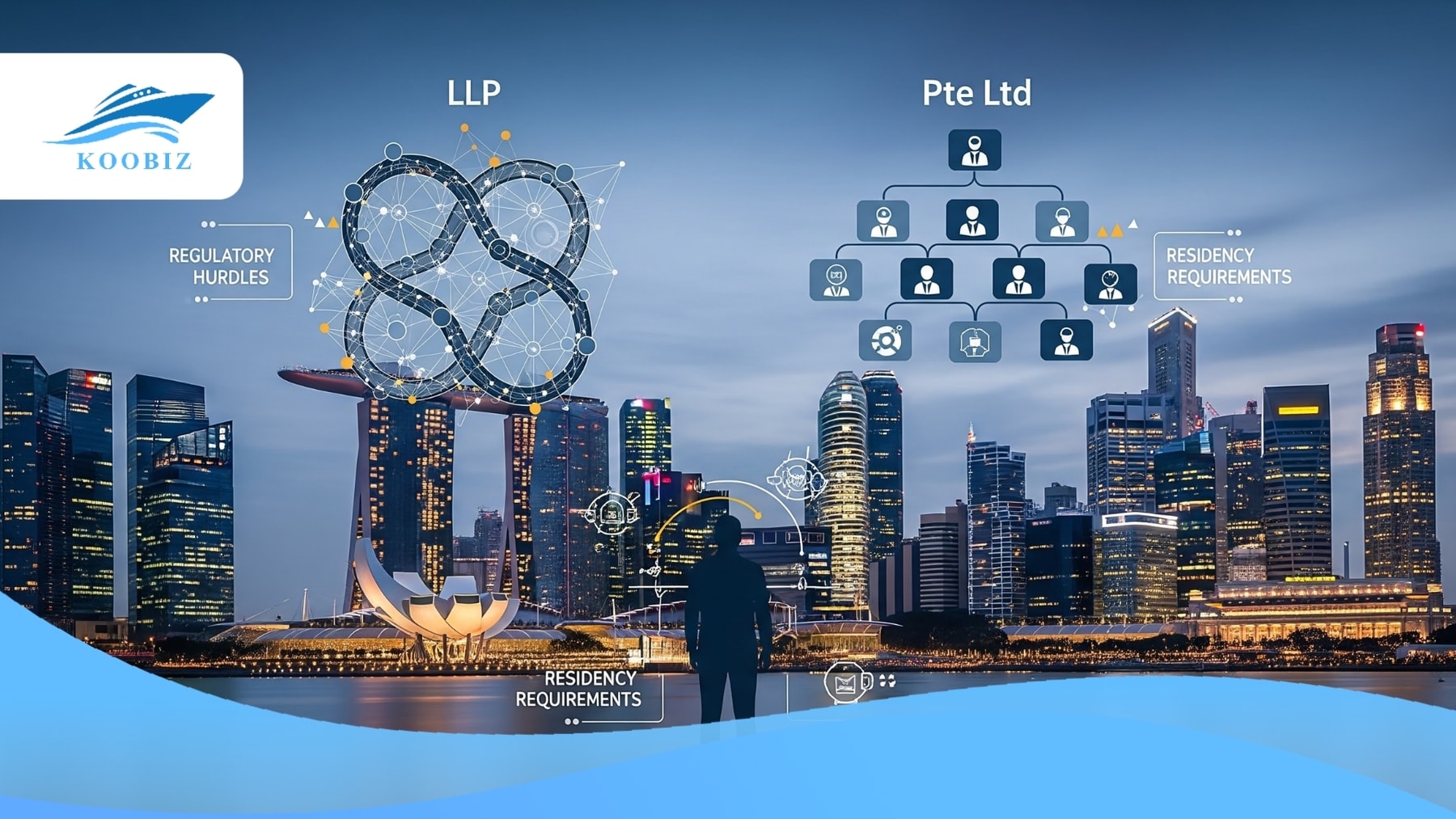
Yes, but you must engage a Locally Resident Director (for Pte Ltd) or a Locally Resident Manager (for LLP).
- For Pte Ltd: You must appoint at least one Locally Resident Director (a Singapore Citizen, PR, or EntrePass/Employment Pass holder). Foreigners often engage a “Nominee Director” service to satisfy this requirement if they are not relocating immediately.
- For LLP: You must appoint at least one Locally Resident Manager.
While you can own 100% of the shares (Pte Ltd) or be a partner (LLP) from abroad, the local officer requirement is non-negotiable under the Companies Act.
Can You Convert from LLP to Pte Ltd Later?
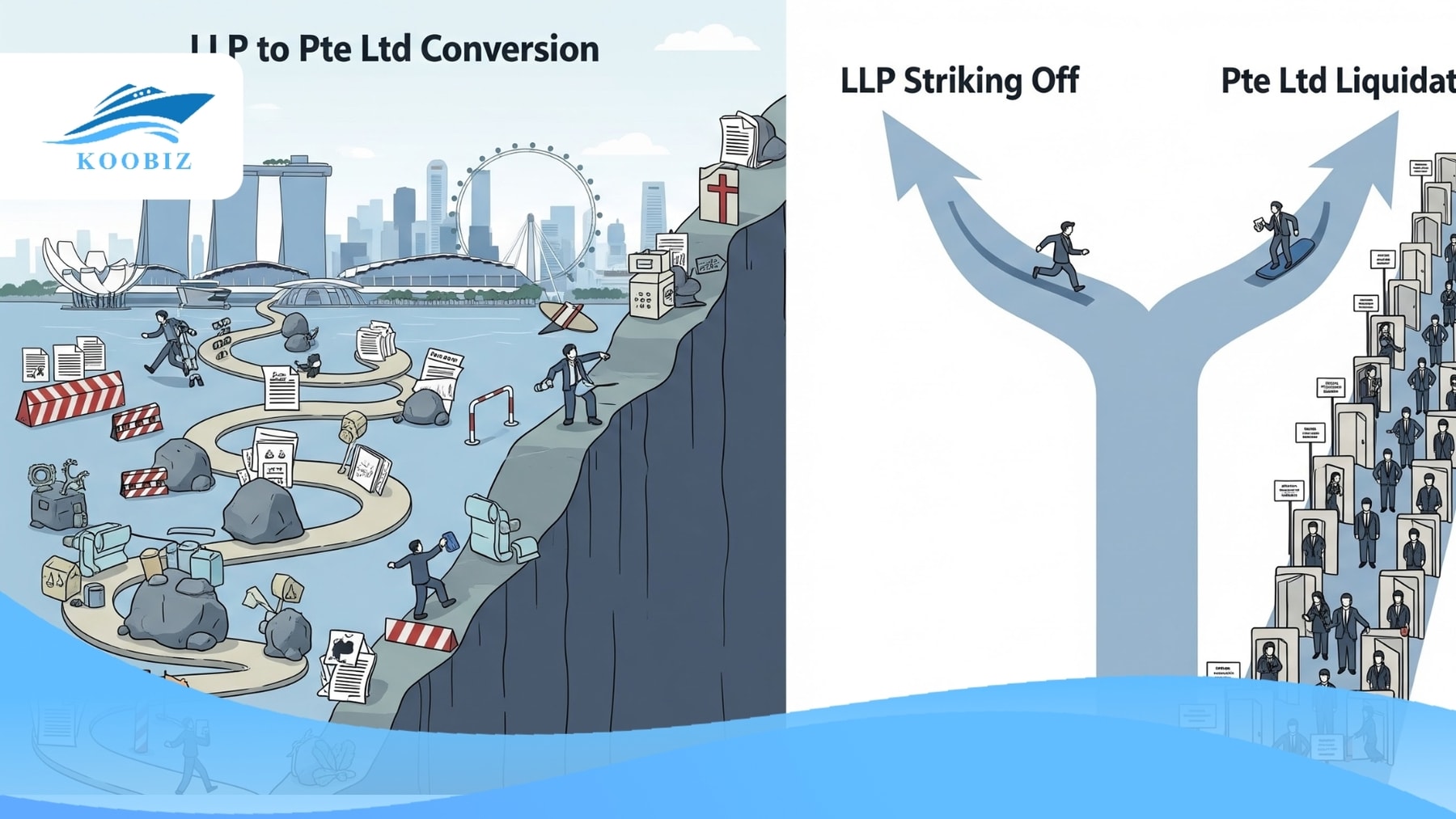
Yes, but it is a complex process of “Transferring Business Undertaking” rather than a simple administrative switch.
This is a rare attribute of the process often overlooked. You effectively have to incorporate a new Pte Ltd and transfer the assets, contracts, and liabilities from the existing LLP to the new company. This involves novating contracts with clients, transferring bank accounts, and formally winding up or striking off the old LLP. It is administratively heavy and costly; therefore, starting as a Pte Ltd is recommended if you anticipate rapid growth.
What are the Closing Requirements (Striking Off)?
Striking off an LLP is generally cheaper and faster than the strict tax clearance and potential liquidation required for a Pte Ltd.
If the venture fails, the exit routes differ. An LLP is generally easier and cheaper to strike off, provided there are no outstanding debts or tax liabilities.
A Pte Ltd requires a more formal process. To strike off a Pte Ltd, the company must have all assets disposed of, remain no outstanding tax liabilities with IRAS, and record no debts owed to any government agency. If the company is insolvent, it must go through a winding-up process (liquidation), Data from the Singapore Department of Statistics indicates that while business formation is high, the “churn rate” highlights the importance of understanding exit strategies before incorporation.
Ready to Launch Your Business? Let Koobiz Handle It.
Whether you decide on the flexibility of an LLP or the scalability of a Pte Ltd, the registration process involves complex paperwork, strict compliance with ACRA, and critical tax decisions.
Koobiz.com simplifies your business journey in Singapore.
- Hassle-Free Incorporation: We handle the entire registration process for both Pte Ltd and LLP structures, ensuring you are compliant from Day 1.
- Expert Advisory: Not sure which entity is right for you? Our experts at Koobiz will guide you through the pros and cons tailored to your specific business model.
- Ongoing Support: From Nominee Director services to Corporate Secretary and Annual Filing, we are your long-term partner in growth.
Don’t let paperwork slow you down. Start your incorporation with Koobiz today and build your business on a solid legal foundation.