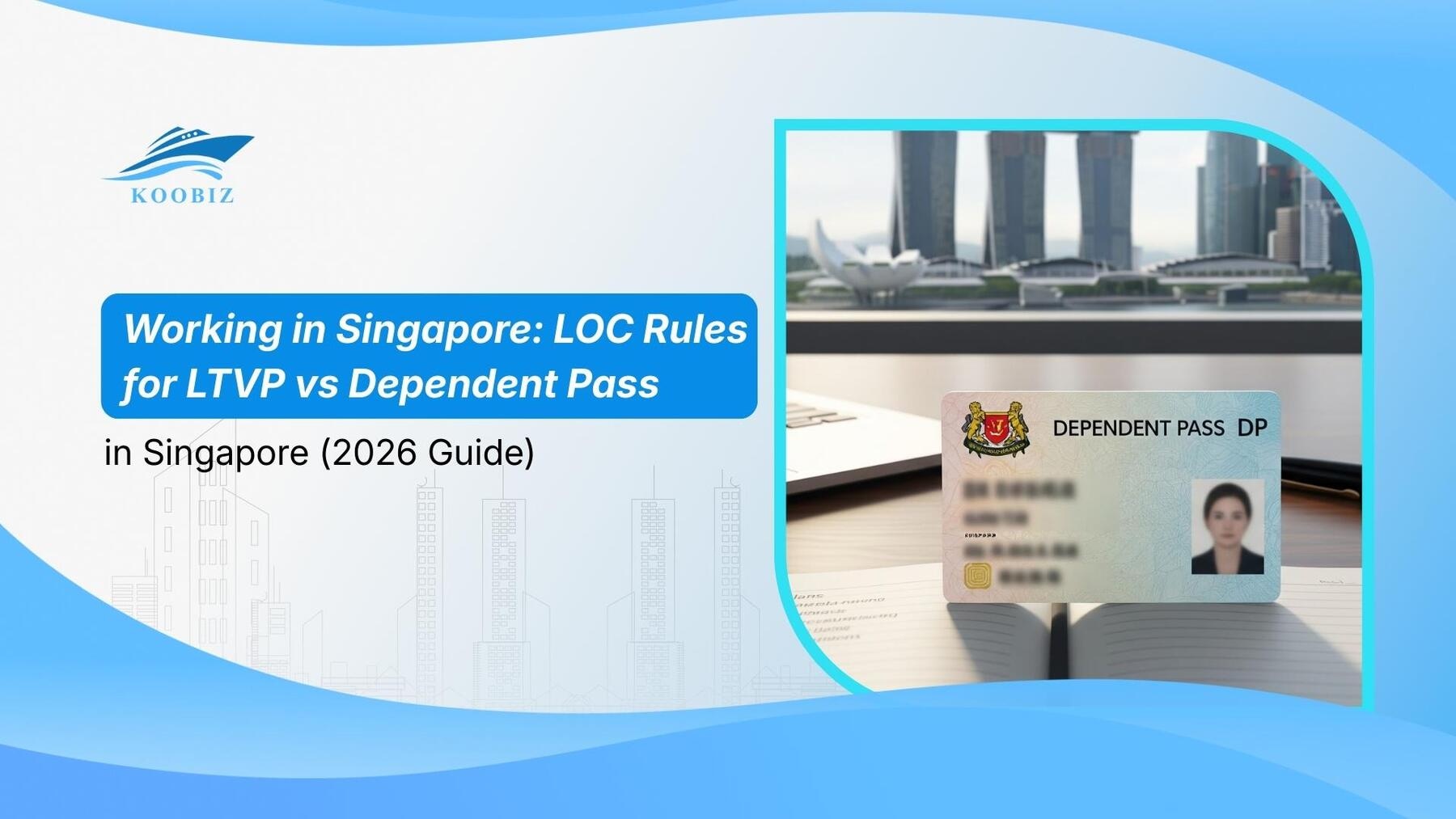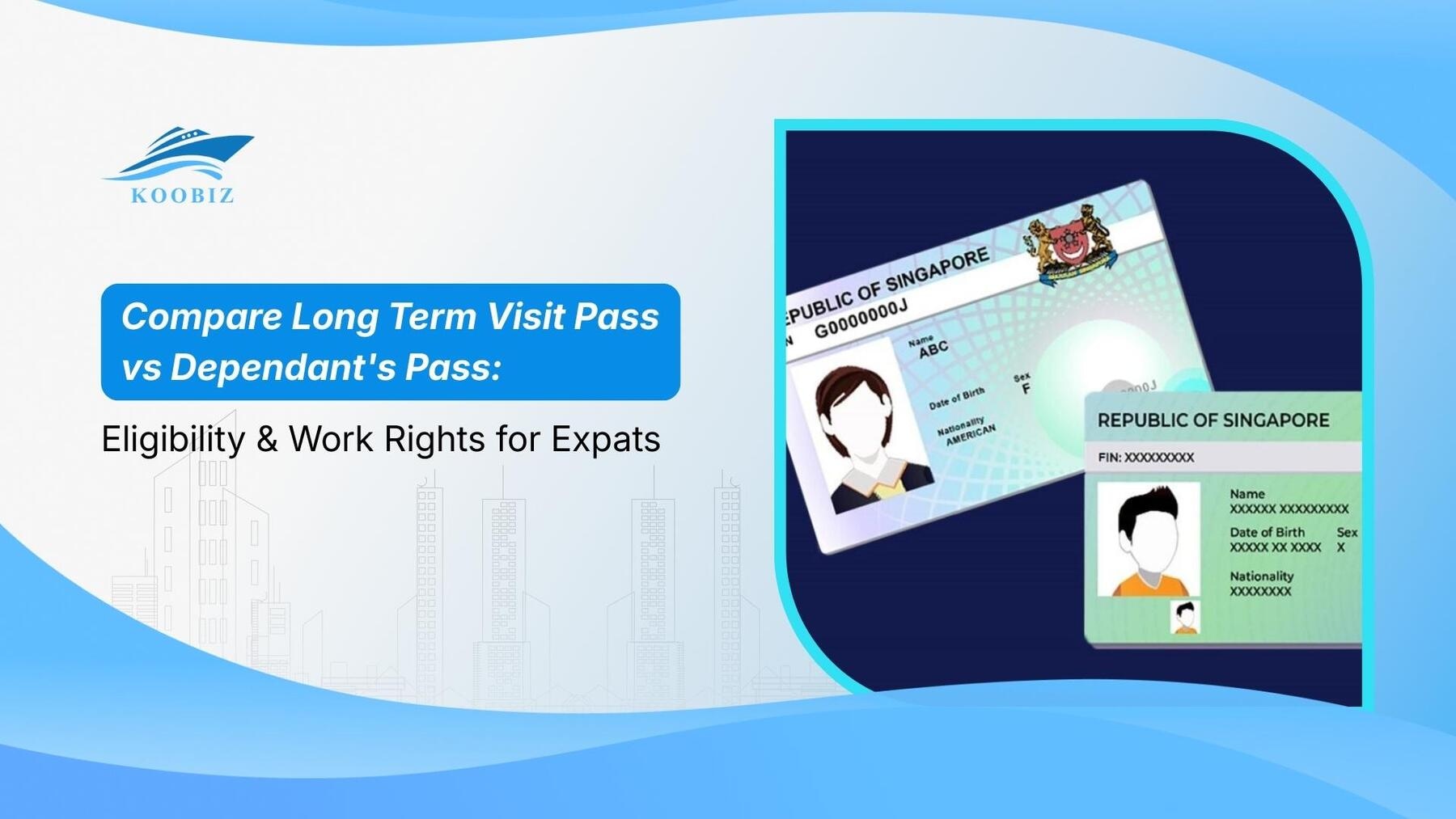


Can Dependent Pass work in Singapore? Yes, but the rules have shifted significantly since May 2021. The former “automatic” Letter of Consent (LOC) for employees has been removed and replaced with the requirement to obtain a formal Work Permit, Employment Pass, or S Pass. The only exception remains for business owners, who can still apply for an LOC under strict conditions.
Can Dependant’s Pass Holders Work in Singapore?
The short answer is yes, but the process is no longer automatic.
Following regulatory changes effective from 1 May 2021, Dependant’s Pass (DP) holders can no longer work in Singapore using the DP alone.
Here is the current reality for DP holders seeking employment:
- No Automatic Right: The Letter of Consent (LOC) for standard employees has been abolished.
- Employer Sponsorship Required: A DP holder cannot commence work without the employer first applying for an appropriate work pass. Your prospective employer must apply for a specific work pass (Work Permit, S Pass, or Employment Pass) on your behalf.
- Approval First: You must receive approval (In-Principle Approval) before commencing any duties.
The Good News:
Despite the additional requirements, DP holders still benefit from several advantages compared to overseas candidates:
- Source Country Waiver: When applying for a Work Permit, you are exempt from “source country” restrictions (meaning you can be of any nationality).
- No Minimum Salary for WP: There is no qualifying salary requirement for a Work Permit, making it suitable for part-time or administrative roles.
At Koobiz, we advise clients that while regulations have tightened, Dependant’s Pass holders can still work in Singapore by following the correct legal procedures.
Key Work Authorization Options for DP Holders
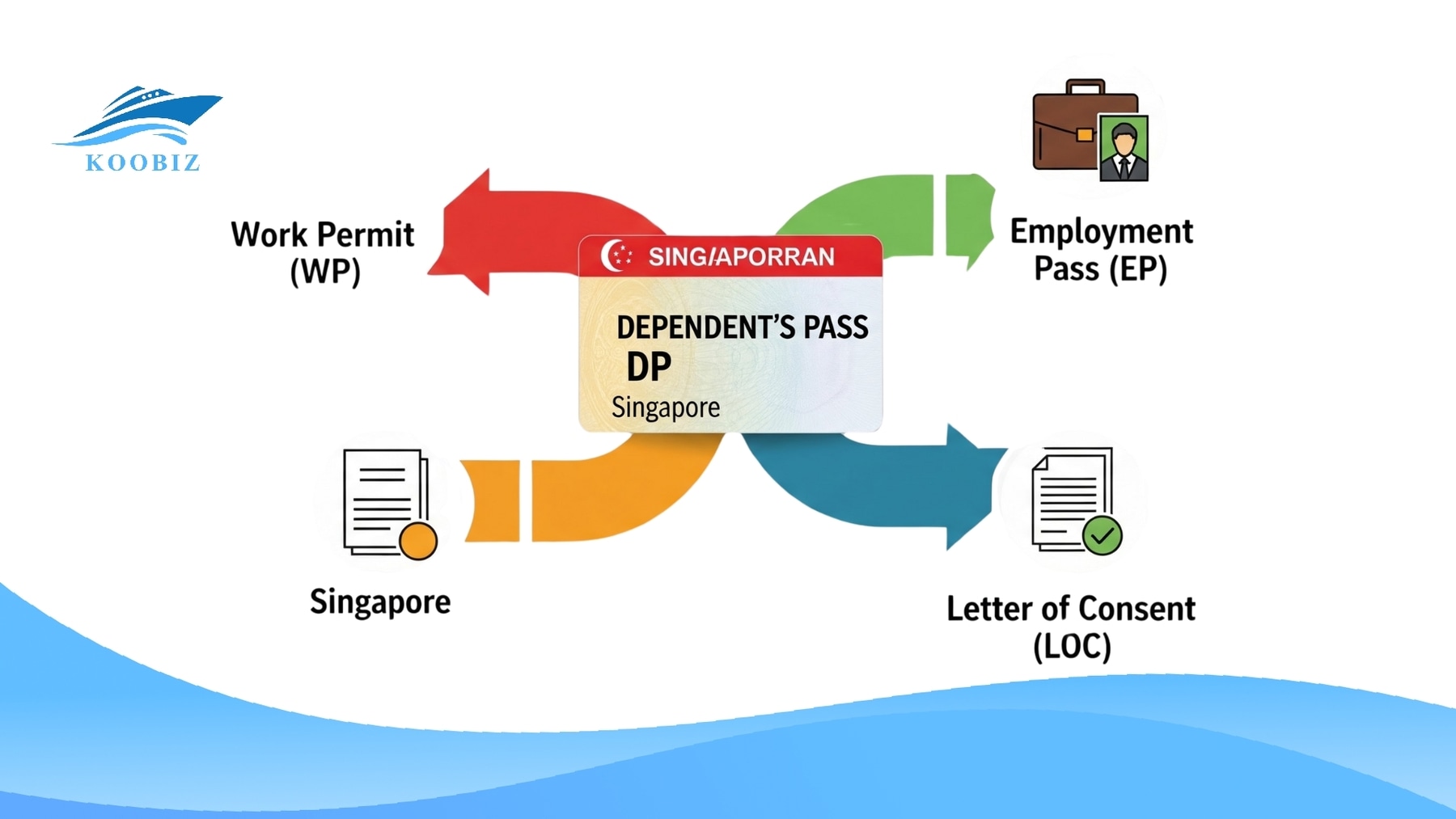
There are three primary work authorization routes available for DP holders in Singapore: the Work Permit (WP), Employment Pass (EP), and S Pass. The appropriate option depends largely on the candidate’s salary level and professional qualifications.
To begin the hiring process, an employer must determine which category the DP holder fits into. This classification affects everything from the employer’s tax liability (levy) to the employee’s future residency prospects.
Work Permit (WP)
The Work Permit is currently the most accessible and common route for Dependant’s Pass holders seeking employment in Singapore. Unlike standard Work Permits for foreign workers, WPs for DP holders do not have a minimum qualifying salary and are not subject to source country restrictions. This makes it a practical option for general employment or roles that may not meet the higher salary thresholds required for an Employment Pass. However, the employer must still have available “quota” for their industry sector.
Employment Pass (EP) & S Pass
For Dependant’s Pass holders who are professionals, managers, or executives, the Employment Pass (EP) or S Pass is the standard work authorization route. To qualify for an Employment Pass, the candidate must earn a fixed monthly salary of at least SGD 5,000, which increases with age, and the sponsoring company must pass the COMPASS (Complementarity Assessment Framework) assessment. The S Pass applies to mid-level skilled staff with a minimum salary of SGD 3,150. These passes are tied to the individual’s qualifications and the company’s ability to support them financially.
Letter of Consent (LOC)
The Letter of Consent (LOC) is no longer available for standard employment and is now restricted to Dependant’s Pass holders who operate their own business. If you intend to start a company in Singapore, you may apply for an LOC to work for your own business, provided specific local hiring milestones are met. Company incorporation and LOC advisory are services supported by Koobiz. Further details on this specific LOC pathway are outlined in the supplementary section below.
Work Permit vs. Employment Pass for DP Holders
For Dependant’s Pass holders, the Work Permit is generally easier to obtain due to the absence of a minimum salary requirement, whereas the Employment Pass requires meeting a higher qualifying salary and passing the COMPASS framework.
Choosing between these two depends heavily on the employer’s quota capacity and the role’s compensation package.
| Feature | Work Permit (For DP Holders) | Employment Pass (EP) |
|---|---|---|
| Minimum Salary | No minimum (Market rate) | SGD 5,000+ (Increases with age) |
| Quota & Levy | Yes (Employer pays levy & needs quota) | No (Quota-free & Levy-free) |
| Pass Status | Tied to Main Pass (Ends if spouse leaves) | Independent (You hold your own pass) |
| Ideal For | Administrative roles, customer service, or part-time positions where the salary does not meet EP standards. | Senior managers, specialized professionals, and executives seeking independent status. |
Employer Obligations: Levy and Quota
From the employer’s perspective, the choice of pass significantly impacts the company’s monthly costs and hiring capacity.
- Work Permit Obligations (Cost & Limits):
- Levy: The employer must pay a monthly Foreign Worker Levy, typically ranging from SGD 300 to SGD 600 or more, depending on the sector and levy tier.
- Quota: Hiring is restricted by the Dependency Ratio Ceiling (DRC). The company must employ a sufficient number of local staff (Singapore Citizens or Permanent Residents) to generate quota for hiring foreign workers.
- Note: While DP holders are exempt from “source country” rules (can be of any nationality), they do count towards the company’s foreign worker quota.
- Employment Pass Exemptions (Quota-Free):
- No Levy: Employers do not pay any monthly levy for EP holders.
- No Quota: There is no limit on the number of EP holders a company can hire, provided the candidates meet the salary and quality criteria.
Koobiz Tip: We regularly assist employers in calculating their available quota to assess whether a Work Permit is a viable option for their staffing structure.
According to MOM data from 2024, the majority of DP holders working in administrative or support roles are now utilizing the Work Permit scheme due to the tightening of EP salary criteria.
Real-World Scenarios: DP Employment in Action
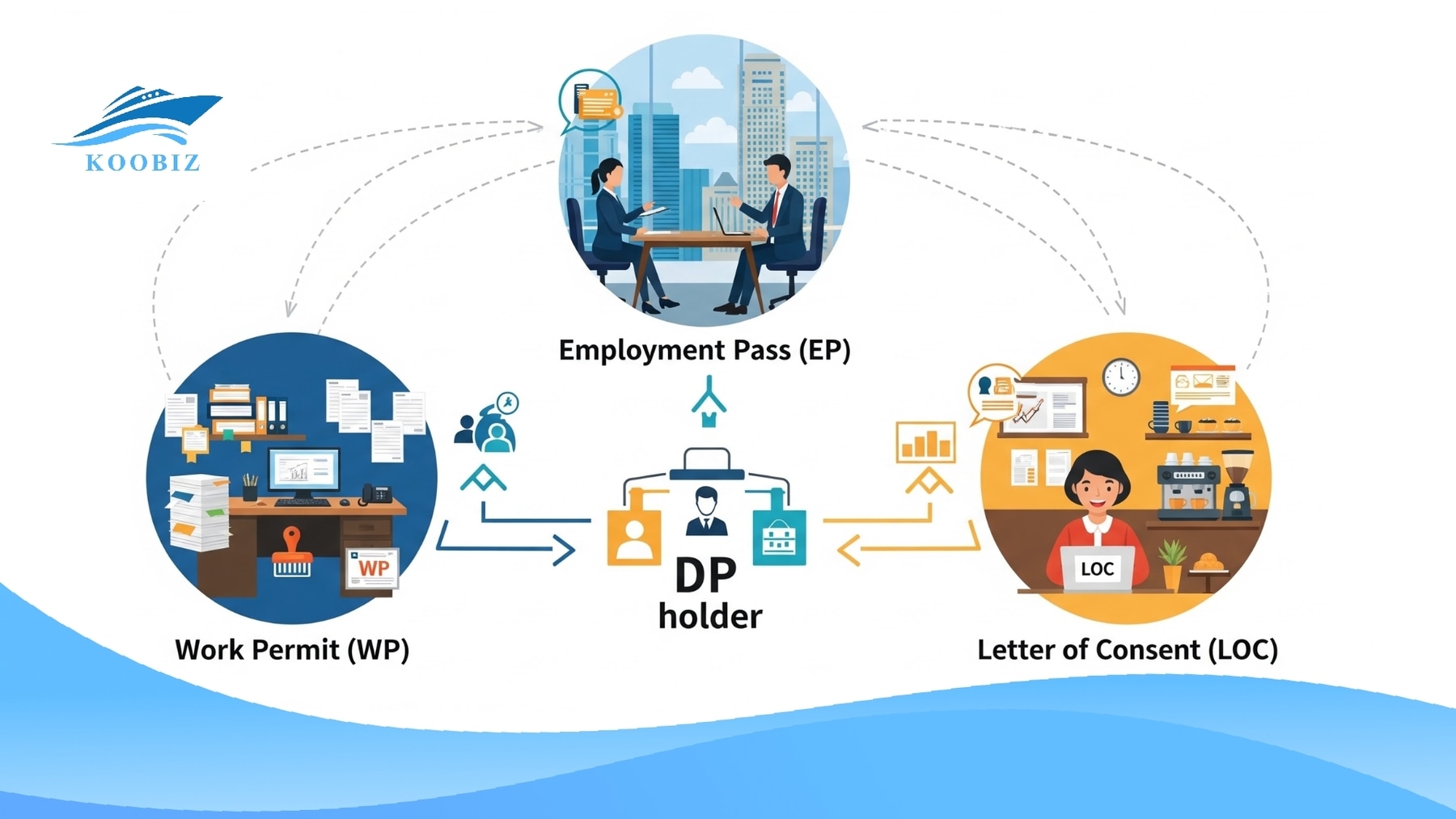
To illustrate how different work authorization routes apply in practice, below are three common case studies frequently encountered by Koobiz.
Scenario A: The Administrative Role (Work Permit Route)
Profile: Sarah, a DP holder, is offered a role as an Office Manager with a salary of SGD 3,500.
- Challenge: Her salary is below the SGD 5,000 minimum required for an Employment Pass.
- Solution: Her employer applies for a Work Permit.
- Outcome: The application is approved. Since Sarah is a DP holder, the employer does not need to worry about “source country” restrictions (she can be of any nationality). The employer pays the applicable monthly levy, and Sarah is able to commence employment shortly after approval..
Scenario B: The Corporate Professional (Employment Pass Route)
Profile: Raj, a DP holder, secures a Senior Consultant position at a tech firm with a salary of SGD 8,500.
- Challenge: He wants a pass that is independent of his wife’s employment status to feel more secure.
- Solution: The company applies for an Employment Pass (EP). Raj’s university degree and high salary help the company meet the COMPASS scoring requirements.
- Outcome: The application is approved, and Raj is issued an Employment Pass. If his wife ever leaves her job (and loses her pass), Raj’s status in Singapore remains valid because he is now an independent pass holder.
Scenario C: The Entrepreneur (LOC Route)
Profile: Maria, a DP holder, wants to start a boutique marketing agency instead of finding a job.
- Challenge: She cannot simply “freelance” legally.
- Solution: Maria incorporates a company with Koobiz, becoming the sole director and shareholder. To qualify for a Letter of Consent (LOC), she hires one Singaporean employee earning at least the Local Qualifying Salary (SGD 1,400 or above).
- Outcome: MOM grants her an LOC. She can now legally invoice clients and run her business.
How to Apply for a Work Pass as a DP Holder
The application process involves three distinct steps, all of which must be initiated by the employer. It is important to note that you cannot apply for these passes on your own behalf.
Step 1: Securing a Job Offer
- Interview & Offer: As the DP holder is already residing in Singapore, in-person interviews are generally permitted. The process formally begins once a written job offer is issued.
- Document Preparation: Once the offer is signed, provide your employer with the necessary documents, including:
- Your valid Passport.
- Your current Dependant’s Pass details.
Step 2: Employer Submits Application via MOM
- Submission: The employer or an appointed employment agent (such as Koobiz’s authorized partners) submits the application through the myMOM portal.
- Processing Time:
- Work Permit: Processing is typically fast, with approvals often issued within approximately one week.
- Employment Pass (EP): Typically takes 10 days to 3 weeks due to the complexity of credential verification.
Step 3: Card Issuance and Notification
- In-Principle Approval (IPA): Once approved, MOM issues an IPA letter.
- Exemptions: As a DP holder, you generally benefit from streamlined requirements compared to overseas candidates:
- Medical Screening: DP holders are often exempt from pre-employment medical examinations.
- Security Bond: Employers are typically exempt from buying a security bond for DP holders on Work Permits.
- Issuance: The employer arranges for the issuance of the approved work pass card.
- Validity: Note that the Work Permit validity is strictly tied to the validity of your main Dependant’s Pass.
The Letter of Consent (LOC) for Business Owners

The Letter of Consent (LOC) is now an exclusive work authorization restricted to Dependant’s Pass holders who are sole proprietors, partners, or company directors wishing to operate their own business in Singapore.
This marks a clear distinction between working as an employee and operating as a business owner in Singapore.
Many DP holders possess entrepreneurial skills and choose to create their own jobs. At Koobiz, we specialize in helping these individuals register their companies to meet LOC requirements.
Eligibility Requirements for LOC
To be eligible to apply for an LOC, the DP holder must be one of the following:
- A sole proprietor of an ACRA-registered business.
- A partner in an ACRA-registered partnership.
- A director with at least 30% shareholding in an ACRA-registered private limited company.Merely being a minority shareholder (holding less than 30%) does not qualify for an LOC. In such cases, the company must hire the DP holder under an Employment Pass or Work Permit instead.
The Hiring Local Employees Condition
To renew the LOC, the business must demonstrate economic contribution to Singapore. Specifically, the business must hire at least one Singapore Citizen or Permanent Resident who earns at least the prevailing Local Qualifying Salary (LQS) and receives CPF contributions for at least 3 months. This prevents “shell companies” from being used solely to grant work rights.
Special Exemption: ONE Pass Dependant’s Pass Holders
Spouses of Overseas Networks & Expertise (ONE) Pass holders enjoy a unique privilege allowing them to work via a Letter of Consent (LOC) rather than requiring a separate work pass.
This is a rare exception within Singapore’s current immigration framework. The ONE Pass is designed for top global talent earning over SGD 30,000 monthly or with outstanding achievements in arts, sports, or academia.
Working via Letter of Consent (LOC)
In recognition of the profile of ONE Pass holders, MOM grants their spouses significantly greater flexibility in employment.
They can work for an employer simply by obtaining an LOC. This LOC does not require the employer to have quota, pay levy, or meet salary thresholds. It is essentially a return to the pre-2021 rules, but exclusively for this elite group. For spouses of ONE Pass holders, the barrier to employment is significantly lower compared to standard Dependant’s Pass holders.
Conclusion
Employment for Dependant’s Pass holders in Singapore remains achievable, provided the applicable Work Permit or LOC frameworks are followed. Whether pursuing corporate employment or establishing a business, understanding these regulatory requirements is essential for long-term compliance and success in Singapore.
About Koobiz
Navigating the intersection of immigration rules and business setup requires expert guidance. Koobiz is your trusted partner in Singapore. We specialize in Company Incorporation for DP holders seeking the LOC route, and provide comprehensive Corporate Services including tax, accounting, and audit to ensure your new business meets the “hiring local” renewal criteria. Furthermore, if you are establishing a business to hire yourself, we can advise on the optimal structure.
Visit Koobiz.com today to consult with our experts on opening your company and unlocking your work eligibility in Singapore.