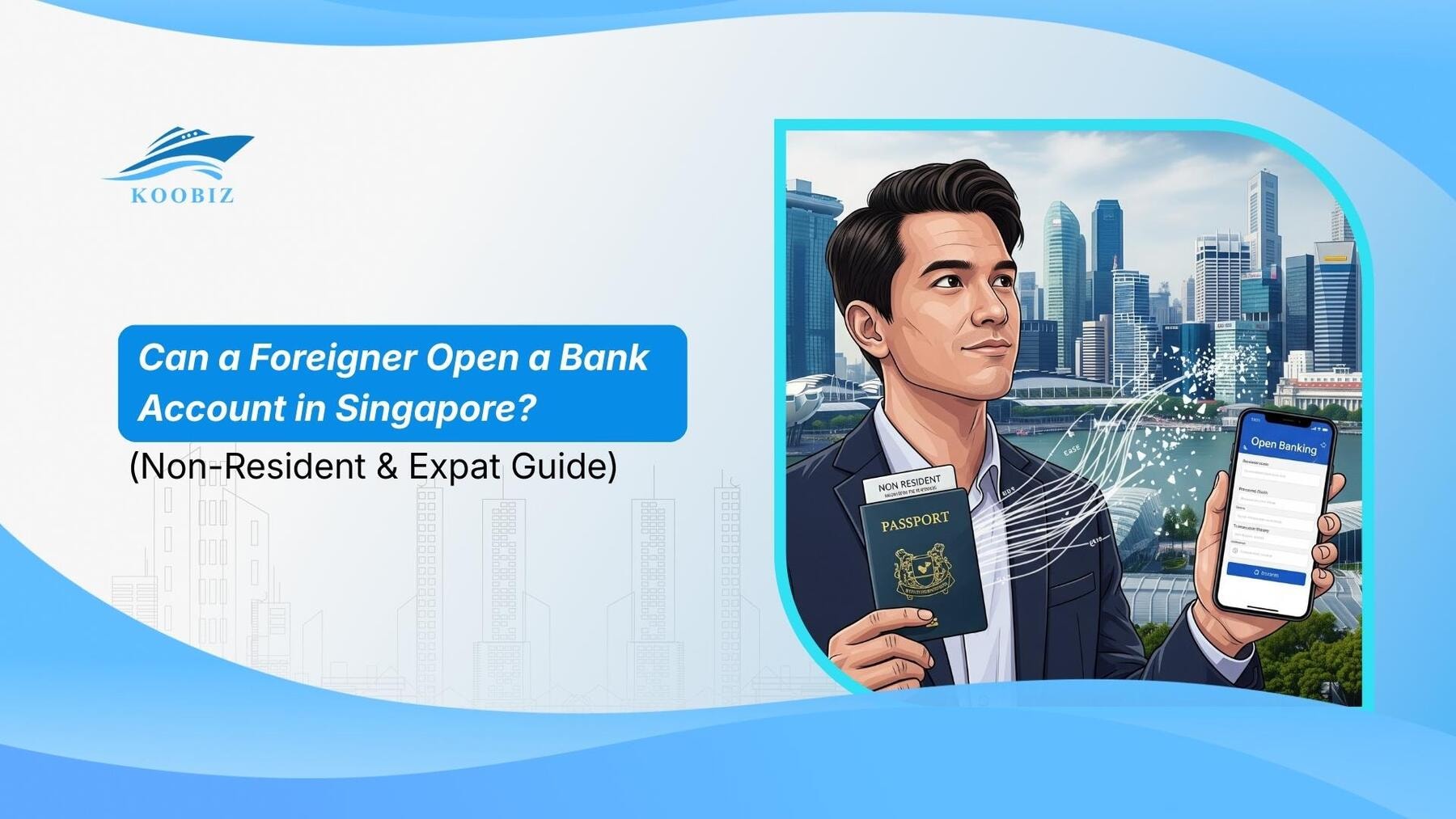


Post-incorporation, securing a robust financial infrastructure is the most critical milestone for ensuring operational readiness in Singapore’s premier global hub. Singapore’s regulatory framework for Anti-Money Laundering (AML) and Counter-Financing of Terrorism (CFT) is now among the world’s strictest, transforming account opening into a compliance-heavy workflow. This reality means that opening a corporate bank account is no longer a simple administrative task but a compliance-heavy workflow.
The Koobiz Advantage: We specialize in navigating the intricate legal distinctions of foreign ownership, ensuring your Board is equipped with the precise documentation needed for bank approval. This guide outlines the essential requirements for The Company, from the legal distinctions of foreign ownership to the specific documentation required by The Board. Whether the goal is to facilitate trade or manage payroll, understanding the corporate account opening workflow is paramount for operational readiness.
Can a Foreign-Owned Company Open a Business Account in Singapore?
Yes, foreign-owned companies are welcome in Singapore’s banking ecosystem, provided they demonstrate tangible economic substance and align with strict regulatory frameworks.
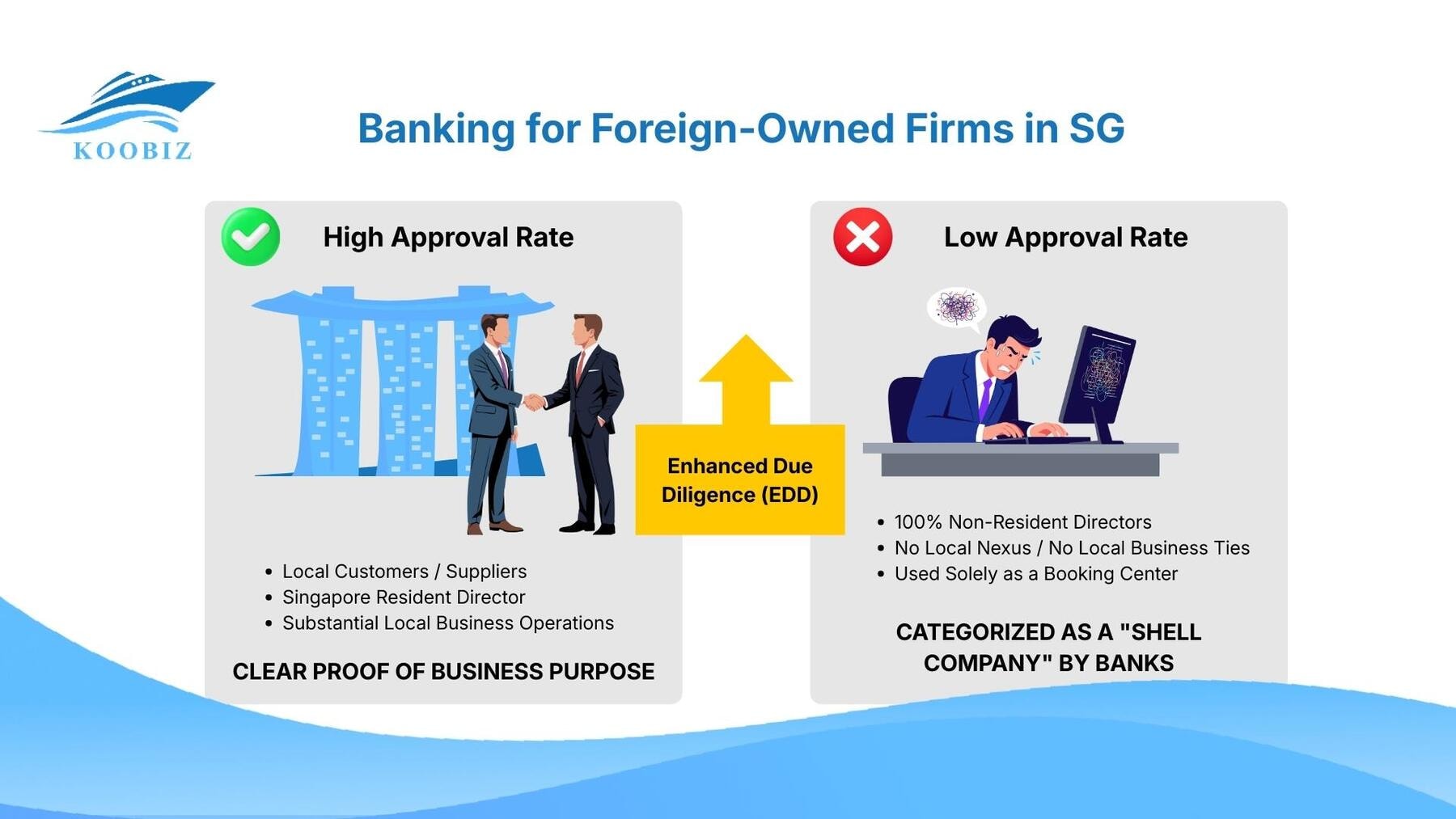
The primary differentiation in the onboarding experience stems from the residency status of directors and the core operational nature of the business. Companies with 100% non-resident directors will undergo Enhanced Due Diligence (EDD), as banks must verify that the account serves a genuine commercial purpose rather than acting as a mere conduit.
Specifically, the concept of “Economic Substance” is the deciding factor. The Company must prove that management and control are exercised within Singapore or that there is a genuine commercial reason for banking in the jurisdiction. Without a clear local nexus, financial institutions may categorize the entity as a high-risk shell company, leading to potential application rejection.
According to recent compliance trends, foreign-owned entities with a clear local counterparty (suppliers or customers in Singapore) see an approval rate significantly higher than those using Singapore solely as a booking center.
Corporate Eligibility & KYC Standards for Businesses
Corporate banking eligibility is evaluated across three critical pillars: Ownership Structure, Individual Stakeholders, and the Nature of Business Activities.
In strict adherence to Monetary Authority of Singapore (MAS) mandates, banks enforce rigorous KYC protocols that penetrate through to the Ultimate Beneficial Owners (UBOs). The vetting process extends beyond the corporate entity, encompassing a comprehensive risk assessment of all individuals exercising significant control.
The Company
The legal entity must be validly registered with the Accounting and Corporate Regulatory Authority (ACRA). Financial institutions will validate your legal standing and registered address through a direct verification of the ACRA Business Profile.
The People
The core of the vetting process focuses on Ultimate Beneficial Owners (UBOs) and Directors, where background checks are mandatory. Banks enforce rigorous screenings for any individual maintaining an ownership stake of 10% to 25% or higher. The Bank requires these individuals to have a clean financial history, free from sanctions or adverse media coverage.
The Activity
Broad business descriptions like ‘general trading’ are insufficient; the bank requires a granular breakdown of your products and services. The application must specify the products, services, and anticipated transaction volumes to mitigate risks associated with the entity being categorized as a high-risk shell company.
Mandatory Corporate Documents & Board Resolutions
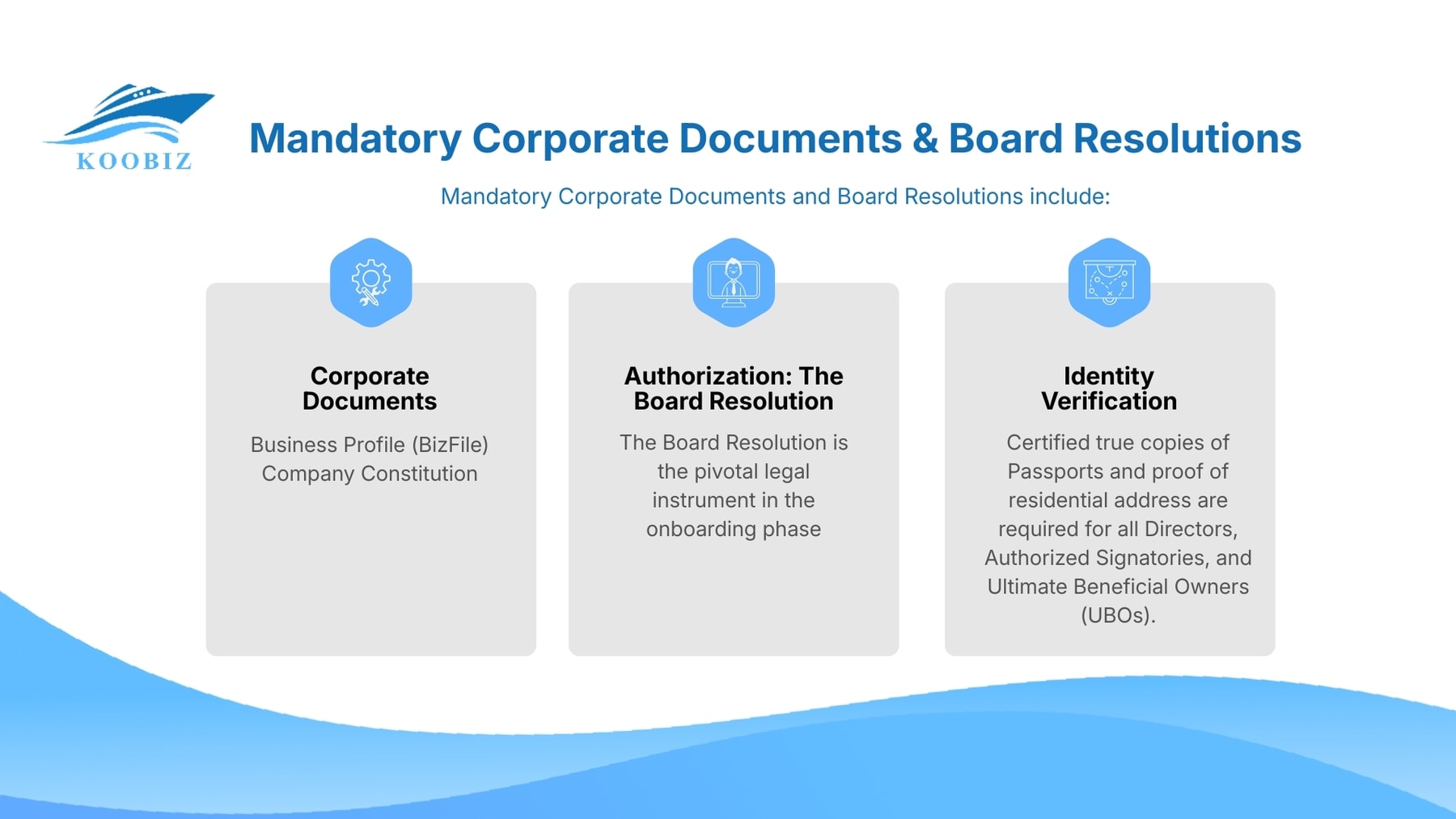
Your documentation suite must cover three foundational legal pillars: Proof of Existence, Formal Authorization, and Identity Verification.
Precision is paramount: Any data mismatch between ACRA records and your bank application is a leading cause for rejection or delays. Standardized templates are often insufficient; all resolutions must comply with the bank’s specific internal legal requirements.
Corporate Documents
A certified Business Profile (BizFile), extracted within the preceding 3 to 6 months, is mandatory to ensure data currency. Additionally, the Company Constitution (formerly Memorandum & Articles of Association) is required to validate the internal bylaws and financial authorities governing your legal entity.
Authorization: The Board Resolution
The Board Resolution is the pivotal legal instrument in the onboarding phase. This is a formal legal document passed by the Board of Directors approving the opening of the account and appointing the Authorized Signatories. This document formally designates Authorized Signatories and defines their specific mandates to manage and operate corporate funds.
Identity Verification
The Bank requires certified true copies of Passports and proof of residential address for all Directors, Authorized Signatories, and UBOs. Unlike personal accounts, Identity Verification for corporate entities requires certified true copies of passports and residential proofs, often necessitating notarial or professional certification.
Corporate Account Opening Workflow: From Resolution to Activation
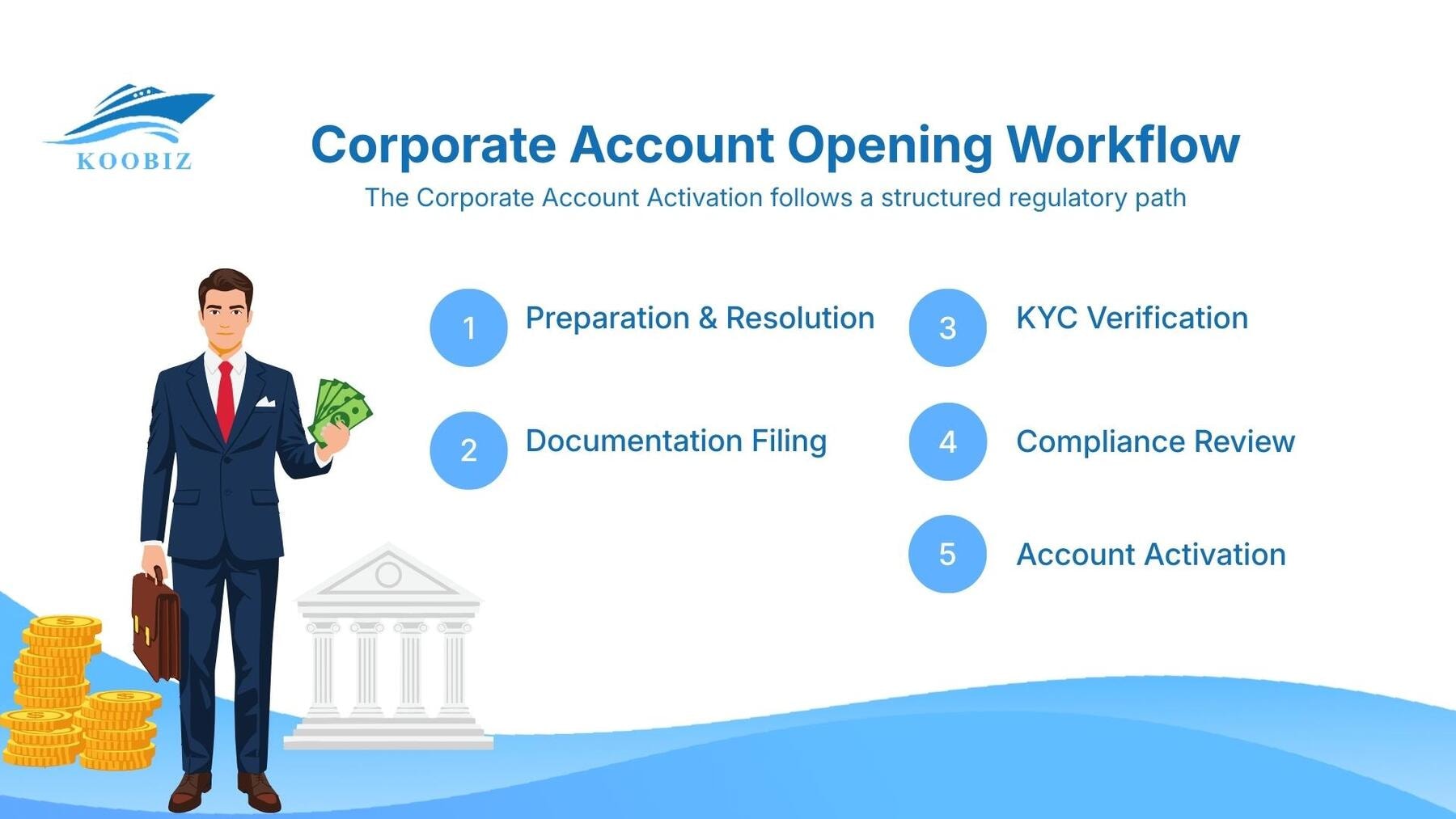
The Corporate Account Activation follows a structured regulatory path: from the initial board resolution to the final compliance activation.
Once the Board has passed the resolution, the focus shifts to the execution of the application. The submission phase is more than a formality; it is a strategic presentation of your business case to the bank’s risk and compliance officers.
- Preparation & Resolution: The Board meets to approve the bank account opening and designates signatories.
- Documentation Filing: Submit the core application alongside your ACRA BizFile, Company Constitution, and verifiable proofs of business (e.g., invoices, contracts).
- KYC Verification: The bank will conduct a Know Your Customer (KYC) interview, which may require a physical meeting or a secured video conference with signatories. For many traditional banks, this requires the physical presence of the Authorized Signatories or a verified video conference.
- Compliance Review: The bank’s internal compliance team reviews the UBO structure and source of funds.
- Account Activation: Once the compliance review is finalized, you must fulfill the initial deposit or paid-up capital requirements to activate the account.
Best Business Banking Solutions: Big Three vs. Fintech
Singapore’s ‘Big Three’ local banks (DBS, OCBC, UOB) remain the gold standard for trade finance and institutional credibility, while Fintech challengers offer superior agility.
Selecting the ideal banking partner hinges on your operational priorities—whether you require complex trade instruments or rapid cross-border settlements.
| Feature | The Big Three (DBS, OCBC, UOB) | Fintech & Digital Banks (e.g., Aspire, Airwallex) |
|---|---|---|
| Primary Use Case | Trade Finance (LCs), Business Loans, Cash Deposits | E-commerce, Cross-border Payments, SaaS Subscriptions |
| Onboarding Speed | 2 – 4 Weeks: Traditional banks often mandate a physical branch visit for identity verification, though some digital options are emerging. | 1 – 3 Days (Fully Digital / Remote) |
| Minimum Balance | High (SGD 10,000 – 30,000 average) | None / Low (Typically SGD 0) |
| Fees | Fall-below fees: Monthly charges apply if the account balance drops below the Minimum Average Monthly Balance (MAMB). | Pay-per-use or low monthly subscription |
| FX Capabilities | Standard Spreads: Transactions are subject to traditional bank foreign exchange spreads and processing fees. | Interbank rates or low markup; Multi-currency wallets |
| Integrations | Legacy Systems: While traditional banks are modernizing, their integration with third-party SaaS tools often remains less seamless than Fintechs. | Seamless integration with Xero, Shopify, Slack |
The Big Three (DBS, OCBC, UOB)
These institutions form the bedrock of Singapore’s financial ecosystem, making them the premier choice for entities requiring Letters of Credit (LCs), institutional lending, or a physical branch network. Their worldwide reputation provides immediate institutional credibility, which is often a decisive factor for international trade partners.
Fintech & Digital Banks
For digital-first businesses, consultancies, or e-commerce firms with high transaction volumes in multiple currencies, Fintechs provide a compelling alternative. They offer a compelling edge in agility, allowing you to manage multiple currencies (USD, EUR, GBP) without forced conversion, seamlessly integrating with modern cloud accounting suites.
Current market trends indicate that many savvy corporations now adopt a hybrid banking strategy: utilizing traditional banks for capital security and Fintechs for daily operational agility.
Physical Presence: Do All Directors Need to Visit Singapore?
Remote Onboarding: While a full board visit is no longer mandatory, Authorized Signatories must typically undergo video verification or a physical interview, depending on the bank’s internal policy.
Digital banking reforms have dramatically reduced logistical hurdles, allowing for secure verification via encrypted video calls or global branch networks. Today, thanks to digital banking reforms, many institutions allow the verification process to be conducted via secure video calls or through the verification of documents by a local branch in the Director’s home country (if the bank has a global presence).
Specifically, Koobiz can assist in arranging these appointments and ensuring that the documentation is pre-verified to minimize the need for travel. It is crucial to note that while the full Board doesn’t need to be present, the key decision-makers controlling the funds must be identifiable.
Understanding Minimum Balance & Fall-Below Fees for Corporates
To maintain an active account, companies must adhere to a Minimum Average Monthly Balance (MAMB), typically ranging from SGD 10,000 to SGD 30,000.
This financial commitment differentiates corporate banking from personal accounts. The Company must maintain liquidity within the account to avoid unnecessary operational costs.
- Initial Deposit: Most local banks require an initial deposit of SGD 3,000 to SGD 10,000 upon activation.
- Fall-Below Fee: If the average daily balance drops below the threshold, the bank charges a fee (approx. SGD 35 – SGD 100 per month).
It is essential to factor these liquidity requirements into your initial working capital planning during the pre-incorporation phase.
Opening Accounts for Offshore Companies vs. Singapore Pte Ltd
Opening an account for a Singapore Private Limited (Pte Ltd) company is a streamlined standard procedure, whereas opening one for a BVI or Cayman Islands entity (Offshore) involves heightened scrutiny and significantly higher rejection rates.
The significant ‘approval gap’ is a direct result of global tax transparency mandates and the heightened risk profiling of offshore jurisdictions.
For a Singapore Pte Ltd, the transparency afforded by ACRA regulation ensures a much more streamlined KYC and onboarding experience.
For an Offshore Company, the bank must perform enhanced due diligence to trace the UBOs through layers of offshore corporate vehicles. This often results in higher account opening fees, longer processing times (3-6 months), and a requirement for a much higher minimum balance (often exceeding SGD 100,000).
Common Reasons for Corporate Account Rejection
Applications are most frequently rejected due to convoluted ownership tiers, opaque funding sources, or business links to high-risk jurisdictions.
Understanding these pitfalls allows The Company to mitigate risks before submission. A rejection leaves a mark on the company’s record, making subsequent applications with other banks more difficult.
- Complex Ownership: If the UBO is hidden behind multiple layers of trusts or offshore entities without clear justification, the bank cannot complete KYC.
- Unclear Business Nature: Inability to provide contracts, a website, or a clear business plan leads to a “Shell Company” classification.
- Sanctioned Risks: Trade connections with sanctioned countries or industries (e.g., defense, cryptocurrency without license) trigger immediate compliance blocks.
The Koobiz Advantage: We specialize in de-risking your application by ensuring your corporate structure and Board Resolutions are optimized for bank approval. From ensuring the initial Company Incorporation is structured correctly for banking eligibility, to preparing the precise Board Resolutions required by compliance teams, our services streamline the path to operational readiness.
If The Company is ready to establish its financial presence in Singapore, contact Koobiz today for expert guidance on corporate banking, tax, and accounting compliance.
Visit Koobiz.com for more details