

Navigating Company Incorporation in Singapore now requires understanding the shift from the traditional Memorandum and Articles of Association (M&AA) to a single Singapore Company Constitution. Following the Companies (Amendment) Act 2014, this change simplifies governance, but many business owners still find the transition complex. Whether you are considering the ACRA Model Constitution or a customized framework, expert guidance from Koobiz ensures your M&AA Singapore requirements are met with precision. This article clarifies the legal differences, mandatory clauses, and compliance steps for your business.
Let’s explore the comprehensive guide to navigating this legal framework, from the basic definitions to the strategic application of the Model Constitution.
What is the Memorandum and Articles of Association?
Before 3 January 2016, Singapore companies commonly used two documents:
- Memorandum of Association (MOA): set out the company’s external identity (name, registered office) and scope of activities (object clauses).
- Articles of Association (AOA): the internal rulebook covering board procedures, director duties, shareholder rights and administration.
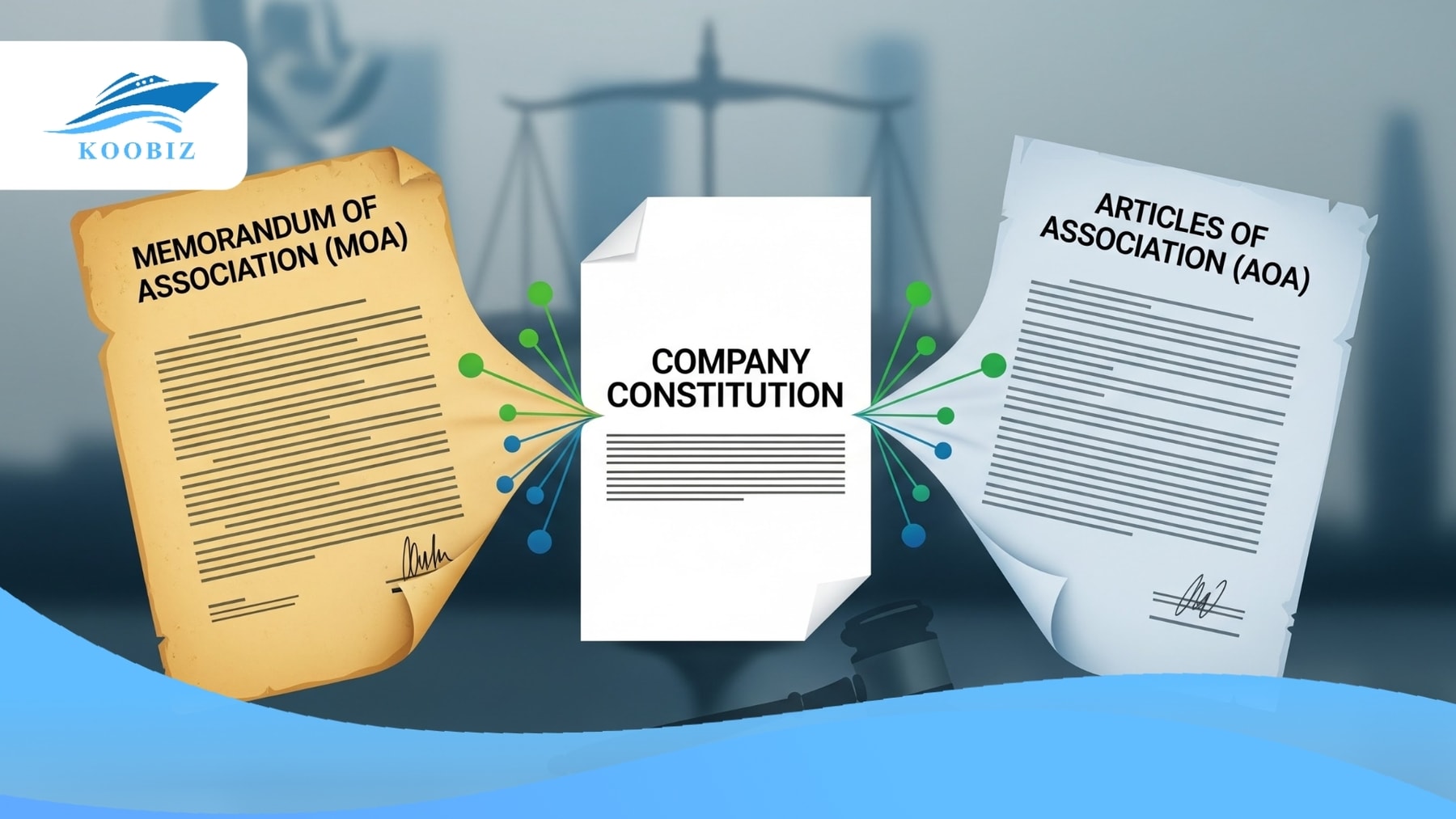
From 3 January 2016, these two documents were combined into a single Company Constitution for all new incorporations. Existing companies incorporated before that date continue to have their M&AA treated as their Constitution (see legal note below).
The Legislative Shift: Unifying Corporate Governance
The transition to a single Constitution was driven by the Accounting and Corporate Regulatory Authority (ACRA) to streamline Singapore’s corporate regulatory framework.
Prior to January 3, 2016, every company incorporated in Singapore was required to file two separate documents. The legislative change aimed to streamline corporate governance by fusing these two distinct sets of rules into one unified “Constitution”. This change aligns Singapore with other modern jurisdictions like the UK and Australia, reducing paperwork for entrepreneurs. For new companies, the term “Memorandum and Articles of Association” is technically obsolete, though the legal principles they contained are preserved within the new Constitution structure.
Memorandum of Association vs the Articles of Association
While they are now merged into a single Constitution, understanding the historical distinction between the Memorandum of Association (MOA) and the Articles of Association (AOA) is helpful for directors interpreting older documents.
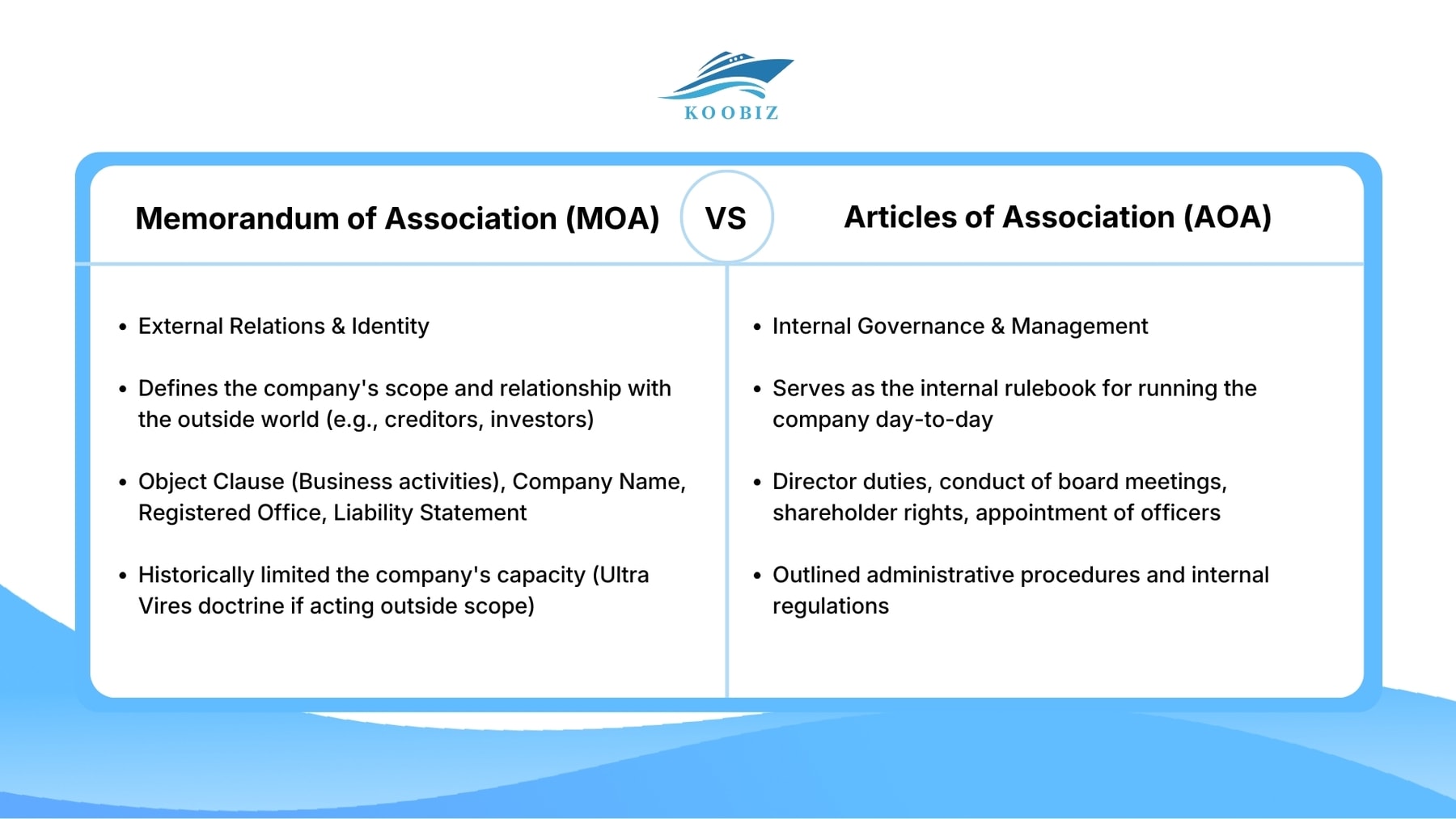
| Feature | Memorandum of Association (MOA) | Articles of Association (AOA) |
|---|---|---|
| Primary Focus | External Relations & Identity | Internal Governance & Management |
| Key Function | Defines the company’s scope and relationship with the outside world (e.g., creditors, investors). | Serves as the internal rulebook for running the company day-to-day. |
| Typical Content | Object Clause (Business activities), Company Name, Registered Office, Liability Statement. | Director duties, conduct of board meetings, shareholder rights, appointment of officers. |
| Legal Concept | Historically limited the company’s capacity (Ultra Vires doctrine if acting outside scope). | Outlined administrative procedures and internal regulations. |
Understanding this historical split helps directors and members interpret pre-2016 documents and decide whether to update them.
Is the Memorandum and Articles of Association Still Valid for Existing Companies?
Yes. For companies incorporated before 3 January 2016, existing Memorandum and Articles of Association are deemed to be the company’s Constitution – they remain legally effective unless the company chooses to adopt a new constitution.
However, this validity comes with specific conditions under Section 19(1)(c) of the Companies Act. For companies that existed prior to January 3, 2016, there is no immediate statutory requirement to merge their old M&AA into a single document. The law operates on a “deeming provision”, meaning that if a dispute arises, the courts and ACRA will treat the combination of the old Memorandum and Articles as the company’s Constitution.
Despite this automatic validity, relying on old documents can be problematic. The old M&AA might contain references to repealed sections of the Companies Act or outdated terminology. For instance, they might refer to “par value” of shares, a concept abolished in Singapore. Therefore, while “valid”, it is highly recommended for older companies to proactively update and adopt a new Constitution to ensure their governance framework aligns with modern commercial practices and current statutory requirements.
According to ACRA guidelines: “Existing companies do not need to take any action to merge their Memorandum and Articles of Association. They will be deemed to be the Constitution of the company”.
What are the Mandatory Clauses Required in a Singapore Company Constitution?
There are mandatory clauses comprising the company name, liability statement, subscriber details, and share capital rules that every Singapore Company Constitution must contain.
Specifically, Section 22 of the Companies Act outlines these non-negotiable requirements for compliance. A Constitution is not just a list of internal rules; it is a statutory contract between the company and its members. Regardless of whether a company uses the standard model or a customized version, omitting these core elements renders the document invalid for incorporation purposes. These requirements ensure transparency and protect creditors by clearly stating the nature of the business entity.
What Information Must Be Included Regarding the Company Name and Liability?
The Constitution must clearly state the full registered name of the company and explicitly declare the liability status of its members.
Under Section 22(1)(a), the Name Clause must match exactly with the name approved by ACRA. More critically, the Liability Clause (Section 22(1)(b)) defines the extent of financial risk for shareholders. For a company limited by shares-the most common structure in Singapore-the clause must state that the liability of the members is limited to the amount, if any, unpaid on the shares held by them. This separation of liability is the fundamental attribute that encourages entrepreneurship, ensuring that personal assets are protected from corporate debts.
What Rules Govern the Subscriber and Share Capital Details?
The Constitution must list the full names, addresses, and occupations of the initial subscribers, along with the number of shares they agree to take.
This requirement, found in Section 22(1)(f) and (g), solidifies the initial ownership structure. The Subscriber Clause serves as evidence of the founders’ intent to form the company. Furthermore, while the concept of authorized capital has been abolished, the Constitution often details the Share Capital structure, including the types of shares (ordinary vs. preference) and the rights attached to them. This section is crucial for investors as it delineates voting power and dividend entitlements from day one.
How Can Companies Adopt or Amend Their Constitution?
Companies can adopt or alter their Constitution by passing a Special Resolution requiring at least 75% of shareholder votes, followed by lodging the notice with ACRA. This procedural requirement ensures that significant changes to the corporate rulebook reflect the majority consensus.
Here is the step-by-step procedure:
- Proposal and Board Meeting The process begins with a board meeting to propose the specific changes to the Constitution.
- Notice of Meeting Shareholders must be notified of the Extraordinary General Meeting (EGM).
- Standard Notice: Typically 14 days for private companies.
- Special Notice: A 21-day notice period is required if the alteration involves changing the “Objects” of the company (to allow creditors to object).
- Passing the Special Resolution During the EGM, the resolution must be put to a vote. Unlike an Ordinary Resolution (>50%), a Special Resolution demands a 75% majority because these changes can fundamentally alter shareholder rights and company operations.
- Filing with ACRA Once passed, the company must file the “Resolution for Alteration of Constitution” via the BizFile+ portal within 14 days. Failure to lodge this notice constitutes an offense.
Professional firms like Koobiz can assist in drafting these resolutions and handling the filing process to ensure all statutory requirements are met correctly.
What is the Model Constitution Provided by ACRA?
The Model Constitution is a statutory template provided by the Singapore government under the Companies (Model Constitutions) Regulations 2015 to simplify incorporation.
To assist new business owners, ACRA introduced this standardized option to reduce legal setup costs. Before 2016, companies had to pay lawyers or corporate secretaries to draft M&AA from scratch or use Table A (the old default). The Model Constitution is “plug-and-play”. A company can choose to adopt it in its entirety, or adopt it with specific amendments. This template covers standard governance scenarios, such as the appointment of directors, conduct of meetings, and capitalization of profits, making it highly suitable for straightforward business structures.
Model vs. customized constitution — who should choose what?
The Model Constitution wins on cost-efficiency and simplicity, whereas a Customized Constitution is optimal for specific governance needs and complex shareholding structures.
For sole proprietorships turning into private limited companies (solopreneurs) or small startups with a simple 50-50 partnership, the Model Constitution is sufficient and saves thousands of dollars in legal fees. However, for venture-backed startups or companies with multiple classes of shares (e.g., Series A preference shares), the Model Constitution is often inadequate. Investors usually require a Customized Constitution to include specific protective mechanisms like tag-along/drag-along rights, right of first refusal, or complex board composition rules that the standard model does not cover. This is where consulting with Koobiz becomes invaluable to ensure your governance structure meets investor standards.
What are Entrenched Provisions in a Company Constitution?
Entrenched Provisions are specific clauses in a Company Constitution that require a higher threshold than a standard special resolution to be amended or removed.
Beyond standard rules, these provisions offer a stronger layer of protection for minority shareholders or specific founding rights. While a standard clause can be changed with 75% agreement, an entrenched provision might specify that it can only be changed with 90% or even 100% (unanimous) consent. These are “rare attributes” in standard companies but are critical in joint ventures where a minority partner wants to ensure that key terms (like the business direction or dividend policy) cannot be altered without their explicit agreement.
Why Should Founders Include Object Clauses in Their Constitution?
Founders should include Object Clauses to strictly limit the directors’ powers and ensure the company remains focused on its specific business purpose.
Although the Companies Act now gives companies “full capacity” (meaning they can do anything a natural person can do) and makes object clauses optional, including them is a strategic choice. For example, in a charitable organization or a Special Purpose Vehicle (SPV) created for a single project (like property development), restricting the “objects” prevents directors from diverting funds into unrelated risky ventures. It provides legal recourse for shareholders to sue for breach of duty if the company strays from its defined mission.
How Does the Constitution Affect Shareholders’ Rights and Dispute Resolution?
The Constitution acts as a binding contract between the company and its members, defining mechanisms for dispute resolution and the enforcement of shareholder rights.
Unlike a private Shareholders’ Agreement (SHA), the Constitution is a public document available for purchase on ACRA. It dictates how conflicts are managed procedurally-for instance, how a deadlock at the board level is resolved (e.g., via a casting vote by the Chairman). It also governs Pre-emption Rights, which protect existing shareholders from dilution by giving them the first right to buy new shares. A well-drafted Constitution minimizes litigation risks by providing clear internal remedies for disputes before they escalate to the courts.
Legal Insight: “A Constitution without clear dispute resolution clauses is a liability. It serves not just as a rulebook, but as the first line of defense in corporate conflict”.
Simplify Your Singapore Incorporation with Koobiz
Navigating the legalities of the Company Constitution doesn’t have to be overwhelming. Whether you are a new startup looking to incorporate or an existing company needing to update your M&AA, Koobiz provides end-to-end corporate services to ensure you are fully compliant.
- Seamless Incorporation: We handle the paperwork, including the Constitution.
- Expert Advice: Choose between Model or Customized Constitutions with confidence.
- Ongoing Compliance: Stay updated with ACRA regulations effortlessly.