

Yes, a Sole Proprietorship in Singapore can hire employees. Hiring can unlock growth, but owners must follow Ministry of Manpower (MOM) rules, meet Central Provident Fund (CPF) obligations, and comply with employment law. This guide explains what to do (and what to watch out for), with practical tips and where Koobiz can help – from payroll & CPF filing to work-pass applications and incorporation services.
Can Sole Proprietors in Singapore legally hire employees?
Yes. A sole proprietor with a current ACRA registration may employ staff. Legally, the owner (or the registered business name) is the employer and enters into contracts of service directly. That means you don’t need board resolutions (as you would for a company), but you are personally responsible for employer obligations – so correct registration and timely compliance are essential.
If your ACRA registration is expired or inaccurate, employment contracts may be disputed and you risk penalties from MOM.
Koobiz helps clients set up compliant payroll systems, register for a CPF Submission Number (CSN), and issue correct employment documents so hiring starts on solid ground.
According to the Ministry of Manpower (MOM), all employers, regardless of size or entity type, are legally bound by the Employment Act once they engage an employee under a contract of service.
What are the Mandatory Requirements for hiring local staff?
When you hire local employees, the core obligations are simple to list but important to get right: CPF contributions, Key Employment Terms (KETs), Skills Development Levy (SDL), and fair hiring practices. Failure to comply can lead to fines and enforcement action.
1. Central Provident Fund (CPF) Contributions
You must register as an employer and obtain a CPF Submission Number (CSN) to submit CPF contributions. Employer and employee CPF contribution rates vary by the employee’s age (e.g., for employees 55 and below, employer share 17% and employee share 20% as at 1 Jan 2025). Contributions are normally due monthly, with statutory deadlines and penalties for late payment.
2. Key Employment Terms (KETs)
Employers must provide written Key Employment Terms to employees who are employed for 14 days or more, and these should be issued within 14 days of the start of employment. KETs list the essentials (names, job title, start date, salary, working hours, notice, etc.). You can include KETs within the employment contract.
3. Skills Development Levy (SDL)
SDL is payable for each employee at 0.25% of monthly wages, with a minimum of S$2 and a maximum of S$11.25 (SDL is capped on the first S$4,500 of wages). Don’t forget to include SDL in your payroll calculations.
4. Fair Hiring Practices
Data from the CPF Board indicates that late payment of CPF contributions is one of the most common offenses among small business owners, punishable by fines of up to SGD 10,000.
Can a Sole Proprietor employ foreign workers in Singapore?
Yes – but this is subject to strict conditions regarding approved source countries, sector-specific quotas. Hiring foreign workers requires appropriate work passes (Work Permit, S Pass), adherence to the sector’s Dependency Ratio Ceiling (DRC), and payment of foreign worker levies. For many sole proprietors, these rules are a practical constraint on scaling with foreign labour.
- Work passes (S Pass / Work Permit): You must apply to MOM for the correct pass. S Pass eligibility includes a qualifying salary threshold that has been adjusted recently; note MOM’s staged increases to the S Pass qualifying salary (policy changed in 2025/2026).
- Dependency Ratio Ceiling (DRC): The DRC limits the share of Work Permit + S Pass holders a business can employ. For the services sector the DRC is 35%, and within that the maximum share of S Pass holders is typically 10% – these quotas are enforced based on CPF-declared local staff numbers. If you have zero local employees who count toward quota, your foreign worker quota will be effectively zero.
Practical implication for sole proprietors: Business owners of sole proprietorships do not count as local employees for quota calculations (only employees on CPF who meet the Local Qualifying Salary count), so a sole proprietor often needs to hire a local employee first (and contribute CPF) to create quota headroom.
Koobiz can help with S Pass/Work Permit applications, quota planning, and payroll reporting so you don’t accidentally lose quota or face higher levies.
Eligibility: You cannot just hire anyone. The worker must come from an approved source country (e.g., Malaysia, PRC, NAS countries) depending on your industry sector.
What Insurance and Benefits must Sole Proprietors provide?
Employers must secure Work Injury Compensation Insurance and meet statutory leave entitlements for qualifying staff. These are not optional protections.
1. Work Injury Compensation Insurance (WICA)
Employers must buy WIC insurance for all employees doing manual work and for non-manual employees earning S$2,600 or less per month (thresholds aligned with Employment Act provisions). If you fail to insure eligible staff, you remain personally liable for compensation and face penalties.
2. Statutory Leave & Other Protections
Under the Employment Act, employees who have worked for at least 3 months are entitled to statutory annual leave, sick leave, and other protections. Part-timers and contract status affect entitlements – check specifics before classifying workers as contractors.
How does unlimited liability affect hiring for Sole Proprietorships?
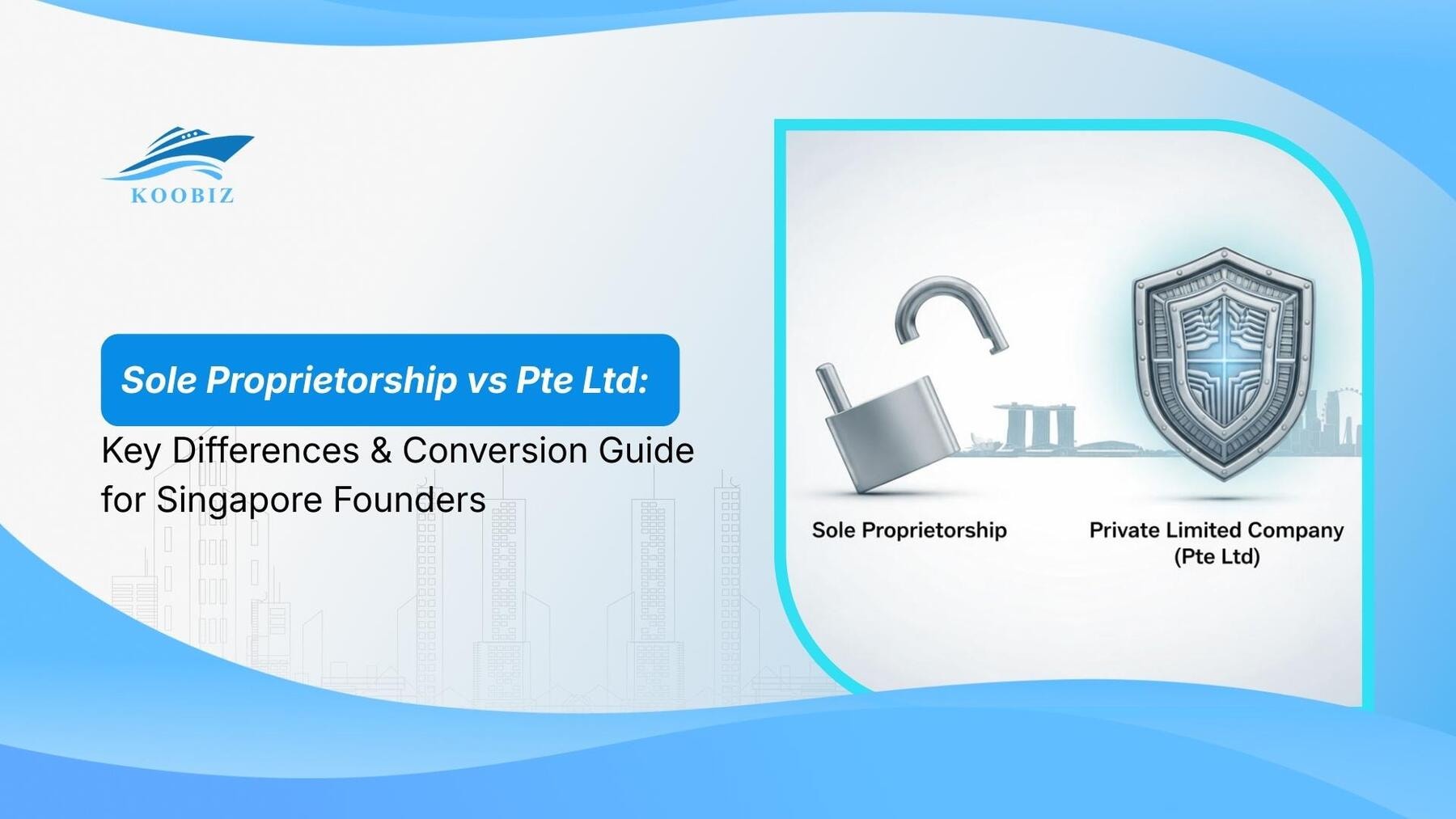
A sole proprietor has unlimited personal liability. Employment disputes, wrongful acts by employees, or large compensation orders can put personal assets at risk. This is the key reason many business owners choose to incorporate as a Private Limited (Pte Ltd) when they plan to grow headcount or hire foreign workers.
Koobiz recommendation: if you plan to hire multiple staff or foreign workers, consider incorporating – Koobiz offers end-to-end company incorporation and migration of payroll/CPF filings so liabilities sit with the company, not your personal estate.
Case Studies: Hiring in Action
To better understand the practical implications of hiring as a sole proprietor, consider these two real-world scenarios illustrating compliance success and liability risk.
Real-world examples clarify how these rules apply to daily operations.
Scenario A: The Compliant Expansion (Success)
Context: Jane owns “Jane’s Bakes,” a home-based bakery registered as a Sole Proprietorship. She wants to hire her first full-time assistant, a Singaporean Citizen.
Action:
- Registration: Jane logs into the CPF website with her Singpass and applies for a CPF Submission Number (CSN).
- Contract: She drafts a Key Employment Terms (KETs) contract stating a salary of $2,000, working hours, and 7 days of annual leave.
- Insurance: Even though the salary is below the WICA mandatory limit for non-manual work, she buys WICA insurance because kitchen work involves physical risks (burns, slips).Result: Jane successfully scales her business. Her employee is protected, and she avoids any fines during MOM inspections.
Scenario B: The Liability Trap (Risk)
Context: Mark runs “Mark’s Reno,” a renovation sole proprietorship. He hires a delivery driver but decides to skip buying comprehensive insurance to save money.
Incident: The driver accidentally reverses the company van into a client’s luxury gate, causing $15,000 in damages.
Consequence:
- Direct Liability: The client sues Mark. Because it is a sole proprietorship, Mark is personally liable.
- Financial Hit: The business account only has $5,000. Mark is forced to use $10,000 from his personal family savings to pay the damages.Lesson: If Mark had incorporated a Private Limited Company, his personal savings would likely have been protected from this business liability.
Frequently Asked Questions (FAQs)
Sole Proprietorship vs. Private Limited: Which Structure is Better for Hiring?
Private Limited wins on liability protection and foreign quotas, while Sole Proprietorship is better for administrative simplicity and lower initial costs.
When comparing these structures for growth, business owners often reach a tipping point where the risks of the sole proprietorship outweigh its simplicity.
| Aspect | Sole Proprietorship | Private Limited (Pte Ltd) |
|---|---|---|
| Liability | Unlimited. Owner’s personal assets are at risk if sued. | Limited. Company is a separate entity; personal assets are protected. |
| Hiring Foreign Workers | Difficult. Strict quotas; owner does not count as local staff. | Scalable. Easier to access quotas and secure work passes. |
| Initial Costs | Low. Simple registration process. | Higher. Incorporation fees and corporate secretarial costs. |
| Tax | Personal Income Tax (0% to 24%). No deduction on owner’s salary. | Corporate Tax (Flat 17% with exemptions). Tax-efficient. |
| Grants | Limited. Harder to access major government grants. | Accessible. Eligible for PSG, EDG, and other hiring subsidies. |
Ready to Scale? Upgrade to a Private Limited Company
If you are planning to hire significant headcount or want to protect your personal assets from employment risks, incorporating a Private Limited company is the smartest move.
Koobiz specializes in seamless company incorporation in Singapore. We handle the paperwork so you can focus on building your team.
👉 Get a Free Consultation on Incorporating Your Business
Do You Need to Pay CPF When Hiring Family Members?
Yes, you generally need to pay CPF for family members if they are employed under a contract of service and receive wages, contrary to common misconception.
To clarify, the CPF Board stipulates that if a family member (including spouse or children) is working for your business and receiving a salary, they are treated as an employee. Therefore, CPF contributions are mandatory.
- The Exemption: CPF exemption only applies if the family member is a partner in the business (and thus self-employed) or if they are purely helping out without a formal employment contract or salary.
- The Risk: If you pay them a “allowance” that functions as a salary but fail to pay CPF, you may be liable for late payment penalties. Always consult the CPF Board or a professional service if you are unsure about your specific family arrangement.
How to Handle Part-Time Employees and Freelancers?
Part-timers (work <35 hours/week) are employees with pro-rated entitlements; freelancers on a “contract for service” are not employees (no CPF/SDL) — but misclassification risk is high if you control hours and outcomes.
Part-Time Employees:
- Definition: Under the Employment Act, a part-time employee is one who works less than 35 hours a week.
- Benefits: They are entitled to CPF (if earning >$50/month) and pro-rated annual and sick leave. You cannot deny them these benefits just because they are not “full-time.”
Freelancers (Contract for Service):
- Definition: These are independent contractors. They are not your employees.
- Benefits: You do not pay CPF, SDL, or provide leave. You pay them a fee for a completed project.
- Risk: Do not treat a full-timer as a freelancer to avoid CPF. If MOM investigates and finds they work fixed hours under your control, you will be forced to backpay CPF with interest.
What Happens to Employees if the Sole Proprietorship Closes?
If the business closes, employment is deemed terminated, requiring the immediate payment of all outstanding salaries and, for foreign staff, tax clearance via Form IR21.
To understand the closure process, “cessation of business” is considered a valid reason for termination, but it does not absolve the owner of financial duties.
- Notice Period: You must give the notice period stated in the contract or pay salary in lieu of notice.
- Salary Payment: All outstanding salary must be paid on the last day of employment.
- Retrenchment Benefits: Sole proprietorships are generally not legally mandated to pay retrenchment benefits unless it is stated in the employment contract, but it is encouraged by MOM for long-serving staff.
- Foreign Workers: You must cancel their work passes and buy their air ticket home. Importantly, you must file Form IR21 with IRAS to withhold their last month’s salary for tax clearance purposes before releasing any remaining money to them.
Summary
Hiring as a sole proprietor in Singapore is a powerful way to grow, but it requires strict adherence to MOM and CPF regulations. From mandatory insurance to liability risks, every step matters. If you are ready to scale up and minimize risk, consider incorporating with Koobiz to separate your personal assets from your business obligations.
Disclaimer: The information provided in this article is accurate as of December 2025. Regulations regarding CPF, foreign worker quotas, and levies are subject to change by the Ministry of Manpower (MOM) and other government agencies. Business owners are advised to verify the latest requirements on official government websites.