

Singapore stands out as a top destination for investors, thanks to a major benefit: tax-free dividends. While many countries tax investment income, Singapore allows you to build and keep more of your wealth. Understanding how dividends work here is key to making the most of your investments.
At Koobiz, we assist businesses and investors in making the most of Singapore’s financial opportunities, from starting a company to tax planning. This guide will walk you through the basics of Singapore’s tax system, highlight top sectors like REITs for income, and explain strategies like reinvesting dividends, all to help you turn company profits into your own tax-free income.
Are Dividends Taxable in Singapore?
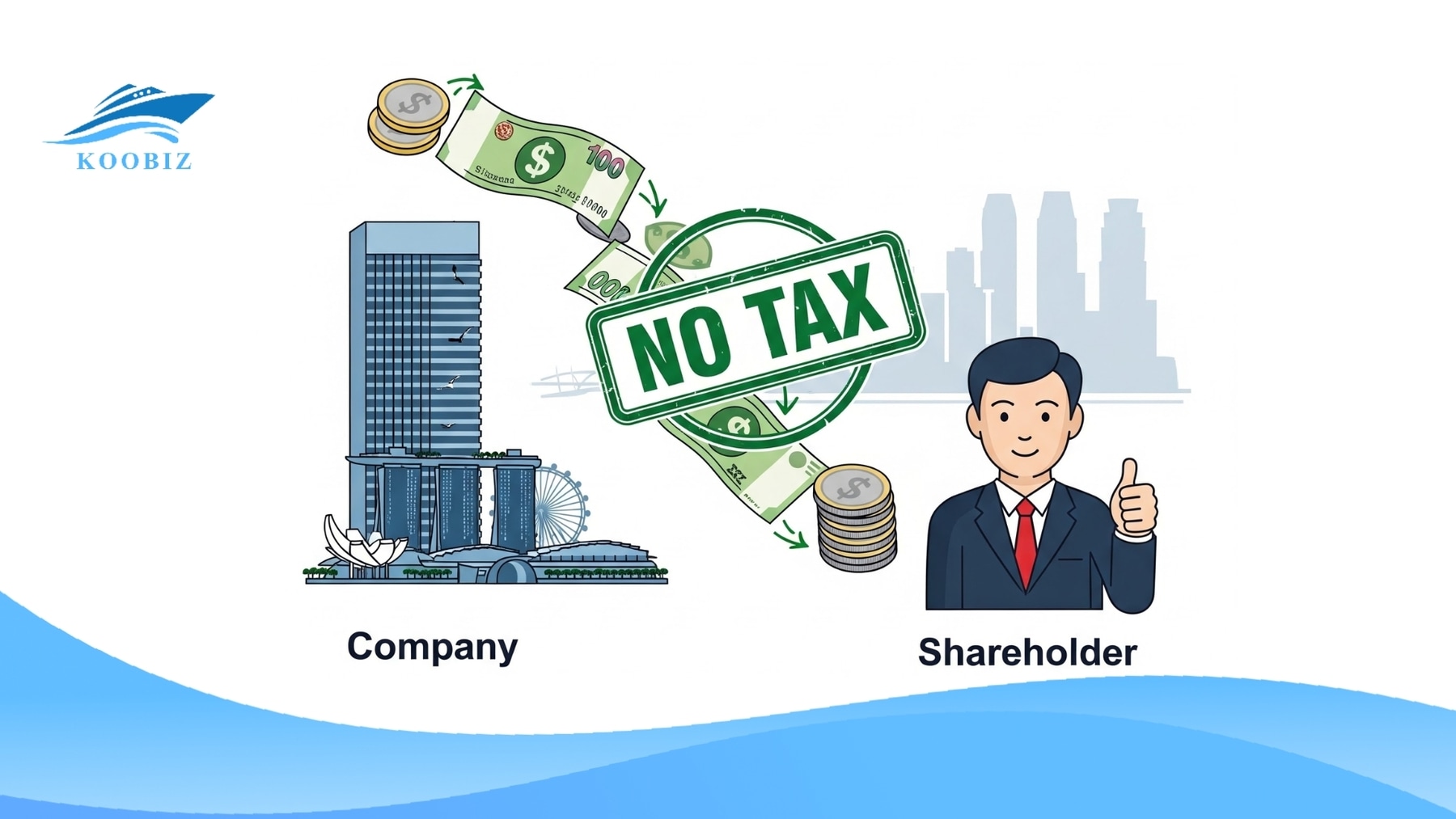
No, dividends paid by Singapore resident companies are generally not taxable in the hands of shareholders, regardless of their tax residency status.
Here’s a simple look at why Singapore is so favourable for dividend investors:
- No Capital Gains Tax: Singapore does not tax the profit you make from selling investments (capital gains).
- No Withholding Tax: Unlike some countries, Singapore does not take a cut from dividends paid to non-residents. You receive the full amount.
- No Personal Declaration Required: For standard dividends, you do not need to report this income on your personal tax return.
This approach is part of Singapore’s strategy to encourage investment and keep things simple. The exemption applies specifically to “standard” dividends under the one-tier corporate tax system, where the company pays tax on its profits first, so the same money isn’t taxed twice when it reaches you. For clients at Koobiz, this simplicity is often a key reason for choosing Singapore for their investment holdings.
Evidence: The Inland Revenue Authority of Singapore (IRAS) states that dividends from a Singapore resident company under the one-tier system are tax-exempt for shareholders.
Understanding the One-Tier Corporate Tax System
The One-Tier Corporate Tax System is a tax regime where the tax paid on a company’s chargeable income is final, and subsequent dividends paid to shareholders are exempt from further taxation.
This system started in 2003, making things much simpler for businesses and investors. Let’s see how it works with an example.
Scenario: The “Tax-Free” Flow of Company X
Imagine you own shares in “Company X,” a Singapore resident company. Here is the math behind your payout:
| Stage | Amount (SGD) | Explanation |
|---|---|---|
| Company Profit | $100,000 | The company’s taxable income before tax. |
| Corporate Tax (17%) | ($17,000) | Paid by Company X to IRAS. This is the only tax tier. |
| Net Distributable Profit | $83,000 | The remaining profit available for shareholders. |
| Dividend Paid to You | $83,000 | You receive the full share of the profit. |
| Personal Tax Payable | $0 | You pay zero tax on this income. |
The Bottom Line: What the company distributes is yours to keep.
What you receive is yours to keep in full. This avoids “double taxation” (where income is taxed first at the company level, then again when you receive it). For entrepreneurs utilizing Koobiz‘s accounting services, this means less administrative burden. You do not need to issue tax vouchers to shareholders for dividend payments, nor do shareholders need to declare these dividends in their annual income tax returns. It creates a seamless flow of capital from corporate earnings to personal wealth.
What is a Dividend Yield and How to Calculate It?
Dividend Yield is a financial ratio that shows how much a company pays out in dividends each year relative to its stock price, expressed as a percentage.
To understand your potential return, look at the yield. Here’s the simple formula:
Dividend Yield = (Annual Dividends per Share / Price per Share) × 100
For example, if a company’s share price is S$20.00 and it pays an annual dividend of S$1.00, the yield is 5%.
Is a High Yield Always Good?
- Safe Zone (4% – 6%): Typical for stable Singapore REITs and Banks.
- Caution Zone (>8%): Often a “Dividend Trap.” A yield this high usually means the share price has crashed due to underlying business problems.
Yield helps you compare income potential, but it’s just the first step in your research.
Dividend Payout Ratio vs. Dividend Yield
While Dividend Yield measures the return on the stock price, the Dividend Payout Ratio measures the percentage of net income a company distributes to shareholders.
Comparing both helps you find a sustainable investment.
| Feature | Dividend Yield | Payout Ratio |
|---|---|---|
| Focus | Return on Investment (ROI) | Sustainability of the Dividend |
| The Question | “How much will I earn?” | “Can the company afford to pay this?” |
| Ideal Range | 4% – 6% (Banks/REITs) | 50% – 70% (Standard Companies) |
| Red Flag | >8% (Risk of cut) | >100% (Paying out more than earning) |
A “safe” dividend stock usually has a sustainable payout ratio (REITs are designed to have higher ratios). It ensures the company isn’t sacrificing its future just to pay dividends now. At Koobiz, we advise business owners to set a balanced dividend policy that rewards shareholders while keeping enough profit for growth.
Top Sectors for High Dividend Yields in Singapore
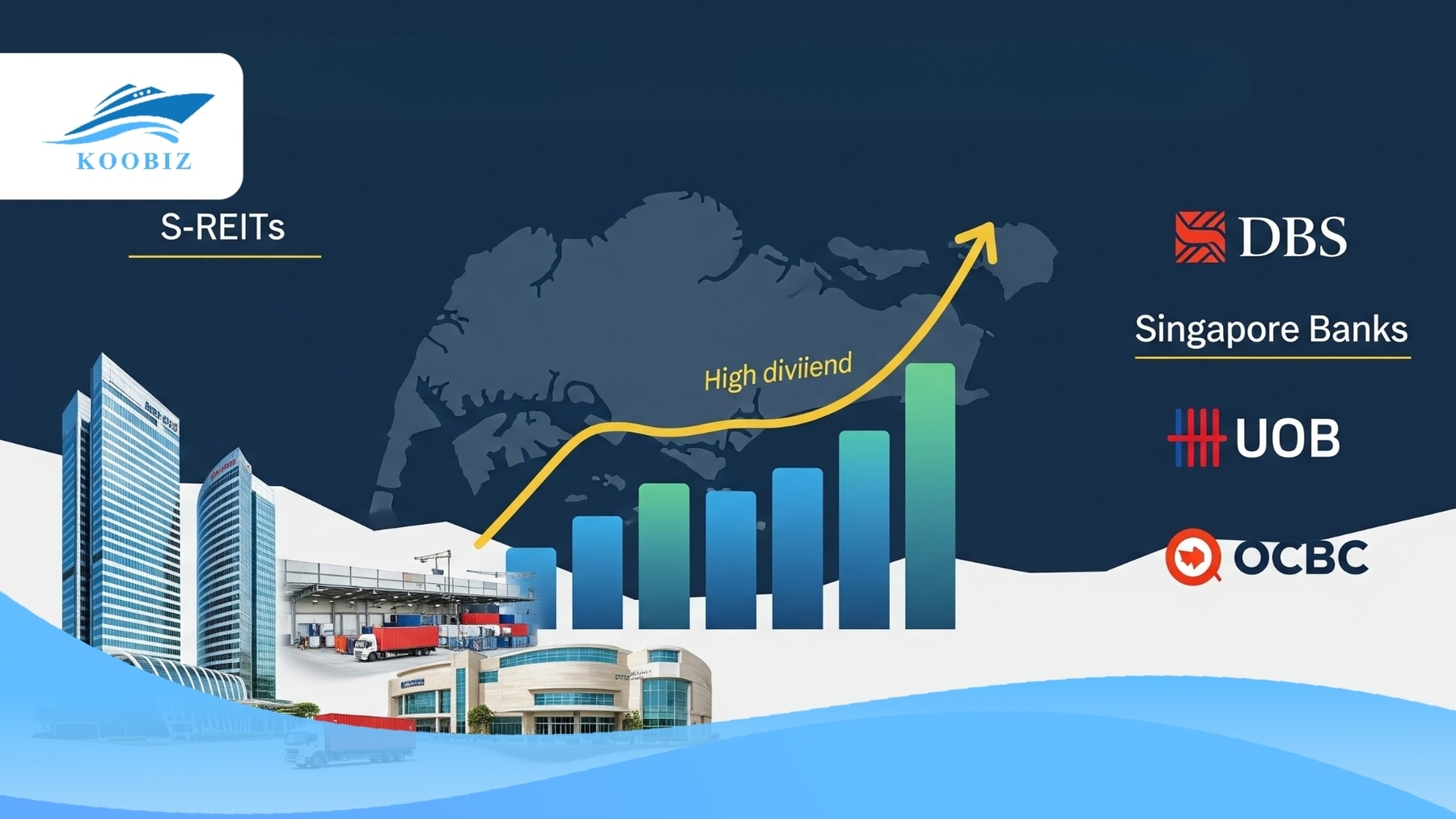
There are two primary market sectors that consistently drive high dividend yields in Singapore: Real Estate Investment Trusts (S-REITs) and the Banking/Finance sector.
Singapore’s market is known for stable, established companies that generate steady cash, which is ideal for dividend seekers. The main market index (STI) is known for offering some of Asia’s highest dividend yields.
Here’s a quick comparison:
| Feature | S-REITs | Local Banks (DBS/UOB/OCBC) |
|---|---|---|
| Primary Goal | High Passive Income | Capital Preservation + Growth |
| Typical Yield | 5.0% – 8.0% | 3.5% – 5.0% |
| Key Risk | Interest Rate Hikes | Economic Recessions |
| Tax Perk | Tax Transparency (0% Corp Tax) | One-Tier Exempt Dividends |
These sectors offer a mix of reliability and regular payouts, making them great for building a passive income stream.
Singapore REITs (Real Estate Investment Trusts)
S-REITs are investment vehicles that own, operate, or finance income-generating real estate and are required to distribute at least 90% of their taxable income to shareholders.
S-REITs are companies that own and manage income-generating properties (like malls, offices, warehouses). They must distribute at least 90% of their taxable income to shareholders.
This 90% rule is why S-REITs offer high yields. They enjoy “tax transparency,” meaning they don’t pay corporate tax if they follow the rules, passing rental income directly to you.
Consider diversifying across different REIT types:
Retail REITs (The “Mall” Plays): Focus on suburban malls that are resilient to economic downturns.
Example: Frasers Centrepoint Trust (FCT) – Dominates the suburban mall scene in Singapore.
Industrial/Logistics REITs (The “Supply Chain” Plays): Focus on warehouses and data centers.
Example: Mapletree Logistics Trust (MLT) – Benefits from the rise of e-commerce and regional trade.
Commercial/Integrated REITs (The “Office” Plays): Focus on prime office space and downtown mixed-use developments.
Example: CapitaLand Integrated Commercial Trust (CICT) – The largest proxy for Singapore’s commercial real estate market.
Local Banks and Blue-Chip Stocks
Singapore’s three local banks—DBS, UOB, and OCBC—are pillars of the economy, known for their strong capital buffers and consistent dividend payouts.
These “blue-chip” stocks form a solid foundation for a dividend portfolio. Their yields may be slightly lower than REITs, but they offer greater stability and potential for gradual dividend increases.
For investors seeking reliability, here is the “Big Three” breakdown:
- DBS Group Holdings (DBS): The largest bank in Southeast Asia. Known for digital innovation and a strong track record of dividend growth.
- United Overseas Bank (UOB): Strong footprint in the ASEAN region, offering exposure to regional growth with conservative management.
- Oversea-Chinese Banking Corp (OCBC): Renowned for its strong wealth management arm and conservative risk profile.
Beyond banks, you might consider other stable blue-chips like Singtel (Telecommunications) or Keppel Ltd (Conglomerate/Infrastructure), which have long histories of paying dividends to shareholders.
How Do You Receive Dividends in Singapore?
There are three main methods for receiving dividends in Singapore: Direct Crediting Service (DCS), Dividends via Cheque, and through a Custodian Account.
To ensure you get paid on time and without fees, choosing the right method is critical. Here is a comparison to help you decide:
| Method | Speed | Convenience | Cost |
|---|---|---|---|
| Direct Crediting (DCS) | Instant (On Payment Date) | High (Auto-deposit to Bank) | Free |
| Custodian Account | +1-3 Days (Processing) | Medium (Dependent on broker) | Low (Possible handling fees) |
| Cheque | +3-5 Days (Mail time) | Low (Bank visit required) | Free (Phasing out) |
The Recommendation: Stick to DCS
To streamline the process, the Central Depository (CDP) strongly encourages the use of the Direct Crediting Service (DCS). By linking your bank account to your CDP account, dividends are automatically credited to you the moment they are paid. This eliminates the risk of lost mail and the hassle of depositing physical cheques.
Note: If you hold shares through a foreign broker (like Interactive Brokers, Tiger, or Moomoo), your assets are held in a Custodian Account. Dividends will be paid to the broker first, then credited to your trading wallet.
What Is the Scrip Dividend Scheme?
The Scrip Dividend Scheme is a corporate action that gives shareholders the option to receive their dividends in the form of new shares instead of cash.
This option is often offered by major Singapore companies, especially banks. It’s a way for them to retain cash while rewarding you. Essentially, you get to buy more shares, often at a discount to the market price.
The Math of the Deal: Why Choose Scrip?
The primary allure is the Discount. Companies often issue these new shares at a price 2% to 10% lower than the market value to encourage you to keep your money in the company.
Example Scenario:
- Market Price of Share: $10.00
- Scrip Issue Price: $9.00 (10% Discount)
- Dividend Due to You: $900
If you elect for Cash, you receive $900.
If you elect for Scrip, you receive $900 / $9.00 = 100 Shares.
- Value of 100 Shares: 100 * $10.00 (Market Price) = $1,000.
- Instant Gain: You just made an extra $100 (an immediate ~11% return on your dividend) simply by clicking “Yes.”

Key Benefits for Investors:
- Zero Brokerage Fees: You pay no commissions or stamp duties on these new shares.
- Instant Equity Boost: You acquire more shares at a discount, accelerating the compounding effect of your portfolio.
For Koobiz clients looking to build long-term positions, understanding how to elect for Scrip is a valuable micro-optimization tactic that compounds significantly over time.
Scrip vs. Cash Dividends: Which Should You Choose?
To make the right decision, you must answer one simple question: “What is my primary financial goal right now?”
Here is the verdict based on your investment lifecycle:
Scenario A: “I want to grow my wealth as fast as possible.” (Accumulation Phase)
- The Verdict: Choose Scrip.
- Why: Reinvesting at a discount buys you more shares for free, supercharging the compounding effect over many years. Ideal for younger investors or those with a long-term view.
Scenario B: “I need this income to pay my bills.” (Retirement Phase)
- The Verdict: Choose Cash.
- Why: You need cash for daily life. Liquidity is essential for paying bills. Ideal for retirees or those depending on this income.
Warning: The “Odd Lot” Problem
Choosing a scrip can sometimes leave you with “odd lots” (like 1,023 shares instead of a round 1,000). These can be slightly less straightforward to sell later, though they are still fully valuable.
Exceptions: When Are Dividends Taxable?
The Golden Rule: Dividends in Singapore are generally tax-free. However, there are specific “Danger Zones” where tax liability kicks in.
It is critical to define the “Contextual Border” here to ensure compliance. If you fall into any of the following categories, you may need to pay tax.
The Taxable Checklist (Red Flags)
- Income through a Partnership:If you receive dividends as part of a partnership’s business income, it may be taxable.
- REIT Distributions to Non-Residents:While residents enjoy tax-free REIT distributions, non-resident individuals are often subject to a final withholding tax of 10% on distributions made out of taxable income.
- Foreign-Sourced Dividends (for Companies/Partnerships):Foreign dividends received by a Singapore company might be taxed unless they meet specific conditions.
- Cooperative Dividends:Payouts from co-ops (e.g., NTUC) may have different tax rules.
Koobiz Action: If you are unsure whether your dividend income is truly tax-exempt, especially if you have cross-border assets, contact Koobiz for a quick tax health check to avoid penalties.
Investing for Retirement: Dividends and SRS
The Supplementary Retirement Scheme (SRS) offers a powerful “double-dip” benefit when combined with high-dividend stocks.
Many investors mistake SRS for a simple savings account. However, cash in an SRS account earns a negligible 0.05% interest. To unlock its true power, you must invest those funds. Here is the math on why this strategy works so well for high-income earners.
The Dividend-SRS Strategy: A Numerical Proof
Let’s look at a concrete example of how you can earn an immediate “Guaranteed Return” simply by contributing and investing.
Scenario: John is a Singapore PR earning $120,000/year. He contributes the maximum cap of $15,300 to his SRS account and invests it in a stable REIT yielding 5%.
| Component | Calculation | Financial Gain |
|---|---|---|
| 1. Immediate Tax Savings | John’s tax bracket is 11.5%. Contributing $15,300 reduces his taxable income. | +$1,759.50 (Cash saved from IRAS) |
| 2. Dividend Income | $15,300 invested at 5% yield. | +$765.00 (Tax-Free Income) |
| Total First-Year Gain | Tax Savings + Dividends | $2,524.50 |
The ROI: By combining tax savings with dividends, John made a 16.5% return on his capital in Year 1 ($2,524 / $15,300).
Koobiz Insight: There are very few risk-free ways to get a double-digit return in year one. Using SRS to buy dividend stocks is the closest thing to a “free lunch” in the Singapore tax code.
Exit Strategy:
When John retires (after the statutory retirement age), only 50% of his withdrawals will be taxed. Since he likely won’t have a salary then, his effective tax rate could be near zero.
Conclusion
Building a portfolio focused on Singapore dividend stocks is a proven path toward financial security. Supported by a simple tax system and strong income-generating sectors like REITs and banks, investors can enjoy the returns from their investments without losing a portion to taxes.
To truly maximize this opportunity, it helps to have the right structure, understand the details, and plan strategically. Whether you need help setting up a company to manage your investments, ensuring tax compliance, or opening a corporate bank account in Singapore, Koobiz is here as your trusted partner. Our team is ready to guide you through Singapore’s business and financial landscape.
Visit Koobiz.com today to schedule a consultation and take the first step toward securing your financial future in Singapore.