

Staying compliant with manpower regulations in Singapore equals keeping up with the Ministry of Manpower’s (MOM) shifting benchmarks-particularly as we move further into 2026. For employers and HR managers, the critical figure to note is the $3,300 minimum qualifying salary, a standard that is now fully effective for all new applications. However, salary is just one component of a complex equation that includes rising levy rates, strict quota caps, and specific renewal timelines that could catch businesses off guard later this year. At Koobiz, we understand that hiring foreign talent is integral to your business growth, which is why we have compiled this essential guide to help you manage compliance and costs effectively.
What is the current S Pass Qualifying Salary in 2026?
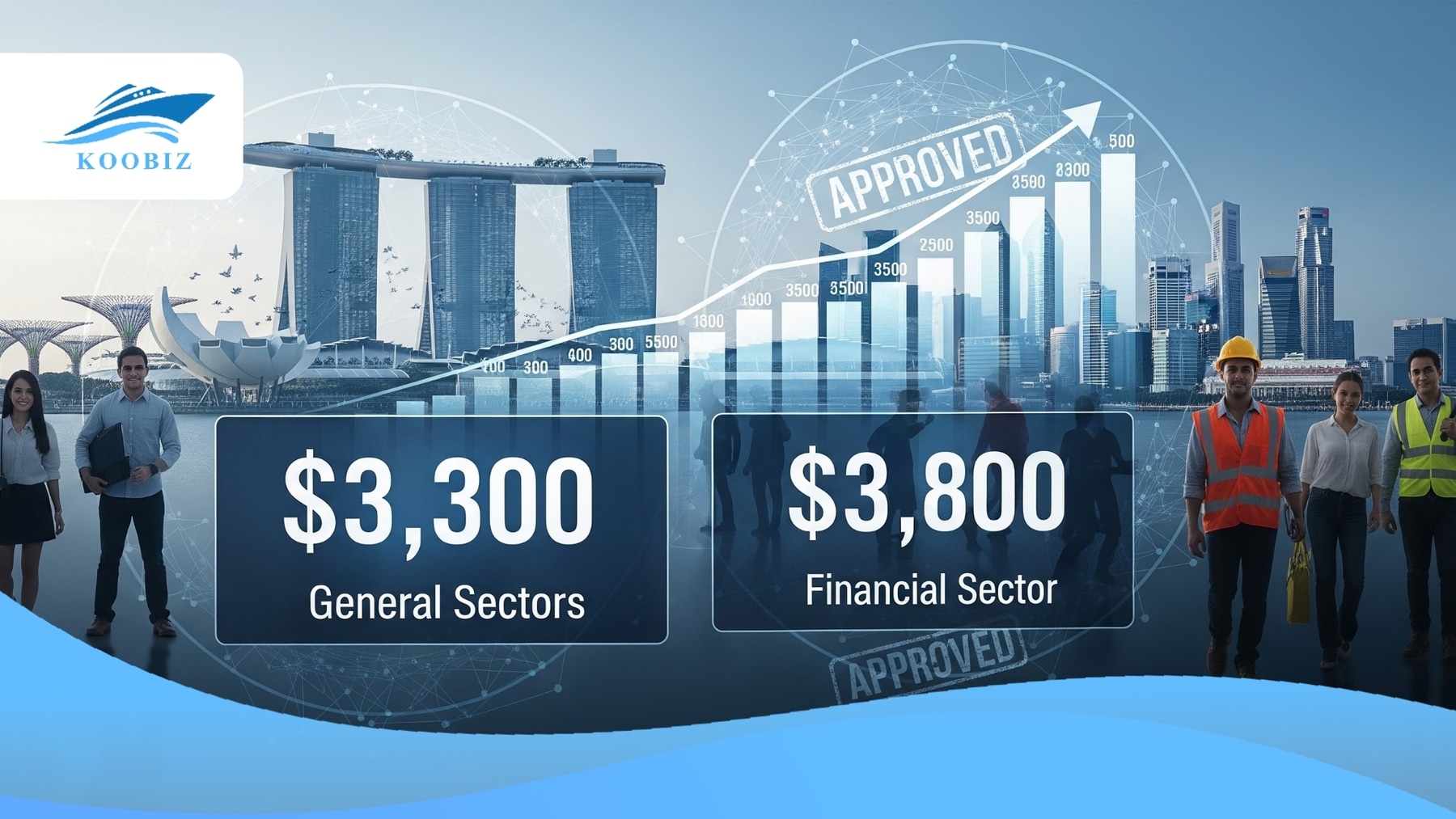
The S Pass qualifying salary is a variable benchmark currently set at a minimum of $3,300 per month for new candidates in most sectors, effective from September 2025 .
To understand the full scope of this requirement, we must look beyond the base figure, as the actual required salary often exceeds this minimum depending on the candidate’s profile. The Ministry of Manpower (MOM) applies this threshold to ensure that S Pass holders are comparable in quality to the top one-third of the local Associate Professionals and Technicians (APT) workforce. As such, meeting the minimum salary of $3,300 does not guarantee approval if the candidate possesses significant experience.
Does the salary threshold differ by sector?
Yes, the Financial Services sector commands a higher qualifying salary of $3,800 per month due to the higher prevailing wage norms in that industry.
While the general sector baseline sits at $3,300, the MOM acknowledges that salaries in banking, insurance, and asset management are consistently higher. Consequently, businesses incorporated under these Standard Industrial Classification (SIC) codes must budget for this premium. For incoming foreign business owners, it is crucial to factor in this higher operational cost when planning your initial headcount.
How does age and experience impact the salary requirement?
The qualifying salary increases progressively with age, reaching up to $4,800 (General) or $5,650 (Financial Services) for candidates in their mid-40s to match local peer income levels.
The “Age-Wage” Trap:
MOM applies a strict “age-wage” curve. A fresh graduate aged 23 might qualify at the base $3,300. However, a 35-year-old applicant with ten years of experience cannot be hired at the minimum floor. They must be paid a salary commensurate with their seniority to be approved.
If an employer submits an application for an experienced professional at the minimum wage, it will likely be rejected on the grounds that the candidate does not command a market rate, implying they may not be a true “mid-skilled” talent.
According to MOM regulations: The specific salary required for each candidate can be checked using the MOM Self-Assessment Tool (SAT), which serves as the definitive calculator for eligibility.
Does the salary threshold differ for renewals in 2026?
Yes, the salary threshold for renewals differs based on the specific expiry date of the pass, especially for passes expiring on or after 1 September 2026.
This creates a “two-tier” renewal system operating throughout 2026. The government provides this buffer to prevent sudden business disruptions, but businesses must act now to review their payroll structures for employees whose passes are due for renewal in the latter half of the year.
Renewal Timelines & Salary Requirements
| Pass Expiry Date | Sector | Minimum Qualifying Salary |
|---|---|---|
| Before 1 Sep 2026 | All Sectors (except Finance) | $3,150 |
| Financial Services | $3,650 | |
| On or After 1 Sep 2026 | All Sectors (except Finance) | $3,300 |
| Financial Services | $3,800 |
Koobiz Strategy: If you have valuable staff members whose passes are expiring between January and August 2026, we recommend proceeding with the renewal process as early as possible (up to 6 months in advance). This allows you to lock in the validity under the lower salary criteria ($3,150) for another tenure, buying time for future salary adjustments.
What are the S Pass Levy Rates and Quotas for Employers?
There are two primary S Pass Levy tiers—Tier 1 and Tier 2—which are determined by the percentage of S Pass holders within your total workforce, alongside specific industry quotas.
The levy is a monthly cost mechanism designed to regulate the foreign employment in Singapore. In reality, it acts as a “tax” on hiring foreigners, reinforcing the policy of prioritizing local employment. Understanding the interplay between your quota (Dependency Ratio Ceiling – DRC) and the levy tier is essential for accurate financial forecasting.
What are the current Levy Rates?
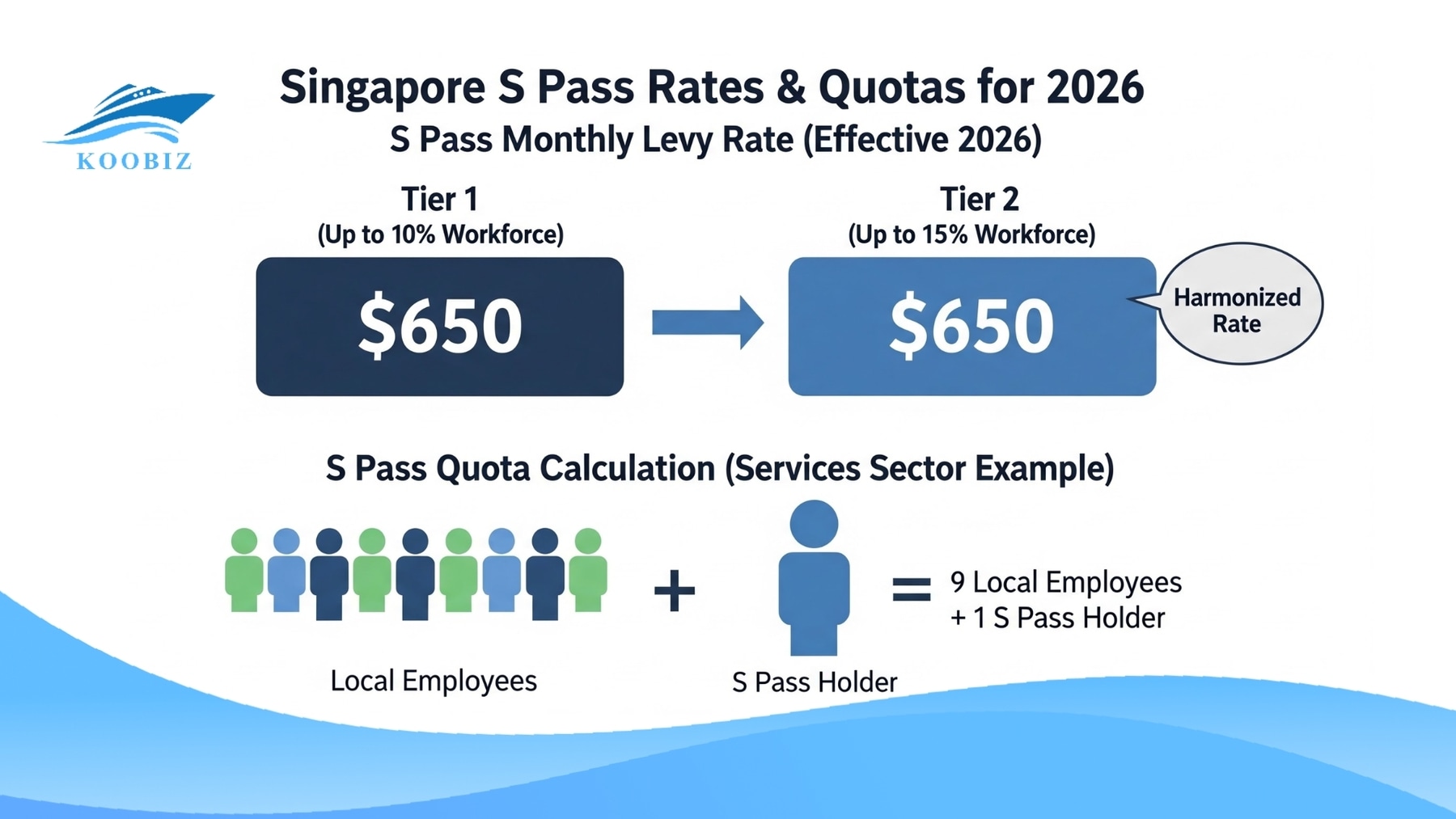
The levy rates for 2026 have been harmonized to $650 for all S Pass holders. The distinction between Tier 1 and Tier 2 now primarily serves to indicate how close you are to your quota limit, rather than a price difference.
| Levy Tier | Allowable Workforce % | Monthly Rate (2026) |
|---|---|---|
| Tier 1 (Standard) | Up to 10% of total workforce | $650 |
| Tier 2 | Above 10% to max cap (15%) | $650 |
Note: Levy rates are subject to periodic review by the government. Always verify the exact figure on the MOM website as minor adjustments can occur during the annual Budget announcement.
How is the S Pass Quota calculated?
The S Pass quota is capped at 10% for the Services sector and 15% for Manufacturing, Construction, Marine Shipyard, and Process sectors of the total workforce.
To hire one S Pass holder in the Services sector (where most Koobiz clients in consultancy and trading operate), you need a specific number of local employees earning the Local Qualifying Salary (LQS – currently $1,600).
- Services Sector: You need roughly 9 local employees to hire 1 S Pass holder (Total workforce = 10; 10% of 10 = 1).
- Manufacturing/Process/Other Sectors: You need roughly 6 local employees to hire 1 S Pass holder (Total workforce = 7; ~15% of 7 = 1.05).
Important Calculation: The quota is calculated based on the CPF contributions made to local staff. Without consistent CPF contributions, your local headcount does not count toward the quota.
How to Calculate the Total Cost of Hiring an S Pass Holder?
The total cost involves summing four distinct components: Fixed Monthly Salary + Monthly Foreign Worker Levy + Medical Insurance + Administrative Overheads.
Many new business owners make the mistake of looking only at the $3,300 salary. In reality, the “Total Cost of Employment” is significantly higher.
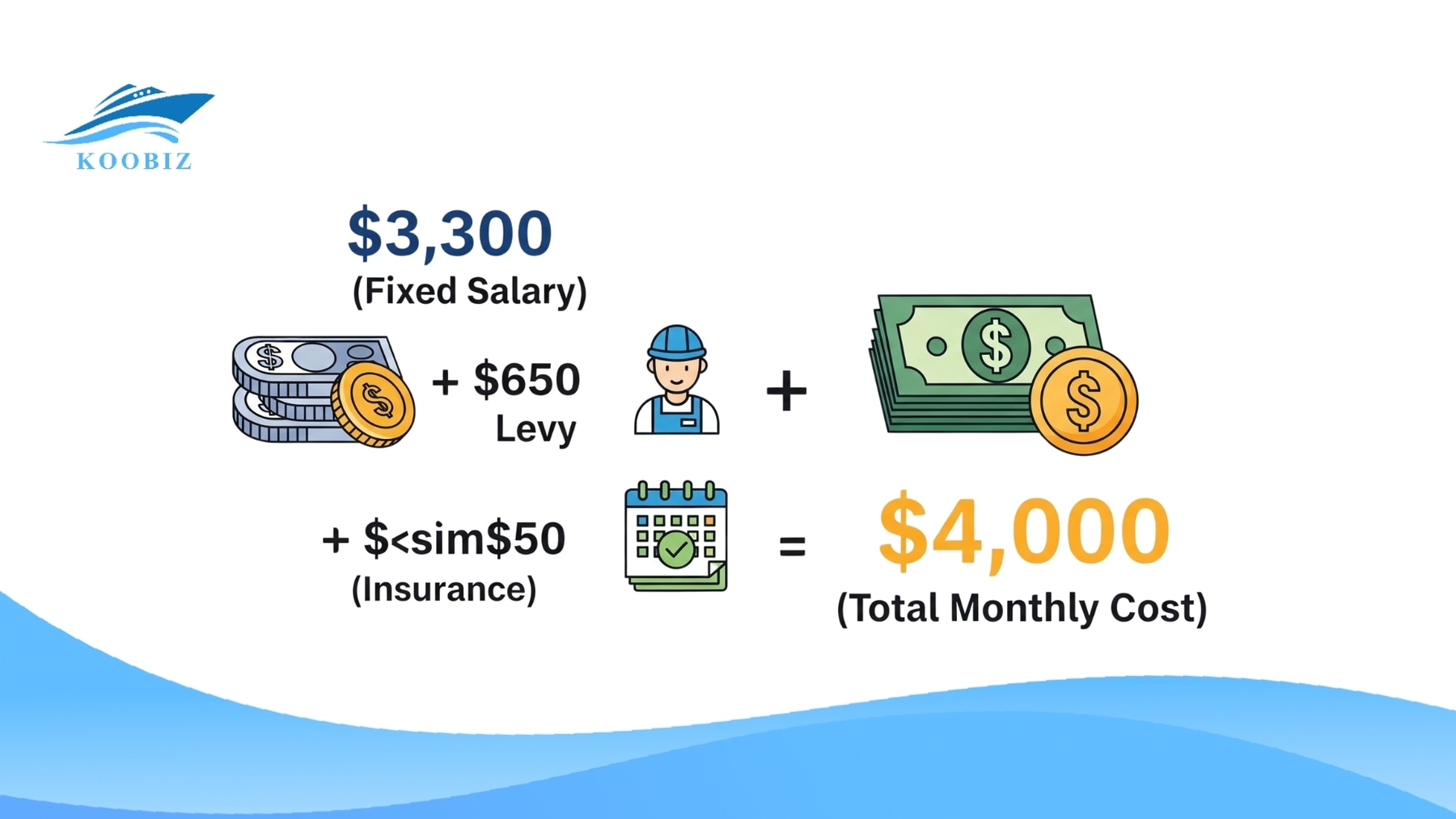
The 2026 Cost Formula (Services Sector Example):
$3,300 (Base Salary) + $650 (Foreign Worker Levy) + ~$50 (Mandatory Medical Insurance) = $4,000 (Total Monthly Cost)
(Excluding recruitment fees or bonuses)
Is the “Fixed Monthly Salary” defined differently by MOM?
The MOM defines “Fixed Monthly Salary” strictly as the sum of Basic Monthly Salary andFixed Monthly Allowances, excluding any variable components. To meet the $3,300 threshold, the amount must be guaranteed and recurring.
INCLUDED in Qualifying Salary:
- Basic Monthly Pay
- Fixed Food Allowance
- Fixed Transport Allowance
EXCLUDED from Qualifying Salary:
- Overtime (OT) Pay
- Bonuses or Annual Wage Supplement (AWS)
- Sales Commissions
- Variable Incentives
- Reimbursement for expenses
At Koobiz, when we assist clients with payroll setup and tax structuring, we emphasize that the employment contract must clearly stipulate this fixed amount. If a candidate’s basic pay is $2,500 and they earn $1,000 in commissions, they do not qualify for the S Pass because the fixed component ($2,500) is below the $3,300 threshold.
Real-World Case Studies: Applying the 2026 Rules
To visualize how these numbers impact your business, let’s look at three storytelling scenarios based on common client situations we handle at Koobiz.
Scenario 1: The “Fresh Grad” Hire (Services Sector)
The Story: CreativePulse, a boutique marketing consultancy with 10 local staff, wants to hire Jun, a 24-year-old Data Analyst from Malaysia. To manage costs, they offer him the exact minimum qualifying salary of $3,300.
- Salary Check: Since Jun is 24 and fresh out of university, the base $3,300 fits the age-wage curve.
- Quota Check: With 10 locals, the company has exactly 1 S Pass slot (10% cap).
Verdict: LIKELY APPROVED
Why: The salary matches the candidate’s lack of experience.
Cost Impact: CreativePulse must budget a total of $3,950/month ($3,300 Salary + $650 Levy).
Scenario 2: The Fintech Miscalculation (Financial Sector)
The Story: AssetFlow, a growing fintech startup, identifies Mark (28) for a Compliance Officer role. They offer him $3,500, thinking it is generous since it is above the national $3,300 minimum.
- The Mistake: They forgot they are classified under “Financial Services.”
- The Gap: Mark is 28 (mid-career). The base floor is $3,800, but his age likely commands $4,200+.
Verdict: REJECTED
Why: The offer is below the $3,800 sector floor and too low for his age.
The Fix: AssetFlow must raise the offer to at least $4,200 to match market norms before appealing.
Scenario 3: The Renewal “Trap” (Manufacturing)
The Story: LogiTrans Pte Ltd has a loyal warehouse supervisor, Kumar (32), who has been with them for 4 years earning $3,150. His pass expires on 15 October 2026. The HR manager plans to just click “Renew” in September.
- The Hidden Danger: Because the pass expires after 1 September 2026, the new rules apply.
- The Shortfall: Kumar’s $3,150 salary is now illegal for an S Pass renewal (Minimum is $3,300).
Verdict: RENEWAL AT RISK
Why: The system will auto-reject the renewal due to insufficient salary.
The Fix: LogiTrans must formally increase Kumar’s basic salary to $3,300 immediately to reflect in the CPF records before the renewal application.
Strategic Planning: S Pass vs EP & PR
S Pass vs Employment Pass (EP): Key Salary & Benefit Differences
The S Pass is designed formid-skilled technical staff with a $3,300+ salary floor and quota restrictions. In contrast, the Employment Pass (EP) is intended for professionals with a significantly higher $5,600+ salary benchmark and no levy or quota.
Use this comparison matrix to decide which pass fits your candidate best.
S Pass vs EP Comparison Matrix
| Feature | S Pass | Employment Pass (EP) |
|---|---|---|
| Target Audience | Mid-skilled technical staff | Professionals, Managers & Executives |
| Min. Salary (2026) | $3,300 ($3,800 Finance) | $5,600 ($6,200 Finance) |
| Foreign Worker Levy | Yes (Standardized at $650) | No (Levy-free) |
| Quota Cap | Yes (Subject to 10-15% limit) | No (No quota limit) |
| Key Assessment | Salary + Quota availability | COMPASS Scoring Framework |
While the EP is often more desirable because it saves the employer the monthly levy cost, the barrier to entry is much higher, especially with the COMPASS scoring framework now fully matured in 2026.
Can S Pass holders apply for Permanent Residency (PR)?
Yes, S Pass holders are eligible to apply for Singapore Permanent Residency (PR); however, approval rates are typically lower compared to EP holders unless they possess specific high-demand skills.
Eligibility does not guarantee approval. The Immigration and Checkpoints Authority (ICA) assesses applicants based on their economic contribution, integration into society, and family profile. Generally, an S Pass holder earning close to the minimum $3,300 may find it challenging to obtain PR. That said, individuals who have accumulated several years of work in Singapore, progressed through salary increments, and are employed in niche industries, may still have a fair chance. Koobiz advises clients to maintain a clean tax record and robust employment history to support their employees’ future PR applications.
What happens if the S Pass application is rejected due to salary?
If an application is rejected, employers can file an appeal within 3 months, provided they can address the specific gap—usually by increasing the offered salary or correcting the experience declaration.
The offered salary is one of the common reasons. While it meets the $3,300 minimum, this level remains too low for the candidate’s university degree and ten years of experience. In this case, the employer must review the Self-Assessment Tool (SAT), determine the correct market rate for that specific profile (e.g., adjusting the offer to $4,200), and submit an appeal with the revised employment contract.
Comparison of S Pass Salary Requirements (2024 vs 2025 vs 2026)
Tracking the historical data helps HR managers forecast future trends.
- 2024: Minimum qualifying salary was $3,150 ($3,650 for Finance).
- Late 2025 (Sep): Increased to $3,300 ($3,800 for Finance).
- 2026: Full implementation of the Sep 2025 rates for all new passes and renewals (from Sep 1).
This trajectory clearly shows the Singapore government’s intent to continually raise the quality and cost of foreign labor. Businesses must be prepared to pay a premium for global talent.
About Koobiz
Navigating Singapore’s employment laws, tax structures, and corporate compliance can be daunting for international entrepreneurs. Koobiz specializes in simplifying this process. Whether you need assistance with Singapore company incorporation, advice on opening corporate bank accounts, or professional tax, accounting, and auditing services.
Our team provides the expert groundwork so you can focus on building your business. We ensure your hiring strategies align perfectly with MOM regulations and financial planning.
Visit Koobiz.com to learn more about our corporate services packages.